


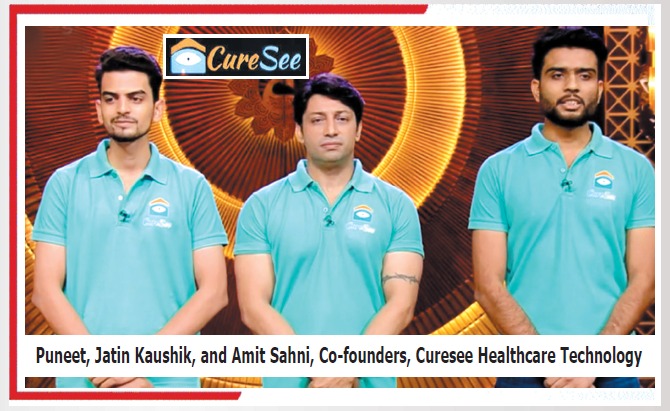
Business Remedies | Rajshree Upadhyaya | To provide accessible, personalized, and evidence-based solutions for visually impaired people, Puneet, Jatin, and Amit Sahni established Curesee, a healthcare technology company, in 2019 through an AI-based vision therapy platform. The three friends – Puneet, Jatin Kaushik, and Amit Sahni – came together with a shared vision of transforming eye care. Trained ophthalmologists Puneet and Amit had long observed how ineffective and inconvenient traditional treatments for lazy eye or amblyopia could be. Both children and adults struggled with cumbersome eye patches that offered little relief.
Jatin, an electrical engineer and Puneet’s childhood friend, brought a technology-driven approach. Their combined expertise and empathy for patients paved the way for the creation of Curesee. The concept was simple yet revolutionary: the platform assessed users through free eye tests and provided customized therapy plans for conditions like lazy eye, squint, or convergence insufficiency. The AI engine continuously monitored users’ progress and adjusted exercises accordingly, ensuring that each stage of therapy was optimized for improvement. Patients who stayed consistent for one to two months often reported remarkable improvements in their vision, including visual acuity and depth perception. Clinical studies supported these claims, lending credibility to the therapy and helping dispel doubts about technology-driven healthcare solutions.
Recognition in Healthcare and Startup Ecosystem
The founders’ dedication to innovation and patient care soon earned them recognition within the healthcare and startup ecosystem. Curesee received the ZS Award and TIDE EIR Fellowship, both prestigious honors that validated the startup’s scientific approach and potential. The Ministry of Electronics and Information Technology awarded them a scale-up grant, further boosting their growth. Their incubation at Pieds, BITS Pilani and association with IIM Kozhikode’s accelerator programs provided essential resources and mentorship to build credibility and scale operations.
These achievements established Curesee as a trusted name in tech-enabled vision therapy. However, the turning point came when Curesee appeared on Shark Tank India Season 2. The founders pitched their solution as a scalable, affordable, and clinically proven method to treat common eye disorders without the need for expensive equipment or invasive procedures. The sharks were impressed by the clarity of the proposal and the product’s practical utility. Known for backing visionary founders, Peyush Bansal offered 50 lakh for a 10% stake in the company. Recognizing the value of his experience and network, the founders accepted the deal to expand their impact.
Rapid Growth and Popularity
Following this, Curesee’s popularity skyrocketed. The platform, with the support of a network of 350 doctors, began providing services to over 9,000 patients across more than 80 cities. Its subscription plans, ranging between 12,000 and 18,000 for three to six months, enabled patients to undergo therapy comfortably from their homes.
A Global Initiative to Redefine Vision Therapy
Monthly revenues rose to 2.64 lakh, reflecting both market demand and the therapy’s effectiveness. Beyond the numbers, Curesee’s approach began reshaping perceptions of healthcare technology in India, proving that empathy-driven innovation could address long-standing gaps in patient care. Looking ahead, Curesee is working on integrating chatbot-based order management to further enhance user experience and streamline operations.
The founders remain committed to improving access to vision therapy and reaching more patients in need. From a simple clinic-based observation to becoming an award-winning AI-powered platform, their journey exemplifies how technology, when combined with compassion and clinical insight, can solve real-world health problems. With its unwavering focus on innovation and patient outcomes, Curesee is poised to redefine how vision therapy is delivered not only in India but across the globe.
 Written & Edited By:
Rajshree Upadhyaya