


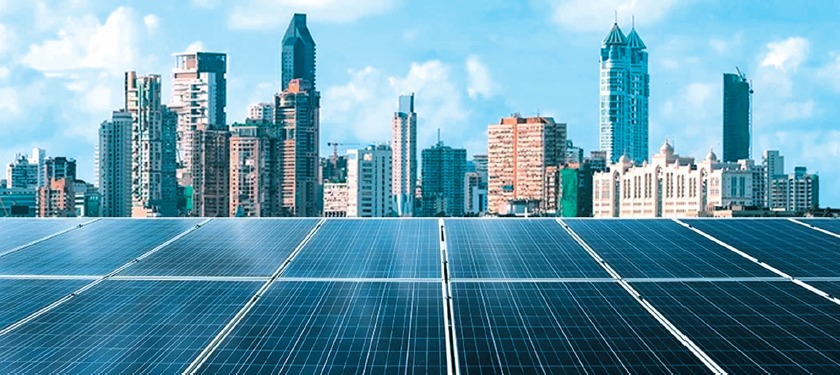
Business Remedies | Charu Bhatia | As the renewable energy sector gains momentum, solar rooftops on commercial buildings are emerging as a major trend among India’s corporate and industrial players. Driven by a combination of rising electricity costs, sustainability goals, and supportive government policies, companies are increasingly turning their rooftops into power-generating assets.
Solar rooftop installations allow businesses to generate electricity on-site, reducing dependence on the grid and lowering operational costs. For large commercial complexes, IT parks, warehouses, and manufacturing units, the potential savings are significant. With the cost of solar panels and installation dropping steadily over the past decade, the return on investment has become increasingly attractive, often paying for itself within 3-5 years.
The trend is not just about cost savings; it is also closely linked to corporate sustainability initiatives. Many companies are committing to ESG (Environmental, Social, and Governance) goals, aiming to reduce their carbon footprints and improve environmental responsibility. Solar rooftops provide a tangible solution to meet these targets while also enhancing brand image among stakeholders, investors, and customers.
Government incentives have further fueled adoption. Programs like the Ministry of New and Renewable Energy’s rooftop solar scheme and state-level subsidies for grid-connected systems offer financial support and faster approvals, making it easier for corporates to invest.
Additionally, companies can opt for power purchase agreements (PPAs) or lease models, allowing them to adopt solar energy with minimal upfront costs. Industry data reflects a robust growth trajectory. According to the Solar Energy Corporation of India (SECI), commercial rooftop installations have surged in the last five years, and forecasts suggest that the segment could reach several gigawatts in capacity by 2030. Sectors like IT, retail, and logistics are leading the adoption curve, leveraging their large roof spaces and high electricity demands to maximize benefits.
Beyond financial and sustainability benefits, solar rooftops contribute to energy security. With power disruptions and fluctuating tariffs a common challenge, on-site generation ensures continuity of operations and shields businesses from grid instability. Companies are also exploring battery storage options to further optimize solar usage and store excess power for nighttime or peak demand periods.
As Indian businesses increasingly embrace green practices, solar rooftops are no longer a niche solution, they are becoming a mainstream corporate strategy. For companies looking to balance profitability with responsibility, the sun is not just a source of light but a source of power, savings, and sustainable growth.
 Written & Edited By:
Charu Bhatia