


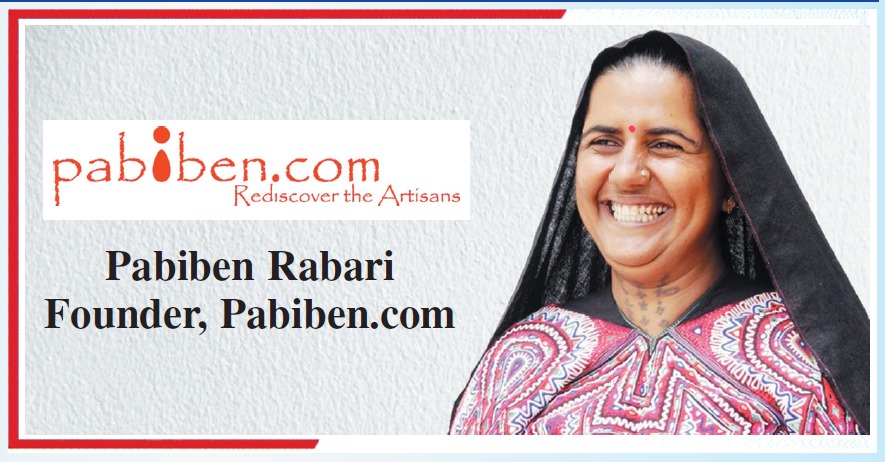
Business Remedies | Rajshree Upadhyaya | In the dusty village of Kukadsar in Kutch, Gujarat, a young girl named Pabiben Rabari stitched her way into history without even knowing it. Born into the Rabari community, where embroidery was an everyday part of life, she mastered the intricate Hari Jari technique at an age when most children were still learning their letters. But her journey was never just about craft. For women in her community, traditions often set boundaries, limiting their chances to earn or build an identity outside domestic spaces. Pabiben quietly defied that norm. With a needle and thread, she began to create not only beautiful pieces of embroidery but also the possibility of independence-for herself and eventually for hundreds of other women.
Her earliest works were modest, simple utility items stitched for dowries and household needs, yet they carried the signature of her determination. Over time, her bold experimentation with motifs and colors led to the creation of the “Pabi bag,” a vibrant, functional accessory that captured attention far beyond her village. The bag was more than a product-it was a symbol of rural women’s artistry being reshaped into something that could command value in urban markets. Slowly, her work found its way into local fairs and exhibitions, then to national craft showcases, and eventually onto platforms that positioned Pabiben as not just an artisan but the face of an emerging brand rooted in tradition.
The turning point came when she partnered with like-minded entrepreneurs who recognized that her art could be scaled without losing its soul. Together, they began to formalize production, build a catalog of products, and adapt designs for modern buyers while keeping every piece handmade. They introduced processes to ensure consistency, packaging that appealed to global consumers, and digital storefronts that allowed Pabiben’s craft to travel far beyond Gujarat. What had begun as a village woman’s hobby was evolving into Pabiben.com-a marketplace that carried the stories of women, stitches, and survival woven into every product.
When the brand entered Shark Tank India, it was more than just another startup pitch. Pabiben herself stood alongside co-founders Nilesh Priyadarshi and Nupur Kumari, carrying with her the dignity of an entire community. They asked for Rs. 50 lakh in exchange for 5% equity, presenting not only the sales figures and margins but also the social impact of their venture. The Sharks questioned everything from scalability to branding, probing whether this was a business ready for the next leap. Yet, what struck them most was the sincerity of the mission-to preserve a dying craft and empower rural women while still building a sustainable enterprise.
Namita Thapar saw both the potential and the purpose. She offered a deal that blended financial support with mentorship: Rs. 10 lakh for 5% equity and a Rs. 40 lakh interest-free loan. It was not just about money; it was about creating the bridge between grassroots artisanship and modern retail. The episode gave the brand nationwide visibility, and the effect was immediate. Orders rose, media interest surged, and, more importantly, the artisans behind the scenes felt a renewed pride in their craft, knowing their work was now celebrated across India.
Financially, the business had already been making steady progress, with lifetime sales crossing into the low crores and annual revenues moving into the lakhs, supported by strong gross margins. But beyond the numbers lay the heart of the brand: the livelihoods of hundreds of women who could now stitch at home while contributing meaningfully to their families’ income. For many of them, this was the first time their artistry had been recognized as professional work rather than unpaid domestic labor.
Today, Pabiben’s brand stands as an unusual blend of heritage and entrepreneurship. It is rooted in the rhythms of Kutch, yet, it has reached urban boutiques, global craft showcases, and online buyers looking for authentic handmade products. The journey continues to pose challenges-balancing the uniqueness of hand embroidery with demands for timely delivery, managing prices that honor both artisan dignity and consumer accessibility-but the vision remains steady. Pabiben began as a girl with a needle and thread, and today, she represents a movement that stitches together culture, commerce, and courage. Her story proves that when tradition is given the space to evolve, it does not fade-it thrives, carrying with it the hopes and livelihoods of generations.
 Written & Edited By:
Rajshree Upadhyaya


