

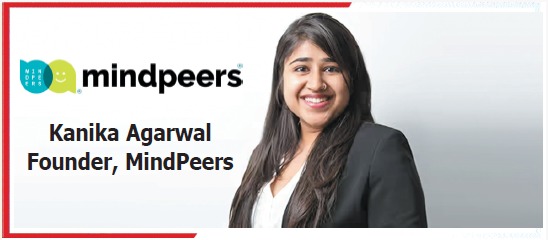
Rajshree Upadhyaya | Jaipur | Business Remedies. MindPeers did not enter Shark Tank India as an experimental idea but as a brand shaped by lived experiences and professional depth. At its core is Kanika Agarwal, an entrepreneur who had earlier built a multimillion-dollar venture in Singapore and worked with Google and Microsoft across the Asia-Pacific region. Yet beneath that glittering résumé lay a personal struggle. While building her first company, anxiety laid the foundation for MindPeers-a platform that views mental health not as a last-resort crisis solution but as a continuous practice of mental fitness.
From the beginning, the company positioned itself differently. Instead of confining itself to therapy alone, it built a layered ecosystem. This included clinical assessments, self-guided tools, and access to professional help. Its app featured validated mood and anxiety tests, therapy sessions with vetted professionals, and even the option to link biological markers such as vitamin and thyroid levels to mental state. The aim was to move conversations about mental health beyond vague self-care advice into measurable, trackable, and actionable steps. At the same time, MindPeers invested in a corporate program, recognizing that the workplace could be both a source of stress and a powerful medium for preventive care.
Partnership proved crucial in shaping the product
The partnership between Kanika and her co-founder, Sahil Chitkara, was crucial in shaping the product. While Kanika drove the vision and mission, Sahil’s background in building scalable consumer platforms ensured that the technology could deliver a seamless experience. Together, they focused on designing a platform where users could begin with simple self-tests and gradually move towards therapy-supported by an architecture robust enough to meet the needs of both individuals and enterprises. Early experiments with AI nudges further highlighted their intention to normalize mental fitness in daily routines, much like step counters do for physical health.
Brand positioned itself among leading names in mental health-tech
In February 2023, their appearance on Shark Tank brought this ambition to life with a bold ask of 53 lakh for 1% equity at a valuation of 53 crore. The negotiations were intense, but what emerged was a rare pooled deal: four sharks-Peyush Bansal, Aman Gupta, Namita Thapar, and Vineeta Singh-came together to invest 1.06 crore for 2%. For a mental-health startup, securing not just capital but collective support on national television was as symbolic as it was strategic, signaling recognition in a sector often weighed down by stigma.
The real challenge came after the spotlight. With new funding and popularity, MindPeers set out to expand both its consumer-focused products and workplace wellness programs. The latter proved especially relevant in India, where insurance-linked or employer-sponsored benefits often scale faster than direct-to-consumer models. Early investors and angels helped sustain momentum, while the brand continued to establish itself as a leading name in India’s emerging mental health-tech landscape. Yet, growth in this category brought scrutiny. Public reactions to the Shark Tank episode included excitement as well as skepticism. Some questioned whether the app experience matched the ambition, while others raised concerns about ensuring credibility in a space where outcomes must be handled with care. MindPeers responded by emphasizing clinical rigor, a strong therapist network, and data privacy-aware that trust in mental health builds slowly and that missteps could weaken long-term impact.
From prime-time pitch to national conversation
By 2024 and 2025, the brand continued refining its identity. The focus was on integrating mental health into everyday life and positioning the app as a companion that tracked not just calendars and health indicators but also mental states. For enterprises, emphasis was placed on building resilient teams with measurable outcomes, providing both prevention and support within a confidential framework. Meanwhile, Kanika emerged as the face of the movement, speaking openly about burnout and ambition, which gave the brand a trusted human foundation.
Looking back, the Shark Tank deal was less about the money and more about the permission to build boldly. MindPeers still carries the responsibility of validating outcomes, balancing technology with clinical oversight, and cultivating trust in a culture where mental health conversations remain delicate. Yet, with a founder who combines personal conviction with professional expertise, a strong tech co-founder, and an app that promises both empathy and science, the company has succeeded in turning a prime-time pitch into a national conversation. If it can maintain this balance, MindPeers may well succeed in making mental health as regular and respected as physical health tracking.
 Written & Edited By:
Rajshree Upadhyaya