
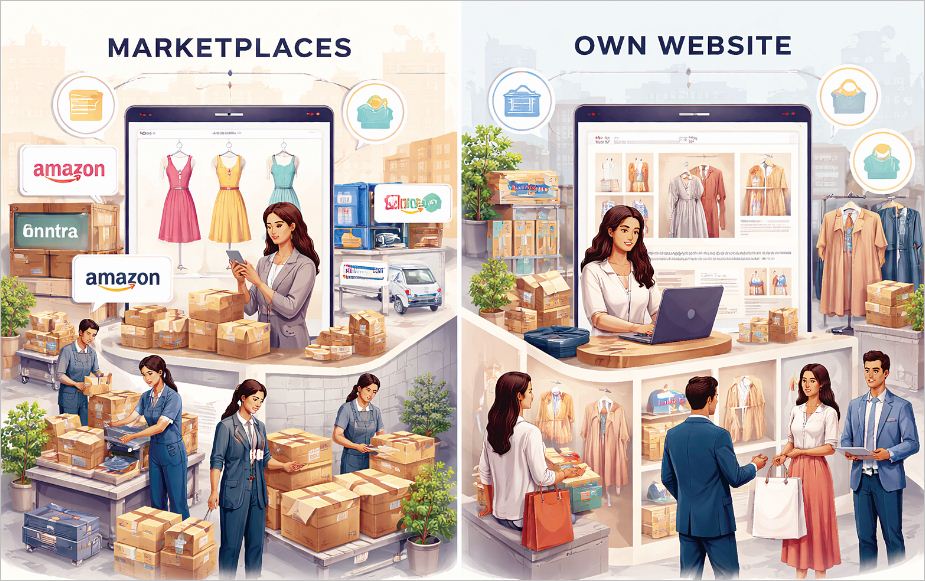
Jaipur | BR News Network | For fashion brands navigating the digital economy, one question continues to dominate boardroom discussions: is it more profitable to sell through marketplaces or through brand-owned websites? The answer is no longer straightforward, as both channels play very different roles in growth and profitability.
Online marketplaces such as Amazon, Myntra and Flipkart offer what many brands need most, scale. They provide instant access to millions of customers, built-in logistics, payment systems and marketing tools. For emerging labels, marketplaces often serve as the fastest way to gain visibility and build initial demand without heavy upfront investment.
However, this reach comes at a cost. Marketplace commissions, advertising fees, discounting pressure and return logistics can significantly eat into margins. In highly competitive categories, brands often find themselves participating in frequent sales campaigns just to maintain visibility. While marketplaces drive volume, the actual profit per unit can be relatively thin.
Brand-owned websites, on the other hand, offer greater control and higher margins. Without intermediary commissions, brands keep a larger share of each sale. They also gain direct access to valuable customer data, from browsing behaviour to purchase history, enabling personalised marketing, loyalty programs and long-term relationship building.
Owning the customer relationship is increasingly becoming the biggest advantage of direct-to-consumer (DTC) channels. Repeat purchases, cross-selling and premium pricing are easier to achieve when brands control the entire shopping experience. Over time, this can significantly improve customer lifetime value and profitability.
Yet, building a successful DTC channel is expensive. Customer acquisition costs have risen sharply due to digital advertising saturation. Brands must invest heavily in performance marketing, logistics, website optimisation and customer service. Without strong brand recall, driving traffic to a standalone website can be challenging.
As a result, most successful fashion companies are no longer choosing one channel over the other. Instead, they are adopting hybrid strategies. Marketplaces are used for discovery and scale, while brand websites focus on loyalty and higher-margin sales. Many brands launch on marketplaces to build awareness, then gradually shift repeat customers to their own platforms through exclusive collections, early access drops and loyalty perks.
The balance between the two channels is becoming a key indicator of long-term business health. Heavy reliance on marketplaces may drive short-term revenue but can limit brand equity and profitability. Overdependence on DTC, meanwhile, can strain marketing budgets and slow growth.
In today’s fashion retail landscape, real profits often lie in mastering both ecosystems. Marketplaces bring the crowd; brand websites build the relationship. The brands that win are those that know how to turn marketplace shoppers into loyal, direct customers over time.