

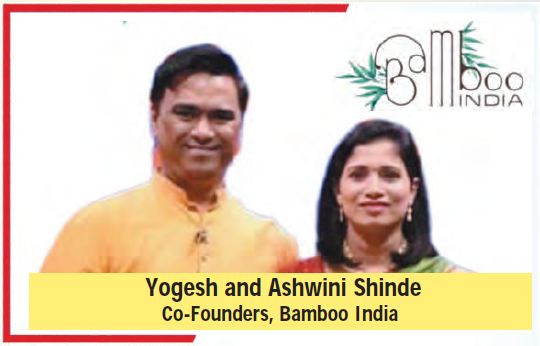
Business Remedies | Rajshree Upadhyaya | June 05,2025 | In their quest to combat rising plastic pollution through innovation, Yogesh Shinde and his wife Ashwini Shinde established a firm that redefined sustainability. In 2016, driven by the desire to make a difference and disturbed by increasing plastic waste, former Indian Army officer and IT professional Yogesh Shinde, along with his wife Ashwini, founded Bamboo India on August 15 in Pune. He was deeply inspired by the recycling systems he had observed during his time in Germany.
The couple aimed to redefine the image of bamboo, once dubbed the “poor man’s timber”, to now be known as the “wise man’s timber.” Their journey began with the simple idea of replacing plastic toothbrushes with bamboo ones, completely biodegradable and affordable. This soon became the flagship product of Bamboo India. However, their vision extended far beyond just selling products. They saw an opportunity not only to address environmental concerns but also to uplift rural communities. By involving farmers and artisans in the production process, they built a business that preserved traditional craftsmanship while empowering local livelihoods.
Established Three Factories Through a Growing Network
The initial days were challenging. Without their own machinery, the Shindes rented equipment to manufacture bamboo products. Gradually, they reinvested their earnings into expanding their manufacturing setup. Over time, Bamboo India grew into a network with three factories located in Pune, Himachal Pradesh, and Guwahati, and collaborated with over 6,000 farmers and artisans across India.
From toothbrushes, their product range expanded to include ear buds, tongue cleaners, straws, notebooks, and eco-friendly corporate gift sets, all designed to replace everyday plastic items with sustainable alternatives. A major turning point came when Bamboo India appeared on Shark Tank India. Their pitch focused not just on profits, but on the broader impact of their products, preventing millions of plastic toothbrushes from ending up in landfills and supporting livelihoods in rural India.
The powerful story moved the sharks, especially Ashneer Grover and Anupam Mittal, who offered Rs. 50 lakhs for 3.5% equity and a Rs. 30 lakh loan. Though the deal ultimately didn’t go through, the national exposure brought Bamboo India into the spotlight.
Launched Bamboo Speakers, Phone Stands, and Pet Products
The Shark Tank platform helped shape the brand’s identity. Bamboo India expanded its operations globally and is now present in 48 countries, with its products gaining popularity among environmentally conscious consumers worldwide. They also ventured into gifts and personal care, launching bamboo speakers, phone stands, and pet products. Despite the growth, the company remained bootstrapped, generating Rs. 2.8 crore revenue in FY 2020-21 and aiming for Rs. 4 crore in the following year. Yogesh remained committed to building a circular economy that ensures fair compensation for bamboo farmers and artisans, while encouraging consumers to make conscious choices.
He emphasized the importance of switching to bamboo, explaining how one bamboo tree can produce over 100 toothbrushes and regrow within four years, unlike plastic, which can take up to 200 years to decompose. Bamboo is naturally biodegradable and absorbs carbon dioxide during growth, making it one of the most eco-friendly materials on the planet.
Balancing Modern Aesthetics with Sustainability
Their brand struck a perfect balance between modern design and sustainable practices. Bamboo India’s products are now sold through their website, Amazon, Flipkart, and in over 2,800 retail stores across India, from urban homes to five-star hotels. An increasing number of consumers are embracing their products as part of a green lifestyle.
What makes their journey truly remarkable is not just the scale of impact but the values they upheld throughout, innovation, sustainability, and social responsibility. Today, Bamboo India stands as a beacon of mission-driven entrepreneurship. The decision by Yogesh and Ashwini to leave behind secure careers and start something new has sparked a movement that challenges plastic dominance and champions environmental responsibility. Their journey reminds us that true innovation often lies not in creating something new, but in reimagining the familiar for the greater good.
 Written & Edited By:
Rajshree Upadhyaya