

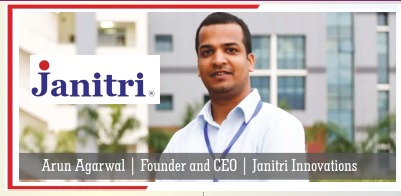
Business Remedies | Rajshree Upadhyaya | July 21,2025 | Arun Agarwal’s journey from a small town in Rajasthan to the forefront of maternal healthcare innovation is as purposeful as it is inspiring. Growing up in Alwar, he witnessed the heartbreak of preventable deaths-neighbors losing newborns during childbirth, relatives surviving only to grieve mothers lost in labor. These personal encounters weren’t just tragic memories; they became the seeds of a mission that would later define his entrepreneurial path.
While his early exposure to his grandfather’s wood-trading business taught him the basics of value creation and inventory, it was technology that ultimately captivated him. Arun pursued a B.Tech in Electronics and followed it up with an M.Tech in Biomedical Engineering at VIT. His college years were marked by a strong involvement in robotics clubs and national tech festivals, even running robotics workshops that earned him over Rs. 60 lakhs before graduation. Yet despite the financial success, he yearned to create deeper societal impact-something that went beyond automation and circuits.
After a brief stint as a patent analyst, Arun began visiting healthcare facilities across rural and urban India in his spare time. Over a hundred centers later, a troubling pattern emerged. Most primary health centers lacked affordable, reliable tools for fetal and maternal monitoring. Nurses and doctors were operating blind, often missing early signs of distress during pregnancy and labor. It was this glaring gap that led to the inception of Janitri Innovations in 2016, following support from BIRAC’s SIIP Fellowship.
Arun’s first major product, the Keyar Patch, was a game-changer-a compact, wearable device capable of tracking fetal heart rate, maternal pulse, and uterine contractions. The device sent data in real time to an app, allowing low-skilled healthcare workers to monitor pregnancies with accuracy. Complementing it was Daksh, a mobile application that generated WHO-guided digital partographs and alerted caregivers to abnormalities. After receiving initial pushback on pricing and usability, Arun and his team introduced a stripped-down version called KeyarLite and adopted a subscription-based model to drive faster adoption. The device, once slow to take off, began gaining traction in public hospitals across Karnataka, Rajasthan, and Delhi-NCR.
In 2023, Arun appeared on Shark Tank India, pitching Janitri not just as a business, but as a mission. His calm, data-backed presentation stood out in a season filled with high drama. Sharks Namita Thapar, Peyush Bansal, and Amit Jain expressed interest, but it was Namita’s offer of Rs. 1 crore for 2.5% equity-contingent on meeting Rs. 20 crore in annual revenue-that Arun accepted, valuing her experience in the healthcare space and Emcure’s vast hospital network.
The episode’s impact was immediate. Janitri’s monthly sales jumped from Rs. 10 lakh to Rs. 50 lakh within months. By mid-2025, the company had crossed Rs. 8.5 crore in revenue, monitored over 200,000 pregnancies per month across 800 hospitals, and claimed to have saved more than 8,000 lives. The startup’s presence had extended to 11 countries, and Arun’s team had filed 12 patents, with four already granted.
In June 2025, Janitri raised $1.4 million in pre-Series A funding led by stock market investor Ashish Kacholia, along with other backers like Prateek Maheshwari and O2 Angels. The funds will be used to expand sales and service networks, develop home-use pregnancy wearables, and introduce neonatal monitoring tools for high-risk newborns. Arun envisions Janitri playing a critical role in the first 1,000 days of life-from conception to early infancy-through a suite of accessible, tech-enabled solutions.
Arun Agarwal’s story is not just about entrepreneurial grit or technological innovation-it’s about listening closely to human pain points and building something that matters. Janitri isn’t a conventional startup chasing valuation; it’s a movement grounded in empathy, driven by science, and committed to ensuring that no mother or baby dies due to lack of timely care. From rural India to global health systems, Arun’s mission continues to ripple outward-quietly, effectively, and with purpose.
 Written & Edited By:
Rajshree Upadhyaya