
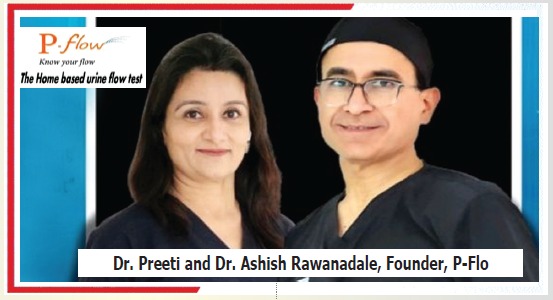
Business Remedies | Rajshree Upadhyaya | Fueled by a passion for innovation, urologist Dr. Ashish and ophthalmologist Dr. Preeti Rawanadale have achieved a significant milestone by creating the world’s first disposable, home-use uroflowmetry kit. Based in central Maharashtra, this doctor couple – Dr. Ashish Rawanadale-Patil, a urologist, and Dr. Preeti Rawanadale-Patil, an ophthalmologist – conceptualized P-Flo as a solution to a very real problem faced by their patients: the embarrassment and discomfort associated with regular uroflowmetry tests.
As founders of Tejanaksh Healthcare, a urology-focused chain of hospitals in Dhule, their mission was clear – to reimagine urinary diagnostics with dignity, accessibility, and accuracy. The uniqueness of P-Flo lies in its simplicity. This single-use diagnostic kit allows patients, including the elderly, bedridden individuals, or those dependent on wheelchairs, to conduct urine flow tests at home. The results are automatically sent to the patient’s mobile phone, eliminating the need for hospital visits and medical consultations.Priced around Rs. 1,000 for three tests, the kit offers nearly 95% accuracy compared to hospital-grade machines. Each test costs only Rs. 200, yielding an impressive gross margin of around 80%.
Shifting Focus to Corporate Structuring
Before gaining attention on Shark Tank India, around 650 kits had already been sold through the Tejanaksh ecosystem, but its potential reach was far greater. Financial estimates suggested that, if scaled effectively, it could generate daily revenues of Rs. 5 lakh, with increasing interest in international markets as well. In Season 2, Episode 15 of Shark Tank India, the couple pitched P-Flo, seeking Rs. 60 lakh for 1% equity, valuing the company at Rs. 60 crore. This proposal was notable not only for the product but also for its approach.
The pitch began with a bold question from Dr. Ashish to shark Peyush Bansal about his last bathroom visit – a memorable example highlighting the complexity and inefficiency of current diagnostics. Though the sharks were impressed, they quickly turned their attention to the corporate structuring. Dr. Ashish held the patent personally, and P-Flo was not yet a separate entity from Tejanaksh Healthcare. These concerns led most sharks – Peyush, Aman Gupta, and Anupam Mittal – to back out. However, Namita Thapar and Amit Jain saw potential.
From Healthcare Provider to Medtech Innovator
The negotiation was tense and strategic. Namita initially offered Rs. 60 lakh for 10% equity, but it was met with hesitation. The founders countered with 3%, she revised to 8%, and finally, Amit brokered a middle ground – Rs. 60 lakh for 6% equity. The deal was accepted, valuing P-Flo at Rs. 10 crore. However, despite the televised agreement, the deal never materialized. Later, citing efficiency and existing infrastructure, the founders decided to keep the product under Tejanaksh’s corporate umbrella and did not form a separate company. As a result, the Shark Tank deal became more symbolic support than a binding investment.
Still, P-Flo gained significant traction after the show. Patent approval for the technology led to a 17.6% increase in Tejanaksh’s stock value and a sharp rise in online visibility. Listings on Amazon and the company’s website fueled public interest and helped initiate talks with hospitals, clinics, and international buyers. Tejanaksh Healthcare, which had posted Rs. 12.03 crore in revenue and Rs. 1.79 crore in net profit for FY 2022-23, has now transformed into not just a healthcare provider but also a medtech innovator.
P-Flo’s Mission: Empowerment
Despite some online skepticism regarding the kit’s accuracy and the complexity of the deal structure, the broader perception recognized the true value of this innovation. Reddit users questioned whether Shark Tank had become more of a branding platform than a genuine investment ecosystem for complex technologies, yet even critics acknowledged P-Flo’s bold attempt to rethink diagnostics.
At its core, P-Flo’s mission is empowerment – giving back control and comfort to patients who previously had little say in how their health was monitored. By combining medical insight, technological innovation, and entrepreneurial spirit, the Rawanadales have created a product that has the potential to change lives, one test at a time. Whether or not the Sharks officially joined them, their journey offers a powerful blueprint for clinician-led startups aiming to reshape healthcare standards.
 Written & Edited By:
Rajshree Upadhyaya


