


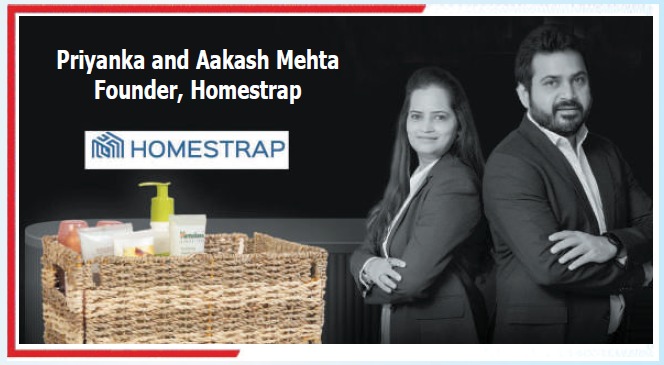
Business Remedies | Rajshree Upadhyaya | To organize the day-to-day problems people face, Aakash and Priyanka Mehta took up the challenge and launched Homestrap, establishing their mark. Homestrap was started in 2013 in Indore, when Aakash and Priyanka Mehta observed how Indian homes, often small and always bustling with activity, struggled with storage problems. Cupboards were overflowing, beds had doubled up as trunks, and every corner carried not only belongings but also emotional weight. They saw an opportunity to create solutions that were not imported ideas adapted for India but products born out of the Indian lifestyle itself. With this thought, Homestrap was launched, called the “Great Indian Cupboard Organizer.” They took up the task of digitizing a category that had long been unattractive and neglected.
The early years were not about flashy marketing but about listening. Customer feedback on torn fabrics, stuck zippers, and loose handles was directly translated into design changes. They worked passionately on making durable organizers, hangers, and stackers that could withstand monsoons, movers, and the heavy load of Indian wardrobes. Even their tone of voice reflected authenticity, rooted in everyday language. Talking about cupboards and household hacks instantly resonated with their audience. By the time they began expanding into marketplaces and their own website, Homestrap had already established itself as a brand that quietly solved real problems instead of selling perfection. This philosophy of solving rather than selling was also reflected in the way they built their team.
Established as a trusted name in the home organization category
With more than three-fourths of their workforce being women, Homestrap’s principle of empathy and organization was not limited to external branding but was also alive within the organization. Their growth remained steady, and the company gradually established itself as a trusted name in the home organization category. Around the same time, in 2023, they stepped onto the stage of Shark Tank India Season 2, ready to take the business they had built over a decade to a wider audience. The pitch was bold-they asked for Rs. 70 lakh for 1% equity, a reflection of the founders’ confidence in their brand and system. The valuation forced most veterans to step back. But Anupam Mittal sensed the underlying potential. He recognized Homestrap’s operational efficiency, inventory and supply chain discipline, and the hard-earned trust among customers. The final deal was a practical mix of equity and debt-Rs. 50 lakh for 7% equity and Rs. 20 lakh debt at 10% interest. It was not a flashy funding story but one rooted in Homestrap’s consistent approach-practical, measured, and effective.
Brand credibility strengthened
The impact after Shark Tank was immediate. Customers flocked in, brand credibility rose, and even vendors and suppliers gained new confidence in working with them. More importantly, the team used this momentum with discipline-improving packaging, enhancing customer service, and expanding categories without ignoring their bestsellers. In FY24, their revenue reached Rs. 29.73 crore, a growth of nearly 50% compared to the previous year, proving that consistency is better than exaggeration. By then, Homestrap claimed to have organized over 20 lakh wardrobes and reached more than 50 lakh households.
Grounded connect makes it more than just a storage brand
The true identity of Homestrap’s success is that it refuses to chase glamour in an environment where utility is everything. The brand thrives because it designs for realities rather than imaginary catalogs-sarees slipping off hangers, toys scattered across rooms, linens getting moldy in the monsoon. Every new product feels like it has lived in an Indian home before being sold. As they look towards expatriate markets and smaller towns across India, the challenge for the Mehtas will be to continue respecting the boundaries they started with-creating solutions that are simple, durable, and perfectly aligned with the Indian lifestyle. This grounded connect makes Homestrap much more than a storage brand; it becomes a quiet movement, making space not just in cupboards but also in people’s lives.
 Written & Edited By:
Rajshree Upadhyaya


