

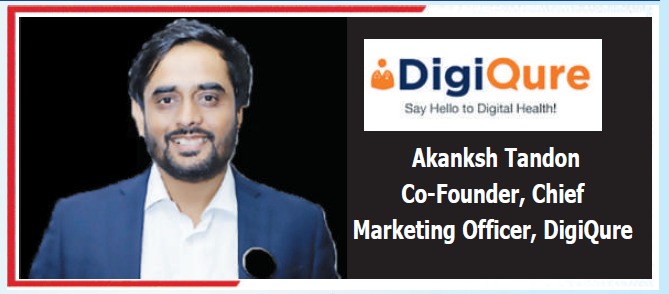
Business Remedies | Rajshree Upadhyaya | DigiQure was born out of a simple yet painful observation. Growing up in small towns of Madhya Pradesh, Akanksh Tandon saw how easily lives could be lost when qualified doctors were out of reach. A close childhood friend died of a curable illness simply because the nearest specialist was too far away. Years later, when he reconnected with his NIT-Bhopal batchmates Saket Asati and Ankur Chourasia, the trio realized they shared the same frustration with India’s uneven healthcare access. In 2020, they decided to tackle it head-on by building DigiQure, an e-clinic network designed not for metros but for the rural heartland.
The model they crafted was practical and empathetic rather than glamorous. Instead of imagining villagers downloading sleek health apps, they set up physical clinics in small towns and villages, staffed with trained health workers who carried out initial screening. Equipped with devices to check vitals, blood sugar, blood pressure, and even ECG, these workers then connected patients to qualified doctors in cities through a seamless video consultation. Prescriptions were printed instantly in local languages, labs and pharmacies were integrated into the system, and serious cases were referred to partner hospitals. To keep it affordable, they launched the Saksham health card, offering unlimited teleconsultations for a family of four at just one rupee a day. For people accustomed to spending thousands of rupees and losing entire days traveling to distant hospitals, this felt nothing short of a breakthrough.
By mid-2023, DigiQure had set up clinics across Sagar and Bhopal districts and created a network of more than fifty doctors from ten hospitals. Thousands of families subscribed to their one-rupee-a-day model, and they began to see steady traction. Yet, the business was still in its infancy, with modest revenues of around twelve lakh rupees over eight months and about eighteen hundred paid subscribers. Despite these early numbers, what set DigiQure apart was the depth of its impact. Patients who once relied on quacks now had real doctors at their disposal. Farmers no longer had to abandon work for a full day to consult a specialist. Mothers with chronic conditions could get regular follow-ups without spending their meager savings.
When DigiQure appeared on Shark Tank India in early 2023, it was not a typical pitch about skyrocketing profits or explosive sales. The founders asked for forty lakh rupees at a valuation of ten crore to expand their e-clinic network. Their clarity of purpose sparked a rare bidding contest. Namita Thapar and Vineeta Singh made an initial offer of forty lakh for twenty percent equity with a merger condition. Peyush Bansal countered with one crore for twenty-five percent, while Anupam Mittal surprised everyone with what was dubbed the “dream deal” of one crore for ten percent equity, contingent on merging their IT entity and pausing expansion until product-market fit was proven. The founders countered Namita at forty lakh for ten percent, and she agreed. While many argued they missed out on a stronger deal, the team valued Namita’s healthcare expertise and her ability to connect DigiQure with hospitals and doctors across the country.
The months after the show brought validation, DigiQure’s clinics began integrating with medical device startups like AyuSynk for digital stethoscopes and Sunfox for portable ECGs, making diagnostics more precise. Their patient numbers rose steadily, and by mid-2023, they reported serving over twenty thousand people in rural Madhya Pradesh. The clinic model grew into a lifeline for families who no longer had to choose between losing a day’s wage and saving a life. For the founders, the journey was never about replacing hospitals or competing with big urban healthcare players; it was about building a reliable first mile of care that could catch problems early and guide patients to the right specialists.
Each founder played to his strengths-Akanksh as the public face driving vision, Ankur handling operations, and Saket ensuring the technology stack was robust and user-friendly. Together, they stitched the pieces into a cohesive experience where technology, affordability, and trust converged. Shark Tank gave them more than money; it gave them visibility and legitimacy, turning their small-town experiment into a national conversation about rural healthcare innovation. Today, DigiQure is still a work in progress, but that is precisely its strength. Its story is not one of overnight success but of gradual, deliberate building-clinic by clinic, family by family, consultation by consultation. In a country where millions are still left behind by mainstream healthcare systems, DigiQure begins exactly where the gaps are widest. And in doing so, it has quietly redefined what it means to bring modern medicine to rural India.
 Written & Edited By:
Rajshree Upadhyaya