


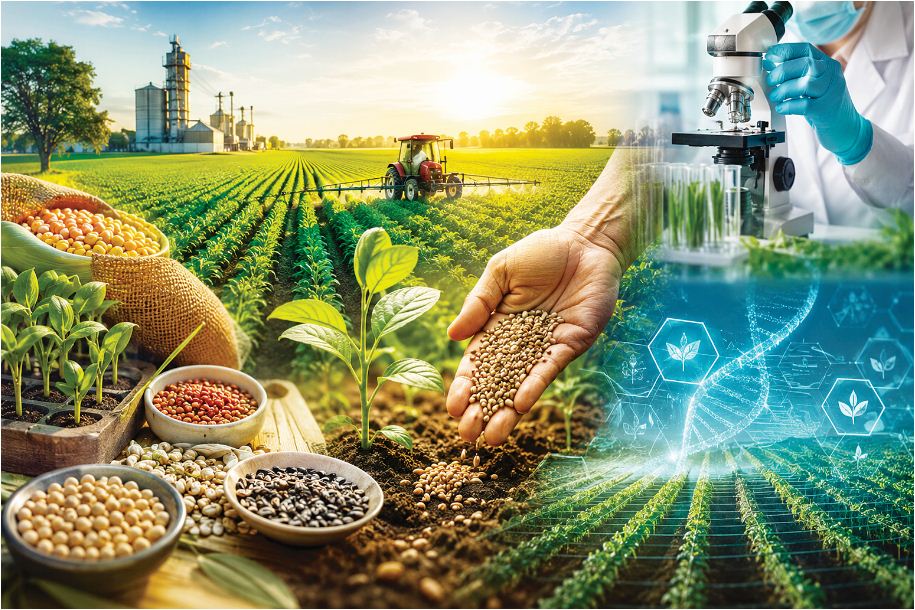
Jaipur | Charu Bhatia | India’s agricultural transformation may no longer be driven solely by tractors, fertilisers or irrigation. Increasingly, the spotlight is shifting to something much smaller but equally powerful, the seed. As climate change, shrinking farmland and rising food demand reshape agriculture, seed innovation is emerging as one of the country’s most promising agribusiness opportunities. Modern seeds are designed to do much more than improve yields. They are being developed to withstand drought, resist pests and diseases, tolerate heat, mature faster and require fewer agricultural inputs. For farmers, these traits can translate into lower production costs, reduced crop losses and more predictable incomes. For businesses, they represent a rapidly growing market fuelled by technology and research.
India is already among the world’s largest seed markets, supported by a strong domestic ecosystem of public institutions, private companies and agricultural research organisations. While traditional crop varieties continue to play an important role, demand for high-quality hybrid seeds and improved planting material is rising steadily across cereals, vegetables, fruits and oilseeds. Technology is accelerating this shift. Advances in biotechnology, genomics, artificial intelligence and data analytics are helping researchers identify desirable plant traits more quickly than conventional breeding methods. Digital tools also enable companies to analyse weather patterns, soil conditions and crop performance, allowing them to develop seeds suited to specific agro-climatic regions.
Government initiatives promoting self-reliance in agriculture, improved seed replacement rates and higher farm productivity have further strengthened the sector. At the same time, the growing emphasis on food security and climate resilience is encouraging investment in research and development. For agribusiness companies, seed innovation is becoming a long-term growth opportunity. Beyond selling seeds, firms are increasingly offering farmers integrated solutions that include advisory services, crop monitoring, precision farming tools and digital platforms. This creates stronger customer relationships while improving farm productivity. The export potential is also expanding. As many developing countries face similar climatic challenges, India’s expertise in developing affordable, high-performing seed varieties could create new opportunities in international markets, particularly across Asia and Africa.
However, challenges remain. Developing new seed varieties requires years of research, significant investment and a robust regulatory framework. Farmers also need greater awareness of improved seed technologies and access to quality-certified products to maximise benefits. Despite these hurdles, the outlook remains positive. As agriculture becomes increasingly knowledge-driven, seed innovation is likely to play a central role in improving productivity, strengthening food security and supporting sustainable farming. Much like the Green Revolution transformed Indian agriculture through high-yielding crop varieties, the next phase of agricultural growth could be shaped by smarter, climate-resilient seeds. For businesses, researchers and policymakers alike, investing in seed innovation may prove to be one of the most important steps towards building a more productive and resilient agricultural economy.