
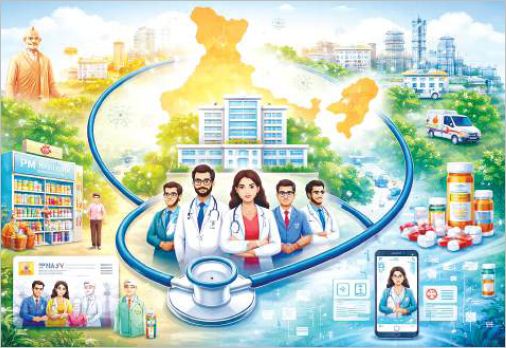
Charu Bhatia | Business Remedies | India’s healthcare sector is undergoing a structural shift, driven not just by private investment and innovation, but by an expanding ecosystem of government-backed schemes. From insurance coverage to digital health infrastructure, these initiatives are not only improving access to care but also reshaping the economics of the industry.
At the centre of this transformation is Ayushman Bharat – Pradhan Mantri Jan Arogya Yojana (PM-JAY), the world’s largest publicly funded health insurance scheme. By offering coverage of up to Rs. 5 lakh per family annually, PM-JAY has significantly increased hospital footfall, particularly in tier-2 and tier-3 cities. For private hospitals, this has opened up new revenue streams, while also pushing them to align with standardised pricing and treatment protocols.
Complementing this is the Ayushman Bharat Health Infrastructure Mission (PM-ABHIM), which focuses on strengthening healthcare facilities across rural and semi-urban India. Increased public spending on infrastructure, from diagnostic labs to critical care units, is creating opportunities for medical equipment manufacturers, construction firms, and service providers.
India’s digital health push is another key growth driver. The Ayushman Bharat Digital Mission (ABDM) aims to build an integrated digital ecosystem with unique health IDs and electronic medical records. This is accelerating the growth of healthtech startups, telemedicine platforms, and data-driven healthcare services. Government platforms like eSanjeevani have already demonstrated the scalability of teleconsultations, especially in underserved regions.
Affordable access to medicines is also being addressed through schemes like the Pradhan Mantri Bhartiya Janaushadhi Pariyojana (PMBJP), which promotes low-cost generic drugs. This has disrupted traditional pharmaceutical pricing models while expanding access, particularly for chronic disease management. Similarly, initiatives like AMRIT are reducing the cost burden of critical treatments.
Preventive healthcare is gaining prominence through programmes such as POSHAN Abhiyaan and the Fit India Movement, signalling a shift from reactive to proactive care. This transition is influencing demand across segments, including diagnostics, wellness services, and nutrition-focused businesses.
On the manufacturing front, the Production Linked Incentive (PLI) scheme for pharmaceuticals and medical devices is strengthening domestic capabilities. By reducing import dependence and encouraging exports, it is positioning India as a global healthcare manufacturing hub.
Taken together, these schemes are creating a more inclusive and commercially viable healthcare ecosystem. They are expanding the consumer base, formalising service delivery, and encouraging private participation across segments. For businesses, this policy-driven momentum presents both opportunities and challenges, requiring adaptability, compliance, and innovation.
As government intervention deepens, India’s healthcare economy is evolving into a more structured, accessible, and growth-oriented sector, where policy is no longer just a regulator, but a key market catalyst.


