


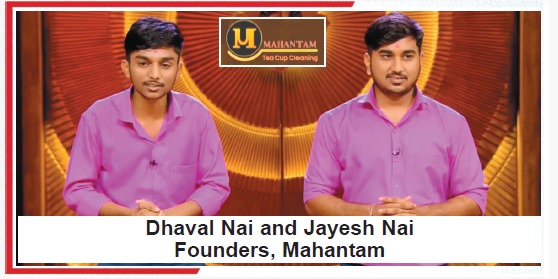
Business Remedies | Rajshree Upadhyaya | When brothers Dhaval and Jayesh Nai from Gujarat walked onto the Shark Tank India stage, they carried with them not just a machine but a memory familiar to millions of Indians. Every cup of tea at a roadside stall is poured into a glass that has likely been rinsed hastily in a bucket of water, swirled by hand, and returned to service within seconds. It is a system born out of necessity, but one that compromises both hygiene and efficiency. The brothers saw an opportunity to change this everyday ritual with engineering that was simple, affordable, and effective. Their brand, Mahantam, was built on the idea that even the smallest of businesses could benefit from smart innovation.
The brothers designed a compact automatic glass-washing machine tailored specifically for tea stalls and small eateries. Unlike expensive industrial dishwashers meant for restaurants, this machine was made to suit the needs of micro-entrepreneurs. It could wash between nine and fifteen glasses per cycle, completing the process in as little as twelve to thirty seconds depending on the model. The machine came in two variants, semi-automatic and fully automatic, priced in the Rs. 28,000 to Rs. 35,000 range-accessible enough for shopkeepers who usually operate on thin margins. Its size was compact, its operation simple, and its promise clear: faster service, cleaner glasses, and reduced water wastage compared to the traditional method of rinsing.
The Shark Tank pitch was a turning point. The founders entered seeking Rs. 30 lakh for 10 percent equity, and their demonstration of speed and utility quickly caught the Sharks’ attention. Watching a machine clean an entire set of glasses in seconds was far more convincing than any words could be. The Sharks questioned durability, servicing, and adoption among stall owners, but they agreed on the strength of the idea and the sheer scale of its market. The brothers walked away with a deal of Rs. 30 lakh for 20 percent equity, gaining not just funding but validation that their product had the potential to move from a clever prototype into a scalable business.
What followed was a wave of attention. Viewers across India debated whether stall owners would pay the upfront cost for better hygiene and faster turnover. Some doubted whether the small shopkeepers would invest in a machine when manual washing costs nothing, while others argued that the efficiency gains, time saved, and customer trust could more than justify the purchase. Questions about electricity consumption, spare parts, and after-sales service filled social media threads, reflecting the practical realities of selling hardware to small entrepreneurs. Yet, this debate itself was a sign of progress-the conversation about hygiene at tea stalls had begun, and Mahantam was at its center.
The Nai brothers understood that success would not come from television fame alone but from persistent ground-level adoption. They introduced the semi-automatic version as a lower-cost entry point for stall owners, hoping to remove the psychological barrier of a large upfront expense. They also emphasized durability and ease of repair, knowing that for their customers, a machine that broke down frequently would be worse than none at all. Their messaging remained focused on one simple image: a tea seller spending less time scrubbing glasses and more time serving customers, with every cup handed over in a sparkling clean glass that built trust.
From that vision emerged early traction. Installations in local tea stalls provided proof of concept, and resellers began showing interest in distribution. For a business operating in a price-sensitive market, these first users were crucial. Word of mouth within the chai community-owners telling each other about faster service and happy customers-was far more powerful than any advertising campaign. The brothers leaned on this organic growth, using the Shark Tank spotlight to secure partnerships and pilot projects in multiple states.
Mahantam’s story is a reminder that innovation does not always come from solving grand, global problems. Sometimes, it is found in the smallest details of daily life-in the cup of tea that fuels millions of mornings. By focusing on hygiene, efficiency, and dignity for small business owners, Dhaval and Jayesh Nai built a product that embodies the spirit of grassroots Indian entrepreneurship. Their challenge now lies in execution: ensuring service networks, scaling manufacturing, and proving that the return on investment makes sense for shopkeepers. If they succeed, the sight of their machines humming quietly behind chai counters could one day become as common as the tea itself, turning an everyday ritual into a cleaner and smarter experience.
 Writen & Edited By:
Rajshree Upadhyaya