

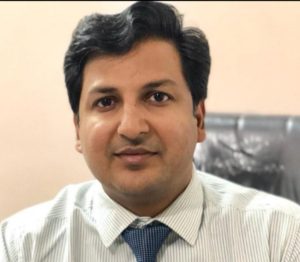
Charu Bhatia, Senior News Editor, Business Remedies in conversation with Dr. Atul Goyal, Founder of Goyal Orthopedic and Joints Centre, Pradaksh Hospital, Malviya Nagar, Jaipur
In the ever-evolving world of healthcare, orthopaedics plays a vital role in helping people regain mobility and live pain-free lives. At the heart of this mission in Jaipur is Dr. Atul Goyal, a dedicated orthopaedic surgeon and founder of Goyal Orthopedic and Joints Centre, presently Pradaksh Hospital, Malviya Nagar. With years of experience across some of India’s most reputed medical institutions, Dr. Goyal has built a centre focused on advanced treatment, patient trust, and holistic recovery. In this detailed interaction, he shares his journey, insights into the field of orthopaedics, the role of technology, and his vision for the future of accessible and affordable bone and joint care.
Question: You have opened a hospital in Malviya Nagar and have been working as a reputed orthopaedic for a long time. How has the journey been so far?
Answer: My journey began with a simple yet powerful aspiration, to become a doctor. Born and brought up in Kota, I completed my primary and secondary education from Kota. As Kota is an educational hub and like many students who dream of entering the medical field, I took coaching from many prestigious teachers and one of the renowned coaching centre in Kota. Kota’s rigorous academic environment shaped my discipline and focus, and the efforts and struggle paid off when I secured Rank 249 in the All India PMT examination at national level in year 2000. For my MBBS, I chose India’s premier medical institute, KEM hospital in Mumbai, which provided a strong academic and clinical foundation. Later, I pursued my postgraduation in Orthopaedics from the prestigious Sancheti Hospital in Pune in 2009.
Studying in such renowned institutions allowed me to explore the vast field of medical sciences and refine my skills. I further pursued fellowships in shoulder and knee replacement from Mumbai and Pune with renowned Joint Replacement surgeons of India and gained extensive experience working at reputed hospitals in Mumbai, including Lilavati and Breach Candy. But over time, however, I felt a strong pull toward my home state, Rajasthan. Jaipur, with its growing healthcare ecosystem, seemed like the perfect place to return and contribute.
After moving to Jaipur in 2016, I initially worked at Rungta Hospital for three years before starting my own clinic. Eventually, this vision started with Goyal Orthopaedic and Joints center in 2018, which now has evolved into Pradaksh hospital, a 30 bedded hospital in the heart of Malviya Nagar, which has now completed more than a year of service. Today, we provide comprehensive orthopaedic care, including knee and hip replacement surgeries, treatment for arthritis, fractures, ligament injuries, joint pain, and more. We also house dental and physiotherapy units to ensure holistic care under one roof.
Question: Why did you choose Orthopaedics as your specialization?
Answer: Orthopaedics appealed to me because it uniquely combines the roles of a physician and a surgeon. I always had a keen interest in surgery, and orthopaedics offers the satisfaction of providing immediate and tangible relief to patients. Seeing a patient who once struggled to walk or move is hands regain mobility and independence is deeply rewarding. In many ways, orthopaedics is about repairing and regenerating lives. The joy and gratitude of patients motivate me every day.
Question: What challenges did you face while starting your own hospital?
Answer: Establishing oneself in a new city is never easy. When I moved to Jaipur, I had no professional network, colleagues, relatives or close friends. Starting from scratch required persistence and patience. We worked hard; we organised free health camps. We provide quality and best treatment at low cost, and also offer treatments at subsidised rates, and sometimes, at very nominal rates if patient is very poor. This helped us to build trust within the community.
Opening a hospital also involves navigating numerous formalities and strict government regulations. Another significant challenge has been the changing dynamics of the doctor–patient relationship. In the past, there was unquestioned trust and respect for doctors. Today, there is often a perception that healthcare is driven by profit, which is far from the truth. For us, patient satisfaction and effective treatment remain the highest priorities. Over time, dedication and genuine care help build credibility. But few things general people should understand that every organisation needs funds to sustain, to grow, to add new technologies and machineries so that patient will get better and good quality treatment. Today, cost of instruments, cost of workers is rising day by day, new costlier technologies keep on coming.
Again, there is a myth that doctors are GOD but this perception is false, as doctors are also human beings, they are not always perfect (no human can be) but they try to be perfect every time. For every doctor, patient’s treatment and wellness is first priority for which they work hard and try do their best.
Question: What marketing strategies did you use to create awareness about the hospital?
Answer: In the early stages, we relied on pamphlets and banners to spread awareness. Gradually, we embraced social media to reach a wider audience. Our approach was not purely promotional; instead, we focused on educating people about orthopaedic health, lifestyle changes, and preventive care. By sharing useful information regularly, we aimed to build trust and empower people to make informed health decisions.
Question: How do you see the role of AI and technology in orthopaedics and medicine?
Answer: Medical science has advanced tremendously, and technology has made diagnosis and treatment faster and more accurate. No doctor can know everything, and the internet has significantly expanded access to knowledge. AI and robotics are already transforming orthopaedics, especially in knee replacement surgeries, where robotic assistance improves precision and outcomes.
Question: Lifestyle changes today are affecting bone health. What preventive measures should people adopt?
Answer: Modern lifestyles involve excessive screen time, leading to poor posture and increasing musculoskeletal problems. Taking frequent breaks, maintaining proper screen height, and exercising regularly are essential. Nutrition also plays a crucial role. The rise of junk food and adulterated products is weakening overall health. We are witnessing the impact of poor lifestyle both internally, due to unhealthy food, and externally, due to poor posture. A balanced diet and regular physical activity are key to prevention.
Question: Orthopaedics and physiotherapy are closely related. How do they complement each other?
Answer: Orthopaedics and physiotherapy go hand in hand but serve different roles. Orthopaedics focuses on diagnosis and treatment, while physiotherapy ensures faster recovery and exercises for maintenance. Most orthopaedic conditions require sustained exercise and therapy. Treatments for knee or back pain often begin with medical intervention, followed by physiotherapy, including heat therapy, exercises, and rehabilitation techniques that speed up recovery. Physiotherapy has a pivotal role post- surgery; it helps in faster and steadier recovery after orthopaedic surgeries.
Question: How has orthopaedics evolved in the past two decades, and what is its future?
 Answer: Orthopaedics has grown significantly over the last 20 years, as lifestyle changes have increased the prevalence of musculoskeletal problems across all age groups. Advances in surgical techniques, especially spine surgeries, have improved outcomes and reduced complications. Technologies like navigation, robotics, and arthroscopy have made procedures more effective and minimally invasive.
Looking ahead, AI will play a greater role in diagnostics and surgical planning. However, cost remains a key concern. Ensuring affordable treatment for economically weaker sections is essential, as every patient’s condition is unique and requires personalised care.
Question: How do you view Rajasthan’s healthcare system compared to other states?
Answer: Rajasthan has made considerable progress, though states like Gujarat and Maharashtra still lead in healthcare infrastructure. While services have improved significantly, there is still room for growth and development.
Question: Are government healthcare schemes effective?
Answer: Schemes like RGHS and Chiranjeevi have helped patients access affordable treatment. However, the reimbursement rates are often lower than the actual costs, especially with advanced technologies involved. While CGHS has increased some treatment rates, similar revisions in other schemes would benefit both patients and healthcare providers. Patient will also get good quality treatment. Also getting good quality treatment is todays basic right of patient too. Sometimes such schemes are also misused too.
 Question: What is your vision for the hospital’s future?
Answer: My goal is to expand the hospital and provide affordable, high-quality treatment to those in need. I aim to develop a comprehensive facility offering complete orthopaedic care under one roof. Collaborating with NGOs could help us enhance infrastructure and reach more patients.
Question: What message would you give to aspiring orthopaedic surgeons?
Answer: Orthopaedics is a fulfilling and dynamic field. The satisfaction of relieving pain and restoring mobility is unmatched. Every case is unique, and the learning never stops. For those passionate about surgery and patient care, it is truly a rewarding journey.


