
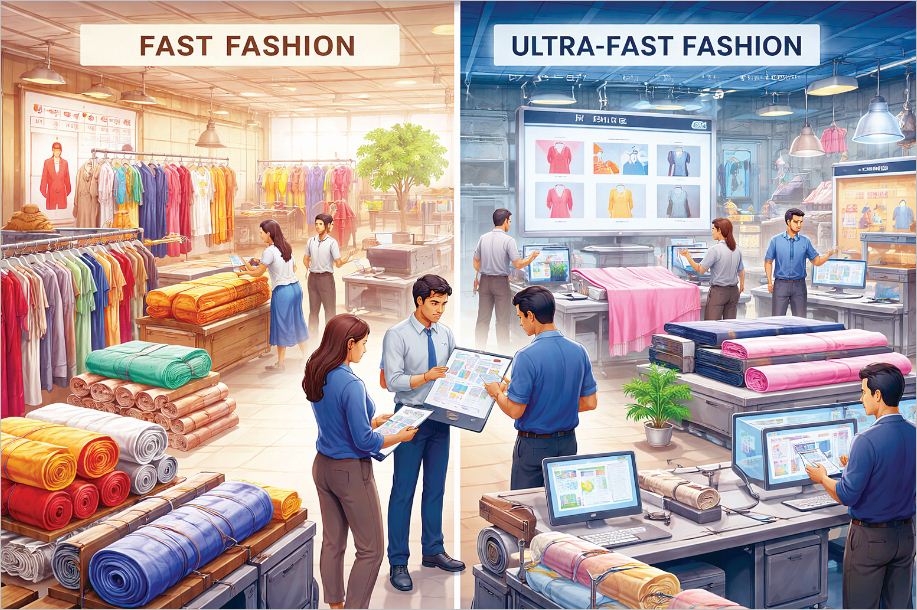
Charu Bhatia | Business Remedies | The fashion industry is moving at unprecedented speed, and textile suppliers are feeling the pressure. While fast fashion has dominated global apparel production for two decades, the rise of ultra-fast fashion, driven by digital-first brands and real-time trend cycles, is reshaping the textile supply chain even further. For fabric manufacturers, this shift is creating both new opportunities and significant operational challenges.
From Seasonal Cycles To Real-Time Production
Traditional fast fashion brands typically work on seasonal collections, refreshing inventory every few weeks. Ultra-fast fashion, however, operates on a near real-time model. Online retailers now launch thousands of new styles every week, often responding to social media trends within days.
For textile suppliers, this means production timelines have shrunk dramatically. Instead of large, predictable orders, suppliers increasingly face smaller, more frequent and highly urgent requests. The focus has shifted from volume to speed and flexibility.
Smaller Orders, Higher Complexity
One of the biggest changes is the move away from bulk fabric orders. Ultra-fast fashion brands prefer low inventory risk, ordering smaller quantities and testing products quickly. If a style performs well, they reorder immediately; if not, they move on.
While this reduces risk for retailers, it increases complexity for textile mills. Manufacturers must now handle multiple short production runs, rapid sampling and frequent design changes. This raises costs, strains production planning and requires investment in agile manufacturing systems.
Rising Demand For Synthetic And Blended Fabrics
Ultra-fast fashion’s speed is also influencing material choices. Synthetic and blended fabrics such as polyester and elastane dominate because they are cheaper, easier to produce quickly and more adaptable to mass production.
This trend benefits suppliers specialising in man-made fibres but creates uncertainty for cotton and natural fibre producers. Demand volatility has increased, making long-term planning more difficult across the supply chain.
Technology Becoming A Survival Tool
To remain competitive, textile suppliers are investing in automation, AI-driven demand forecasting and digital sampling. Technologies like 3D fabric visualisation allow brands to approve designs without waiting for physical samples, saving time and reducing development cycles.
Suppliers that embrace digital transformation are better positioned to meet the expectations of ultra-fast fashion clients.
Sustainability Pressures Growing Stronger
Despite its rapid growth, ultra-fast fashion faces increasing scrutiny over sustainability. Global regulations and consumer awareness are pushing brands to demand traceability, recycled materials and lower carbon footprints from suppliers. This creates a complex balancing act. Textile manufacturers must deliver faster and cheaper while also meeting stricter environmental standards.
A New Era For Textile Suppliers
The shift from fast fashion to ultra-fast fashion is redefining the textile business model. Success now depends on speed, flexibility, digital capability and sustainability. For suppliers willing to adapt, the transformation offers growth opportunities, but the pace of change leaves little room for delay.