

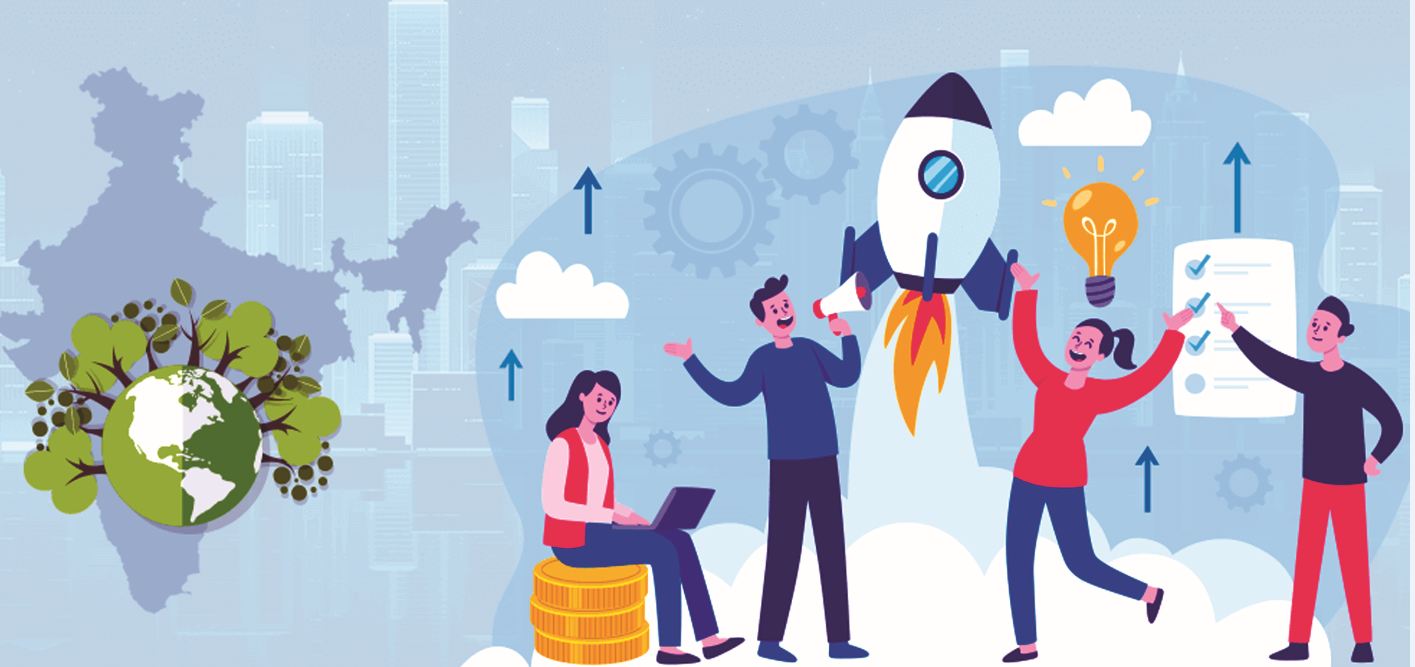
Charu Bhatia | Business Remedies | April 05,2025| In the last 10 years, over 120,000 startups have been registered in India, making it the third-largest startup ecosystem in the world. Alongside this, the country is home to the third-highest number of startup unicorns, rising from just one unicorn in 2011. Here are four emerging trends from this rapidly evolving entrepreneurial ecosystem in India.
1. Rising gender parity
In terms of broader business conditions beyond tech, the gender gaps between male and female entrepreneurship are narrowing in India. According to the Global Entrepreneurship Monitor (GEM) 2023/24 report, in 2001, there was a 3:1 gender ratio of male to female entrepreneurship, but in 2022, there was near gender parity, though that has since regressed slightly in favour of male entrepreneurship.
In recent years, two government schemes have played a major part in narrowing this gap. First, women entrepreneurs lacked credit due to limited access to collateral; the MUDRA scheme helped bridge this by offering collateral-free loans of up to INR1 million for small businesses. Over 69% of beneficiaries of this scheme have been women. Second, the Jan Dhan scheme enabled financial inclusion for women by making it easier to open bank accounts and offering an overdraft facility of INR 10,000. This has brought gender parity in bank account ownership in India, as outlined in the Global Findex database 2021.
2. Mindset shift towards entrepreneurship
A confluence of government efforts has provoked an Indian cultural mindset change from people being job seekers to job creators. Starting with the school education phase, efforts have been made in recent years to focus on creativity and innovation. In 2020’s New Education Policy, there was an explicit focus on critical thinking and multidisciplinary thinking to develop innovation. Alongside it, there has been a drive towards the creation of spaces for experimentation with required support infrastructure, such as the Atal Tinkering Labs in schools in 2016, Atal Incubation Centres in universities in 2017, and Atal Community Innovation Centres in rural areas in 2021.
3. Digital public infrastructure is formalizing informal entrepreneurship
Aadhaar and UPI are part of India’s Digital Public Infrastructure (DPI), called India Stack, which is helping formalize the informal sector entrepreneurs, like the streetside vendor, through financial inclusion and digital payments. More recently, the creation of a DPI-supported commerce effort, Open Network for Digital Commerce (ONDC), is digitizing the informal sector and enhancing
market visibility.
4. Despite an improved ecosystem, startups are concentrated in a few regions
The Global Entrepreneurship Monitor (GEM) 2023/24 report placed India second on ecosystem quality. This marked improvement is partly attributable to the enhancements in physical and digital infrastructure.
On the digital front, internet subscribers in the country have risen from 251.9 million in 2014 to 954.40 million in March 2024.
While the improved startup numbers and ecosystem conditions are encouraging, nearly 60% of startups are concentrated in about five states of the country, and certain select cities within those states.
For India to realize its ambition of a $55 trillion economy by 2047, it needs to democratize entrepreneurship to reach more regions of the country. This is also crucial for stemming the large migration of youth away from rural areas, which has led to overcrowding in certain cities, and disruption in the social and family structures within rural areas.

Written & Edited By:
Charu Bhatia