

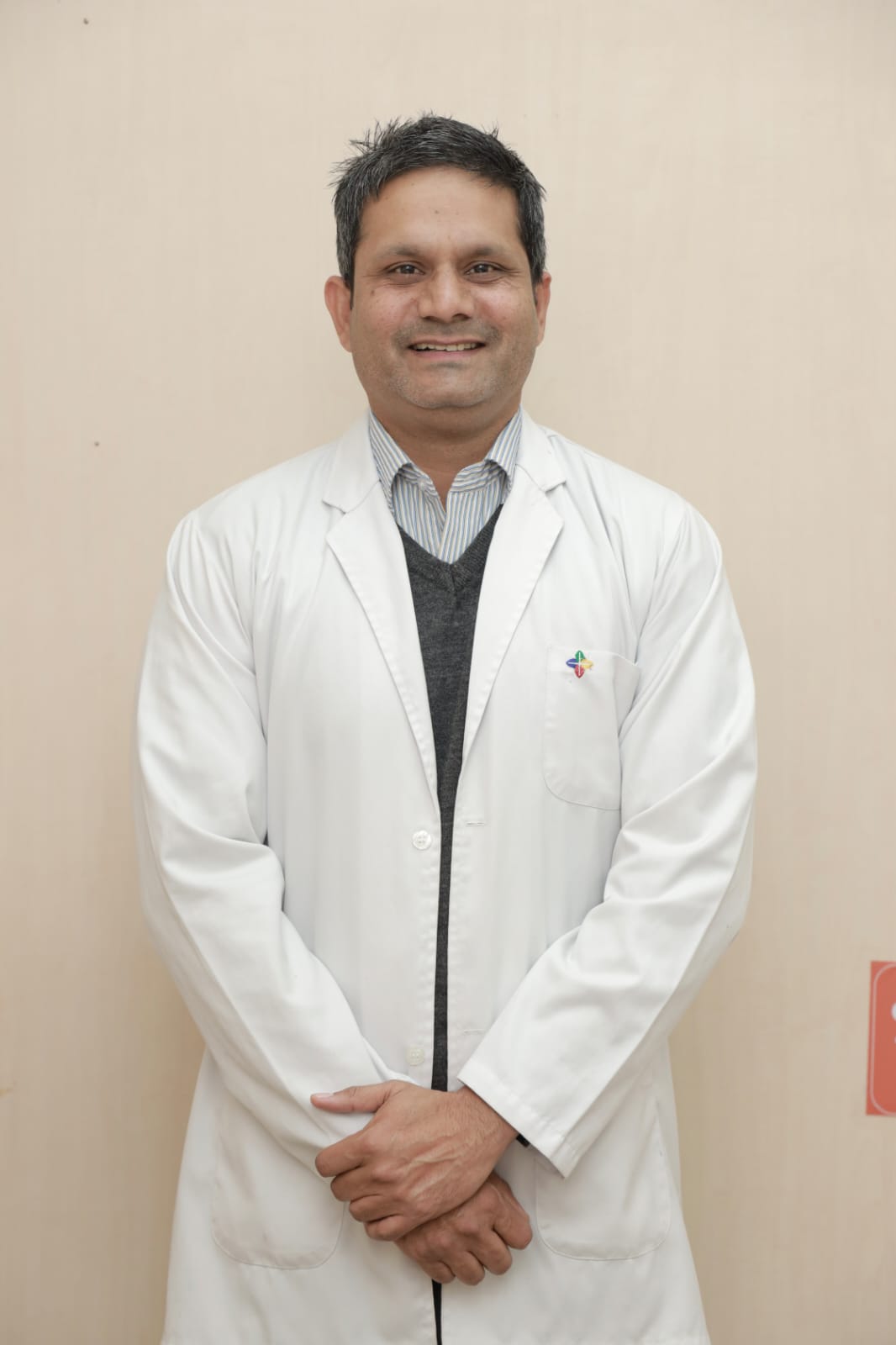
Charu Bhatia, Senior News Editor, Business Remedies, in conversation with Dr. Ishwar Meena, Foot and Ankle Surgeon and Sports Injuries Specialist in Jaipur
From a modest government school background to becoming one of Rajasthan’s dedicated Foot and Ankle Surgeons, Dr. Ishwar Meena’s journey is defined by resilience, reinvention and relentless hard work. Currently serving at Apex Hospitals and running his own clinic in Jagatpura, he is also a specialist in sports injuries, an area gaining increasing relevance in India’s evolving fitness culture. Once an aspiring civil services candidate, Dr. Meena chose the scalpel over the service badge, carving a niche in a rare orthopaedic subspecialty and steadily transforming foot and ankle care in the state.
Question: You are one amongst the two Foot and Ankle Surgeons and Sports Injuries specialists in Rajasthan, having your own clinic as well as serving at Apex Hospitals. Please tell us about your journey so far?
Answer: If I go back to my childhood, becoming a doctor was never my first dream. I actually aspired to become an IPS officer. I come from a large family, we are ten siblings, and I am the youngest of all. Growing up in such a big household meant resources were limited, but inspiration was abundant. I would often see my elder brother deeply immersed in books. Watching him study sincerely instilled in me a deep respect for education and discipline.
During my 11th standard, I chose Biology and entered the Science stream. That decision marked the beginning of my journey toward medicine. I completed my schooling in a government school, where the medium of instruction was primarily Hindi. When I entered MBBS, the entire curriculum was in English. That transition was extremely challenging. Understanding complex subjects like Anatomy, Physiology and Biochemistry in a different language was overwhelming. I struggled academically in the beginning and scored less in my exams.
I have never considered myself a brilliant student, but I have always been hardworking. MBBS is not a course that can be memorised superficially. Subjects like Anatomy require deep conceptual understanding. There came a point when I felt like quitting. The pressure was immense and self-doubt crept in. However, my friends encouraged me to give myself one more chance. I decided to accept the challenge. I spent long hours in the library, often studying till late at night and sometimes even falling asleep at the table. That perseverance helped me complete my MBBS successfully.
When it was time to choose my postgraduate specialisation, I was advised to opt for Pathology. However, my heart was inclined toward Orthopedics. Fortunately, that year the number of Orthopedics seats increased, and I secured one. I pursued my PG from Rajiv Gandhi University of Health Sciences in Karnataka. Those years shaped me as a surgeon and strengthened my clinical foundation.
In 2013, I appeared for an interview for Senior Residency and joined Lal Bahadur Shastri Hospital in Delhi. Around this time, my childhood dream of becoming an IPS officer resurfaced. Between 2017 and 2019, I prepared for the Civil Services Examination while continuing my professional responsibilities. I also worked in Tihar Jail during this period, which gave me a very different exposure to society and human behaviour.
In 2019, I joined the centre of Dr. S.M. Tuli, one of India’s most renowned orthopedic surgeons. Working under his mentorship was a turning point in my career. I had applied for a fellowship in Knee Replacement in Singapore but was instead offered a fellowship in Foot and Ankle Surgery. Initially, it was unexpected. However, my mentor advised me to consider it seriously, explaining that Foot and Ankle was an emerging subspecialty in India with very few trained experts. He felt that the scope and need in this field were immense.
I trusted his guidance and pursued an eight-month fellowship in Foot and Ankle Surgery. That decision proved transformative. I realised how complex and under-recognised this area of orthopedics is. In 2021, I joined Mahatma Gandhi Hospital, and in February 2025, I became associated with Apex Hospitals. Alongside, I run my own clinic in Jagatpura. Officially, there are only two dedicated Foot and Ankle Surgeons in Rajasthan, and I am proud to be one of them. I also am the first from Rajasthan whose article on big toe has been published in an international journal.
Question: In recent times, the nature of the doctor-patient relationship has evolved. How do you see that? Also, kindly tell us about the availability of doctors in India, both in terms of quality and quantity?
Answer: Yes, the doctor-patient relationship has changed significantly. Earlier, patients had unquestioned trust in their doctors. Today, with technology and the easy availability of information on Google, patients often come with prior research and sometimes preconceived notions.
 In rural areas, technology penetration is still limited, so people largely rely on their doctor’s advice. However, in urban areas, patients are more informed and aware. Social media has also made it easier for patients to know about doctors, their qualifications and areas of specialisation.
While awareness is good, it can sometimes create confusion or unrealistic expectations. A doctor’s knowledge grows with constant learning and exploration, and medicine is not a one-size-fits-all science. Every patient is unique.
If we look at the doctor-to-population ratio in India, it remains inadequate. In many regions, especially peripheral and rural areas, specialised surgeons are not available. Patients often travel long distances to cities for proper treatment. The burden on urban healthcare systems is therefore immense.
Question: How do you see the role of AI and robotics in medicine?
Answer: Artificial Intelligence and robotics are undoubtedly the future of medicine. In specialities like Gynaecology and Urology, robotic-assisted surgeries are already being utilised effectively with excellent outcomes.
However, in Orthopedics, particularly in Foot and Ankle replacement surgeries, the penetration of robotics is still limited. The anatomy of the foot and ankle is extremely intricate. While AI can assist in planning and precision, the tactile understanding and intra-operative decision-making of an experienced surgeon remain irreplaceable. Technology should be viewed as an aid, not a replacement.
Question: The government has introduced many healthcare schemes for patients. What are your views on them?
Answer: From a patient’s perspective, government healthcare schemes are highly beneficial. They make treatment accessible to economically weaker sections. However, awareness is key. Patients must know where and how to avail these benefits.
There is also a practical challenge. Many schemes allocate minimal financial coverage for surgeries and procedures. At such low reimbursement rates, maintaining high-quality standards becomes difficult. In several cases, hospitals or doctors end up bearing additional costs. Sustainable healthcare requires a balance between affordability and quality.
Question: What are the most common types of sports injuries you encounter?
Answer: One common injury is Achilles Tendon (TA) rupture, a tear of the tendon connecting calf muscles to the heel bone. It causes sudden, severe heel pain and difficulty in walking.
Another frequent injury involves the ATFL and CFL ligaments. These lateral ankle ligaments provide stability and are often injured together during ankle sprains. When damaged, patients struggle to place their foot straight.
A commonly ignored yet serious injury is Lisfranc injury, which affects the midfoot. It is often mistaken for a simple sprain but can involve torn ligaments or fractures. If not treated promptly, it can severely impact an athlete’s career. Twisting falls or high-impact trauma are common causes.
Question: What is different about foot and ankle issues? Can they not be treated by a general orthopaedic?
Answer: Sub-specialisation has become increasingly important in modern medicine. The ankle alone comprises 26 bones, 33 joints and over 100 ligaments. Its biomechanics are extremely complex.
While general orthopaedic can manage many cases, specialised training helps in dealing with intricate deformities and advanced procedures. For example, MRI should ideally be performed a few days after injury because initial fluid collection can distort findings. Such nuanced understanding improves diagnosis and treatment outcomes.
Question: What is your future vision?
Answer: My vision is to establish myself as a leading Foot and Ankle Surgeon in India and to spread awareness about this sub-specialty. Many people ignore foot deformities, not realising that they alter the entire biomechanics of the body and can lead to secondary problems in knees, hips and spine.
Conditions like Clubfoot (CTEV) in infants can be treated effectively if diagnosed early. Public awareness and timely intervention are crucial.
Question: What message would you give to young medical aspirants?
Answer: Medicine demands hard work, patience and dedication. Choose this profession not for financial gain but for service to humanity. It is a noble field, and its sanctity must be preserved. Follow your passion wholeheartedly. If you commit yourself sincerely, success will follow.