

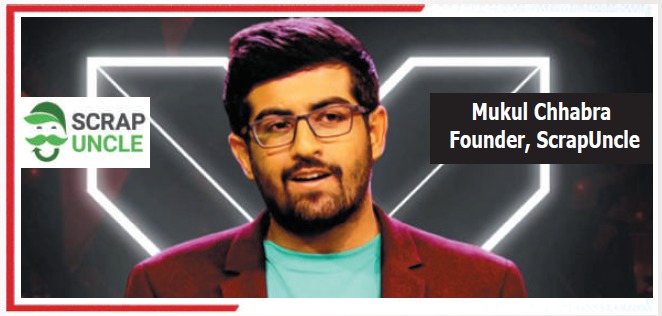
Business Remedies | Rajshree Upadhyaya | The story of ScrapUncle began in the bustling lanes of Delhi, where the familiar call of the kabadiwala has been a part of daily life for generations. Mukul Chhabra grew up watching his uncle work in the scrap business. The old system of haggling, inaccurate weighing, and unpredictable service was ready for change. During his studies at IIIT-Delhi, he decided to reimagine this business with technology, transparency, and convenience at its core.
His first experiment was called Swapeco, a student-led effort to standardize scrap collection, but as the idea matured, it evolved into ScrapUncle, a brand that brought order to one of the most unorganized aspects of urban life. The concept was simple yet transformative. Families could schedule a pick-up through the ScrapUncle app or website, and a trained officer would arrive at the chosen time. The material was weighed on a digital scale, the pre-displayed rates in the app reduced the need for bargaining, and payment was made instantly. By keeping the model simple and reliable, Mukul positioned ScrapUncle as a service trusted by families while also providing recyclers with a cleaner and more consistent supply chain. Operations began on a small scale limited to Delhi-NCR, but by focusing on process rather than promotions, the startup built a strong foundation for expansion.
Scrap collection became an organized habit
When Mukul appeared on Shark Tank India Season 2, he carried with him the clarity of someone who knew his business inside out. His pitch was fresh and straightforward-India needs a modern, reliable kabadiwala, as millions of tons of recyclable waste are discarded every year. The idea struck a chord, sparking a bidding war between Anupam Mittal and Amit Jain. Eventually, Mukul closed a deal with Jain, raising Rs. 60 lakh for 5% equity at a valuation of Rs. 12 crore.
This not only gave ScrapUncle the capital it needed but also instant recognition, strengthening its credibility among households that had never considered using an app for scrap services. Television fame was just the beginning. Post Shark Tank, the startup doubled down on its promise of verified officers, standard rates, and timely service. By acting as a bridge between households and authorized recyclers, ScrapUncle removed much of the opacity from the sector.
The model quickly attracted investor interest. In 2023, the company raised Rs. 3.7 crore in a pre-seed round led by Bestvantage Investments and a family office linked with Madhuram Papers, with Jain also participating. This funding was used to expand coverage in Delhi-NCR, improve logistics, and build partnerships with residential communities and corporate offices-turning scrap collection from a personal transaction into an organized habit.
Even a simple-looking service can scale when run with discipline
What makes ScrapUncle’s growth fascinating is how it turned something as ordinary as waste collection into a service people can trust. Every scrap pick-up adds data to the system-what items are discarded most in a neighborhood, how volumes fluctuate during festivals, when offices clean their storage rooms-and this data helps improve efficiency. By winning trust household by household and ensuring materials reached recyclers faster, the company has positioned itself as a small but meaningful part of India’s circular economy. Compared to flashy startups, its financials remain modest, but in a logistics-heavy business within a complex sector, progress matters more than headline numbers. Industry reports suggest its valuation has nearly doubled since Shark Tank, proof that a simple-looking service can indeed scale when run with discipline. The same simplicity reflects in its social media and customer communication-clear pricing, easy scheduling, and straightforward contact numbers instead of jargon or flashy campaigns. In an industry long plagued by opacity, this transparency has become ScrapUncle’s biggest differentiator.
Carrying forward the philosophy of “Collect, Weigh, Pay, and Repeat”
At its core, the brand has stayed true to its origins. It hasn’t tried to romanticize waste management with lofty slogans, but instead focused on making the most common form of recycling-household scrap sales-predictable and reliable. The promise is not of grand solutions but of countless small interactions-where customers feel respected, materials fetch fair value, and recyclers get what they need. From the lanes of Delhi to the set of Shark Tank, ScrapUncle has carried forward this philosophy: Collect, Weigh, Pay, Repeat. In doing so, it has given dignity to a trade often overlooked, while quietly creating a system where sustainability fits seamlessly into daily life through scheduled pick-ups.
 Written & Edited By:
Rajshree Upadhyaya