
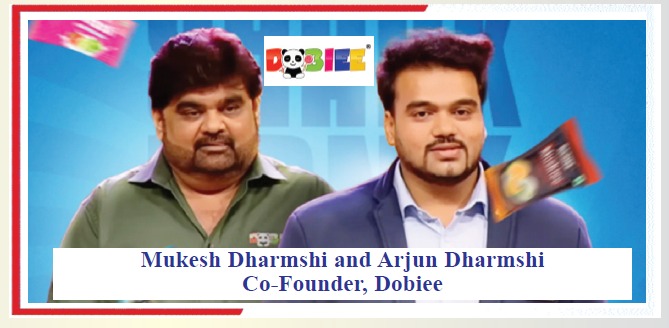
Business Remedies | Rajshree Upadhyaya | July 30,2025 | The journey of Dobiee began in 2021 in Mumbai as a simple, yet heartwarming dream shared between a father and son. Mukesh Dharmshi, who had spent years working in candy shops and making sweets for others, and Arjun Mukesh Dharmshi, an international mechanical engineering graduate from France, came together to create a brand not born in a boardroom, but rooted in childhood memories, a shared love for candy, and the desire to relive those old memories. They envisioned a brand that stood out not because of flashy marketing, but because of products that brought back the joy of childhood – candies with unique combinations like pineapple-coconut and pink-green guava, along with playful toy candies, each hiding a little surprise inside.
In less than fifteen months, Dobiee sold over 9 lakh packets and reached more than 50,000 retail stores across nine states. Their monthly income surged to Rs. 32 lakh, and total earnings crossed Rs. 4 crore. What made this even more impressive was their in-house production model. Each candy packet, priced at Rs. 100 MRP, cost them Rs. 22 to produce and was sold to distributors at Rs. 45, giving them a solid gross profit of Rs. 23 per packet and approximately a 10% net profit. Their streamlined operations and efficient supply chain allowed them to scale rapidly without compromising on quality or cost.
Within Two Months, Monthly Income Jumped from Rs. 30 Lakhs to Over Rs. 1 Crore
The real turning point came when they appeared on Season 2 of Shark Tank India and asked for Rs. 72 lakh for a 2% equity stake, valuing the company at Rs. 36 crore. Their straightforward and honest pitch impressed the sharks. While some, like Piyush Bansal, Aman Gupta, and Namita Thapar, rejected the idea citing concerns about the candy industry, Amit Jain and Anupam Mittal saw potential. Amit offered Rs. 40 lakh for 5% equity and the remaining Rs. 32 lakh as a loan at 11% interest, while Anupam offered Rs. 72 lakh for 11% equity. After several rounds of negotiation, the founders and Amit agreed on Rs. 72 lakh for 6.5% equity. The growth that followed was nothing short of remarkable. Within two months of the episode airing, Dobiee’s monthly income soared from Rs. 30 lakh to over Rs. 1 crore. The brand could no longer meet demand, as limited production capacity meant they could only fulfill 30% of orders. Nevertheless, their reach expanded, with retail presence growing from 50,000 to over 90,000 stores. The profit margin jumped from 5% to nearly 12%, and the momentum continued despite efforts to increase production.
One of the Most Real and Effective Promotions on the Show
Dobiee soon became a case study on how an emotionally driven, simple product can disrupt a crowded market. On Reddit and startup forums, their pitch was praised as one of the most authentic and effective promotions of the show. Commentators appreciated their ground-level distribution strategy, disciplined cost management, and relevant brand story. While some expressed concerns about long-term quality control and the inclusion of toys, most saw the brand as a rare example of scalable simplicity. The team began to move beyond physical retail, planning to launch on Amazon and deepen their digital presence with Instagram campaigns and influencer collaborations. Their distribution strategy, run by CNF agents and regional stockists, was key, but online channels were seen as the next big leap. Despite being a young brand, Dobiee already aspired to be not only a national favorite but also a global player in the Rs. 20,000 crore candy market.
A Story of Reviving Cultural Memory
At its core, Dobiee’s journey is a story of two generations coming together to revive a cultural memory. It’s a tale of connecting experience with a youthful perspective, flavor with fun, and tradition with scale. In an industry often considered saturated or stagnant, Dobiee brought freshness not through disruption, but through heartfelt rediscovery – turning candies back into a joyful experience once again.
 Written & Edited By:
Rajshree Upadhyaya