

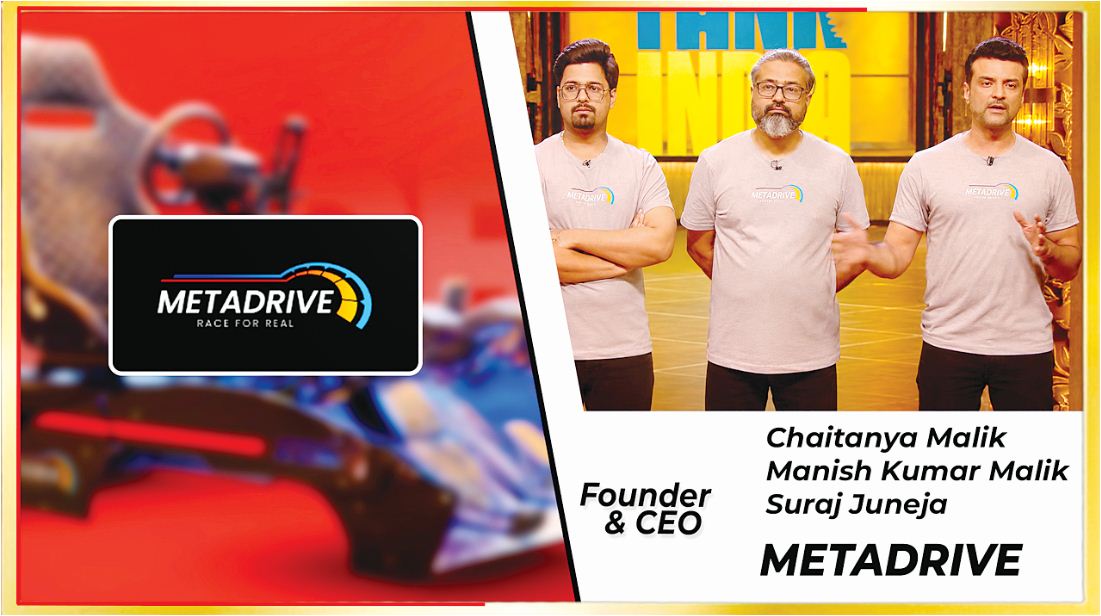
Business Remedies | Jaipur | Rajshree Upadhyaya | Indian deep-tech motion simulator brand MetaDrive was founded in 2022 by founder Chaitanya Malik, co-founder Manish Kumar Malik, and co-founder Suraj Juneja, who have established a strong presence in India’s emerging simulation technology sector. The startup gained national attention after appearing on Shark Tank India Season 5, where it was recognised as one of the most notable deep-tech startups of the season. The founders presented their vision of developing advanced motion simulation technology in India. Although the startup did not secure an investment from the Sharks, its appearance highlighted the company’s engineering capabilities and ambitious mission to build world-class simulation systems domestically.
Operating under Karshin Simulators Private Limited, MetaDrive was established with the objective of designing and manufacturing world-class simulation systems in India rather than depending on imported alternatives. The journey began with a shared passion for engineering, technology and immersive experiences. Chaitanya Malik envisioned creating highly realistic driving simulators capable of blurring the line between virtual and real-world driving. Manish Kumar Malik contributed his technical expertise to transform the concept into a practical solution. The venture gained further momentum when entrepreneur Suraj Juneja joined as co-founder, bringing valuable business and manufacturing experience. Together, they focused on developing technology suitable not only for motorsport enthusiasts but also for commercial and professional applications.
Recognised for Technological Sophistication
Unlike conventional gaming setups, MetaDrive focuses on delivering highly immersive experiences through its Static Motion Simulator, 3 Degrees of Freedom (3DOF) Motion Simulator, and 6 Degrees of Freedom (6DOF) Motion Simulator. These systems recreate the physical sensations of acceleration, braking, cornering and road conditions, enabling users to experience realistic vehicle dynamics. The company’s technology is used in professional racing simulation, driver training, gaming experiences, and simulation-based solutions for institutional and industrial applications. By manufacturing these systems in India, the founders aim to make advanced simulation technology more accessible while showcasing the country’s growing capabilities in deep-tech innovation. During their Shark Tank India pitch, the founders sought Rs. 90 lakh in exchange for 1% equity, valuing the company at Rs. 90 crore. The Sharks appreciated the technological sophistication of the product and acknowledged the team’s engineering efforts. However, the discussion soon shifted towards the company’s ownership structure, previous funding rounds and investor agreements. The founders cited confidentiality obligations regarding certain agreements, leaving several questions unanswered. While the panel praised the innovation behind MetaDrive, concerns about transparency ultimately led to the startup leaving the show without securing an investment.
Continuing to Advance Indigenous Simulation Technology
Despite not receiving funding, the company’s appearance on national television significantly increased brand awareness. The founders have continued positioning MetaDrive as an Indian technology company capable of developing advanced simulation platforms for both entertainment and professional applications. Their journey demonstrates that participation in Shark Tank India can provide valuable visibility even without closing an investment deal, helping innovative startups showcase their technology to a wider audience.
As of 2026, MetaDrive continues to operate actively through its official website and corporate channels. The company remains focused on showcasing its range of motion simulators, engaging with potential customers and promoting collaborations within the simulation and motorsport ecosystem. Although its Shark Tank journey ended without an investment, MetaDrive has remained committed to advancing indigenous simulation technology and strengthening its position within India’s rapidly evolving deep-tech landscape.
 Written & Edited By:
Rajshree Upadhyaya