

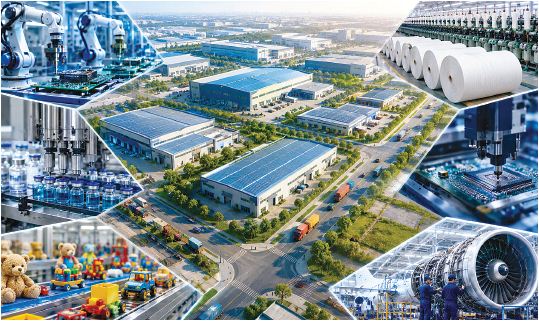
Jaipur | Charu Bhatia | India’s manufacturing sector is witnessing a shift in the way industrial infrastructure is being developed. Instead of creating large, multi-purpose industrial estates, states are increasingly focusing on product-specific industrial parks that bring together manufacturers, suppliers, logistics providers and research institutions under one ecosystem. The strategy is helping businesses reduce costs, improve efficiency and strengthen India’s competitiveness in global supply chains.
From textile parks in Tamil Nadu and technical textile hubs in Gujarat to electronics clusters in Uttar Pradesh, toy parks in Karnataka, medical device parks in Telangana and bulk drug parks in Andhra Pradesh and Himachal Pradesh, specialised industrial zones are emerging as the next phase of India’s manufacturing growth story.
Unlike traditional industrial areas that accommodate businesses from multiple sectors, product-focused parks are designed around the needs of a single industry. They provide sector-specific infrastructure, common testing laboratories, warehousing facilities, waste management systems, training centres and logistics support tailored to that particular product category.
For manufacturers, this clustering creates significant operational advantages. Raw material suppliers, component manufacturers, packaging companies and transport providers operate within close proximity, reducing transportation costs and production timelines. Businesses also benefit from shared infrastructure, which lowers capital expenditure while improving productivity.
The model is particularly valuable for industries that depend on precision manufacturing and strict quality standards. Electronics manufacturers, for instance, require specialised clean-room facilities and testing laboratories, while pharmaceutical and medical device companies benefit from common research facilities and regulatory support. Having these resources within the same industrial ecosystem enables companies to scale operations more efficiently.
The government’s push for initiatives such as PM Gati Shakti, the Production Linked Incentive (PLI) Scheme and dedicated freight corridors is further strengthening these specialised manufacturing zones by improving connectivity between factories, ports and export hubs.
Industry experts believe specialised parks also make India more attractive to global companies seeking reliable manufacturing destinations under the “China+1” strategy. Instead of building entire supply chains from scratch, international firms can establish operations within existing industrial ecosystems where suppliers and skilled labour are already available.
The benefits extend beyond large corporations. Small and medium enterprises (SMEs) located within these clusters gain easier access to larger manufacturers, advanced technology, financing opportunities and export markets. This collaborative environment encourages innovation while creating employment across engineering, logistics, maintenance and ancillary services.
Several states are now competing to attract investments by developing industry-specific parks tailored to their regional strengths. Gujarat continues to expand chemical and textile clusters, Uttar Pradesh is investing in electronics manufacturing, Karnataka is focusing on aerospace and toys, while Telangana is positioning itself as a hub for life sciences and medical devices.
As global supply chains become increasingly specialised, India’s “one park, one product” approach is emerging as a strategic manufacturing model. By bringing together production, innovation, infrastructure and logistics within dedicated industrial ecosystems, these clusters are helping manufacturers improve efficiency while supporting the country’s ambition of becoming a global manufacturing powerhouse. In the coming years, specialised industrial parks are expected to play a defining role in attracting investments, boosting exports and accelerating India’s transition from a cost-competitive producer to a high-value manufacturing destination.