

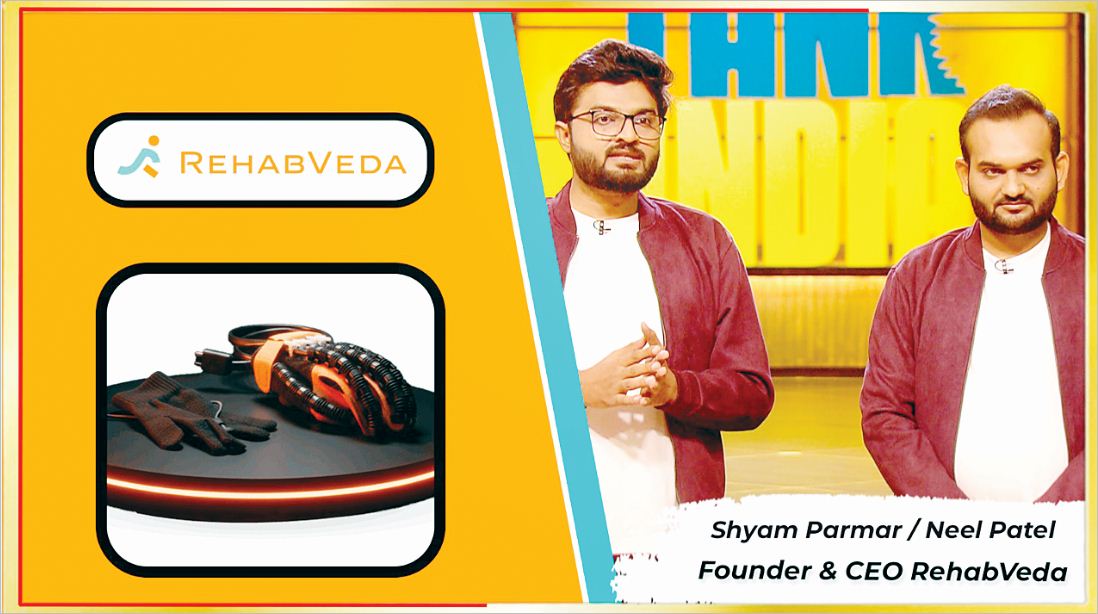
Jaipur | Rajshree Upadhyaya | By emphasizing the retraining of the brain alongside the body, Shyam Parmar and Neel Patel established RehabVeda as a distinctive player in the healthcare space. When RehabVeda appeared on Shark Tank India, it stood out for bringing deep-tech healthcare innovation into a platform typically dominated by consumer brands. Founded in 2019, the startup was built on a key insight: traditional rehabilitation methods often focus on physical movement while overlooking the brain’s direct role in recovery.
With backgrounds in neurotechnology and engineering, the founders set out to bridge this gap by developing solutions that connect brain signals to physical motion-especially for patients recovering from stroke and paralysis. The idea emerged from extensive research in EEG-based neural decoding and neuroplasticity. Shyam Parmar focused on understanding how brain signals can be interpreted in real time, while Neel Patel worked on transforming this complex science into a usable and scalable product.
This collaboration led to the development of brain-computer interface-based neurorehabilitation systems that aim to retrain both the brain and the body. Their approach seeks to make recovery more active, measurable, and effective compared to conventional physiotherapy.
At the core of RehabVeda’s offering is its flagship R1 brain-controlled rehabilitation system, which integrates an EEG headset, artificial intelligence processing, and robotic assistance. This system enables patients to initiate movement using brain signals, helping rebuild neural pathways through continuous feedback and repetition. Additionally, the company is developing AI-powered rehabilitation monitoring tools and assistive neurotherapy solutions, allowing patients to continue therapy outside clinical settings and making advanced rehabilitation more accessible.
Continuous testing with therapists and patients refined the system
The journey of building such technology was filled with challenges. Early prototypes faced issues like inconsistent EEG readings and delays between neural signals and mechanical responses. Achieving reliable performance required multiple iterations. Continuous testing with therapists and patients played a crucial role in refining the system, ensuring it was both clinically effective and user-friendly. This iterative process of trial, error, and improvement became a cornerstone of the company’s growth.
During their pitch on Shark Tank India, the founders highlighted a significant gap in India’s rehabilitation ecosystem, where access to advanced neuro-recovery solutions is limited and expensive. They initially sought Rs. 1 crore for 2.5% equity, valuing the company at Rs. 40 crore. Their pitch emphasized affordability and scalability, positioning their technology as a viable alternative to expensive imported systems.
The sharks showed strong interest in the innovation and its long-term potential. After negotiations, Rehabveda secured a deal with Namita Thapar and Peyush Bansal-Rs. 1 crore for 3% equity-bringing the valuation to approximately Rs. 33.33 crore. This investment reflected confidence in both the technology and the founders’ ability to operate in a complex, research-driven domain.
Solving human challenges through technology
Rehabveda continues to evolve in the neurotechnology space. The company is focused on expanding product capabilities, strengthening clinical partnerships, and increasing accessibility to its solutions. Its long-term vision includes scaling within healthcare institutions, exploring global opportunities, and continuing innovation in brain-driven rehabilitation.
Rehabveda’s story goes beyond building a product-it is about redefining recovery itself. By placing the brain at the starting point of movement, the company offers a new perspective on rehabilitation. In doing so, it demonstrates how technology can address deeply human challenges, with the potential to restore independence and significantly improve the quality of life for countless patients.
 Written & Edited By:
Rajshree Upadhyaya