
Charu Bhatia | Business Remedies | Intraday trading in 2026 looks very different from what it was even five years ago. Once dominated by manual chart-reading and gut-driven calls, the space has evolved into a tech-powered, data-first ecosystem where speed, precision and discipline define success. As Indian markets witness deeper retail participation and tighter regulations, intraday traders are increasingly relying on smarter tools to navigate fast-moving price action.
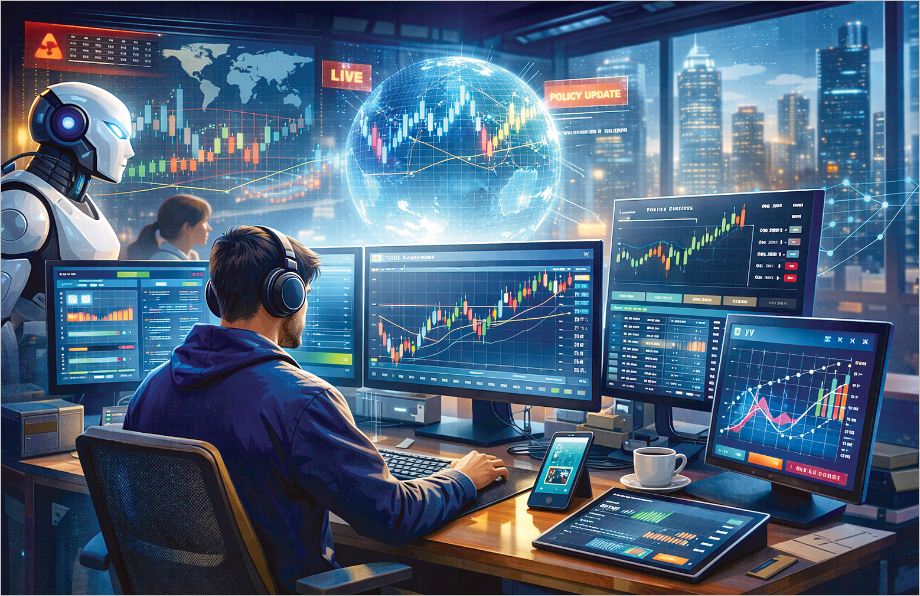
One of the biggest shifts shaping intraday trading today is the rise of advanced trading platforms. Mobile-first apps now offer institutional-grade features, real-time data feeds, customizable charts, heat maps and instant order execution, making high-frequency decision-making accessible to everyday traders. Low-latency execution and seamless integration with market data allow traders to react within seconds, a critical edge in intraday setups where timing is everything.
Artificial intelligence and machine learning are also quietly transforming intraday strategies. Many platforms now use AI-driven analytics to identify momentum stocks, unusual volume spikes and short-term trend reversals. While fully automated trading remains the domain of institutions, semi-automated tools, such as rule-based alerts and strategy scanners, are helping retail traders reduce emotional bias and stick to predefined plans. In a market where overtrading is a common pitfall, such tools bring much-needed discipline.
Another defining trend in 2026 is the growing popularity of options-based intraday strategies. With shorter expiry cycles and improved liquidity, traders are increasingly using options for directional bets as well as hedging intraday positions. Strategies like scalping, range trading and volatility-based setups have gained traction, especially during event-driven sessions such as Union Budget announcements, RBI policy days and global macro triggers.
Risk management has also moved to the forefront. After years of regulatory warnings and market volatility, traders are placing greater emphasis on capital preservation. Features such as smart stop-losses, trailing exits and position-sizing calculators are now standard on most platforms. Many traders follow strict daily loss limits, recognising that survival in intraday trading is less about winning big and more about avoiding large drawdowns.
Equally important is the role of information speed. In 2026, news travels instantly through market feeds, social platforms and AI-curated alerts. Intraday traders closely track global cues, from US bond yields to crude oil prices, and adjust positions in real time. However, the abundance of information has also made filtering noise a key skill, separating successful traders from impulsive ones.
Despite the technology boom, experts agree that intraday trading remains high-risk. Smarter tools can enhance decision-making, but they cannot replace experience, patience and psychological control. In 2026, the most consistent intraday traders are not those chasing every move, but those using technology to trade less, plan better and act faster when the opportunity truly aligns.
As markets grow more efficient, intraday trading is no longer about speed alone, it is about making smarter decisions, faster, with technology as a partner rather than a crutch.