


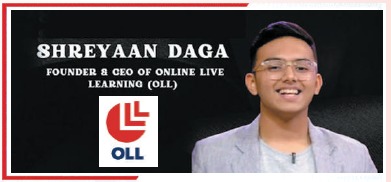
Business Remedies | Rajshree Upadhyaya | When the pandemic shuttered classrooms in 2020, a tenth-grader in Mumbai named Shreyaan Daga saw an opportunity where others saw disruption. While most of his peers adapted to online lectures, he imagined the internet as something larger than a digital classroom-it could be a marketplace of skills. With a small team that included Bhumika Sharma, Kushal Ghosh, and Payal Pandit, he launched Online Live Learning, or OLL, a platform where anyone with expertise could teach and anyone curious could learn. By early 2021, the platform had begun attracting attention for its audacity. YourStory profiled the then 15-year-old, calling OLL a space where anyone could teach or learn, signaling the early promise of a founder who moved faster than his age would suggest.
The initial version of OLL was scrappy but ambitious, hosting live sessions on everything from coding and robotics to public speaking and money basics. The concept resonated with early backers, and in September 2022, OLL raised $115,000 in a seed round led by We Founder Circle’s EvolveX accelerator, bringing total funding to about Rs. 1.1 crore. The mandate was clear-expand the network of schools and teachers while transforming a grassroots experiment into a structured edtech business.
The turning point came in early 2023 when Shreyaan walked into the spotlight of Shark Tank India Season 2. Just 18 at the time, he pitched OLL as a skills-for-schools platform and asked for Rs. 30 lakh for 2% equity. His crisp presentation impressed the Sharks, and Peyush Bansal and Vineeta Singh extended an offer of Rs. 30 lakh for 5%. Viewers marveled at the poise of a teenager negotiating on national television. Yet, in interviews after the episode aired, he revealed that the deal never closed. While the Tank valued OLL at Rs. 6 crore, external investors soon came forward at valuations closer to Rs. 24 crore, and Shreyaan chose to pursue those conversations instead. It was a rare glimpse into the messy afterlife of reality-show investments, showing that what happens after the cameras stop often matters far more than what happens in the room.
Behind the theatrics, OLL was steadily evolving. What began as a general marketplace slowly pivoted into a school-centric model. The platform partnered with institutions to deliver skill-based curricula, teacher training, and competitions in areas like robotics and AI, while securing certifications from bodies such as STEM.org and UNESCO-linked programs. By shifting from a B2C experiment to a B2B2C model, OLL found a more scalable path-winning the trust of schools and integrating itself into classrooms rather than chasing parents directly.
Shreyaan’s own narrative became as compelling as the product he was building. Long before his Tank appearance, he had been featured on podcasts, speaking about how young founders could organize expert teachers and motivated learners into a credible system alongside traditional schooling. By the time the show aired, OLL claimed to have trained tens of thousands of students, with monthly revenues touching Rs. 18 lakh and over 300 teachers actively engaging on the platform. His bold declarations, such as one day acquiring giants like Byju’s or Unacademy, became viral moments-admired by some for their audacity and criticized by others as naïve. On platforms like Reddit, debates flared over whether celebrating teenage dropouts sent the wrong signal. Yet, admiration for his courage and ambition remained undeniable.
As OLL matured through 2023 and 2024, the company raised a few hundred thousand dollars more in early capital, enough to refine its supply of vetted instructors and to support schools in adopting its programs. The broad vision narrowed into a tighter promise: certified, structured courses designed to withstand principal-level scrutiny while keeping prices accessible to middle-class families. Beyond India, OLL began expanding globally, introducing recorded sessions to complement its live classes and even partnering with CNBC-TV18 to launch a Shark Tank-style platform for young innovators in grades five to twelve.
What makes OLL stand out is not just its pandemic-era origin story, but the way it has woven youthful daring with institutional discipline. The Shark Tank episode amplified the brand, but the real work lay in convincing schools that skill-based learning could coexist with textbooks and exams. The journey from a lockdown experiment to a growing edtech venture reflects both the ambition of its teenage founder and the resilience of a model that has steadily shifted from attention to adoption. Whether or not Shreyaan ever buys out the edtech giants he once spoke of, he has already carved out a space in which OLL has become more than just a bold pitch-it has become a movement to give skill-based education a permanent seat in the classroom.
 Written & Edited By:
Rajshree Upadhyaya


