
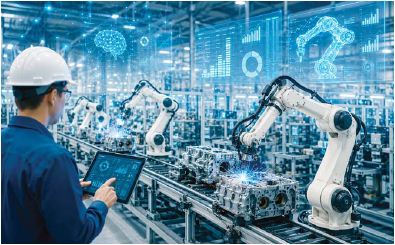
Jaipur | Charu Bhatia Artificial intelligence (AI) and data analytics are rapidly transforming the global manufacturing sector, helping industries improve productivity, reduce operational costs and make faster business decisions. As factories become increasingly digital, manufacturers are adopting smart technologies to streamline operations and remain competitive in an evolving industrial landscape.
Industry experts say the next phase of manufacturing growth will be driven not just by automation, but by intelligent systems capable of analysing massive volumes of real-time data. From predictive maintenance to supply chain management, AI-powered tools are changing how factories operate across sectors such as automotive, electronics, pharmaceuticals and consumer goods.
One of the biggest advantages of AI in manufacturing is predictive maintenance. Traditionally, equipment failures often resulted in costly downtime and production delays. Today, AI systems can monitor machinery performance in real time, identify unusual patterns and predict potential breakdowns before they occur. This allows companies to schedule repairs in advance and avoid major disruptions.
Data analytics is also helping manufacturers optimise production efficiency. Smart sensors installed on factory floors collect continuous operational data related to temperature, machine speed, energy consumption and output quality. AI platforms analyse this information to identify inefficiencies and suggest process improvements, leading to better resource management and lower wastage. Another major shift is visible in quality control systems. AI-powered cameras and computer vision technologies are now being used to detect defects in products with greater speed and accuracy than manual inspections. This improves product consistency while reducing human error and production losses.
Supply chain operations are also becoming smarter with the help of AI and data-driven forecasting. Manufacturers can now analyse market demand, inventory levels and logistics patterns more accurately, helping businesses avoid overproduction or supply shortages. This has become particularly important as industries face global disruptions and fluctuating consumer demand.
Experts believe AI adoption is also accelerating the concept of “smart factories”, where interconnected systems communicate automatically to improve decision-making and operational efficiency. These factories use technologies such as Industrial Internet of Things (IIoT), robotics and cloud computing to create more flexible and responsive manufacturing environments.
However, the growing use of AI in manufacturing also brings challenges. Companies must invest heavily in digital infrastructure, cybersecurity and employee training to fully benefit from these technologies. The demand for skilled workers capable of handling AI systems and data analysis is also increasing rapidly.
Despite these challenges, businesses across the world are continuing to invest in intelligent manufacturing solutions. Analysts believe companies that successfully combine AI, automation and data analytics will gain a significant advantage in productivity, sustainability and long-term profitability. As manufacturing enters a more technology-driven era, AI and data are expected to become central to the future of industrial growth and operational efficiency.


