


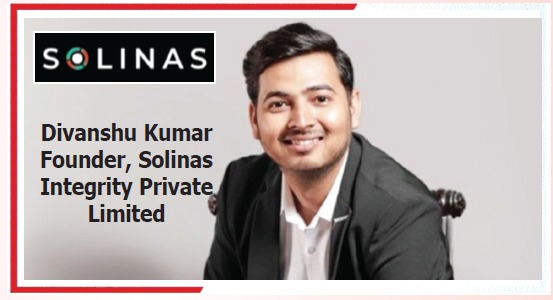
Business Remedies | Rajshree Upadhyaya | August 06,2025 | With a mission to bring cleanliness to urban areas, Divanshu Kumar took the bold step of developing AI and robotics systems to solve the long-standing problem of manual scavenging and pipeline inspection. In a country where sanitation often wavers between necessity and neglect, Solinas has emerged on a daring mission to clean some of India’s most dangerous corners-without putting human lives at risk.
Founded at the intersection of engineering innovation and social responsibility, Solinas Integrity was established by IIT Madras alumnus Divanshu Kumar, who, along with a multidisciplinary team of engineers and researchers, sought a solution through robotics and artificial intelligence. The idea of Solinas was born during Divanshu’s time at IIT Madras, where he witnessed firsthand the fatal consequences of sending humans into septic tanks and sewer lines. Inspired by this incident and determined to intervene, he began developing robotic systems that could replace human entry into such hazardous environments.
Solinas then began building its product ecosystem, led by two major solutions-Endobot and HomoSEP. Endobot is an AI-powered robotic crawler that travels inside water and sewer pipelines, inspecting for leaks, blockages, and structural damages using high-definition cameras and sensors. It transmits this data to a cloud platform called Swasthe AI, which uses machine learning to generate predictive diagnostics for water utilities and municipalities. HomoSEP, on the other hand, is a septic tank cleaning robot that uses a multi-blade rotating mechanism to break down hardened sludge, eliminating the need for human entry.
Emphasizing the Need to Modernize Sanitation Infrastructure
In Season 2 of Shark Tank India, Solinas presented its vision to the panel, seeking Rs. 90 lakh in exchange for 2% equity, placing the company’s valuation at Rs. 45 crore. The proposal was more than just a funding request-it was a call to action. The team highlighted the urgent need to modernize sanitation infrastructure and showcased how their robots were already being deployed by municipal bodies across India.
While sharks Namita Thapar and Amit Jain offered Rs. 52 lakh for 2% equity and Rs. 38 lakh as debt at 10% interest, the founders were not in favor of debt funding. Instead, they accepted a more strategic offer from Peyush Bansal and Anupam Mittal.
90 Lakh for 3% Equity
By the time of their pitch, Solinas had already made significant strides. Their products were present in over 30 cities across 15 states, and their revenue grew from Rs. 1.2 crore in FY 2021-22 to an estimated Rs. 5 crore in FY 2022-23. Prior to Shark Tank, they had also raised Rs. 4.2 crore in seed funding and secured two design patents for their robotic systems. With a gross margin of approximately 60%, the company demonstrated solid business fundamentals backing their social mission.
Solving the Problem of Manual Scavenging
Beyond the numbers, what truly sets Solinas apart is the scale of its impact. By eliminating the need for human entry into toxic environments, they have directly addressed the problem of manual scavenging-a practice that is officially banned but still prevalent in India. In cities like Trichy, their technology has helped detect hidden leaks and contamination, enabling municipalities to save water, reduce infrastructure costs, and prevent sanitation-related deaths. Their robots-particularly the 90mm version of Endobot-became the first of their kind in India capable of navigating narrow, complex pipeline networks in crowded urban environments.
Attractive for NGOs Working in the Sanitation Sector
Solinas has also begun offering its AI-powered cloud platform Swasthe AI as a service to water boards. This has helped shift from reactive maintenance to predictive diagnostics. This software layer, combined with hardware innovation, has positioned Solinas as a scalable, SaaS-like model over a physical product. This made it appealing not only to government buyers but also to private infrastructure firms and NGOs working in the sanitation sector.
The support from Peyush Bansal and Anupam Mittal was not just financial-it symbolized a broader shift in Indian entrepreneurship, where deep-tech ventures with high-impact missions are finally receiving the capital and visibility they deserve. Solinas’ story is one of courage, science, and a deep desire to modernize one of India’s most neglected systems. In doing so, they haven’t just built robots-they’ve built hope.
 Written & Edited By:
Rajshree Upadhyaya