


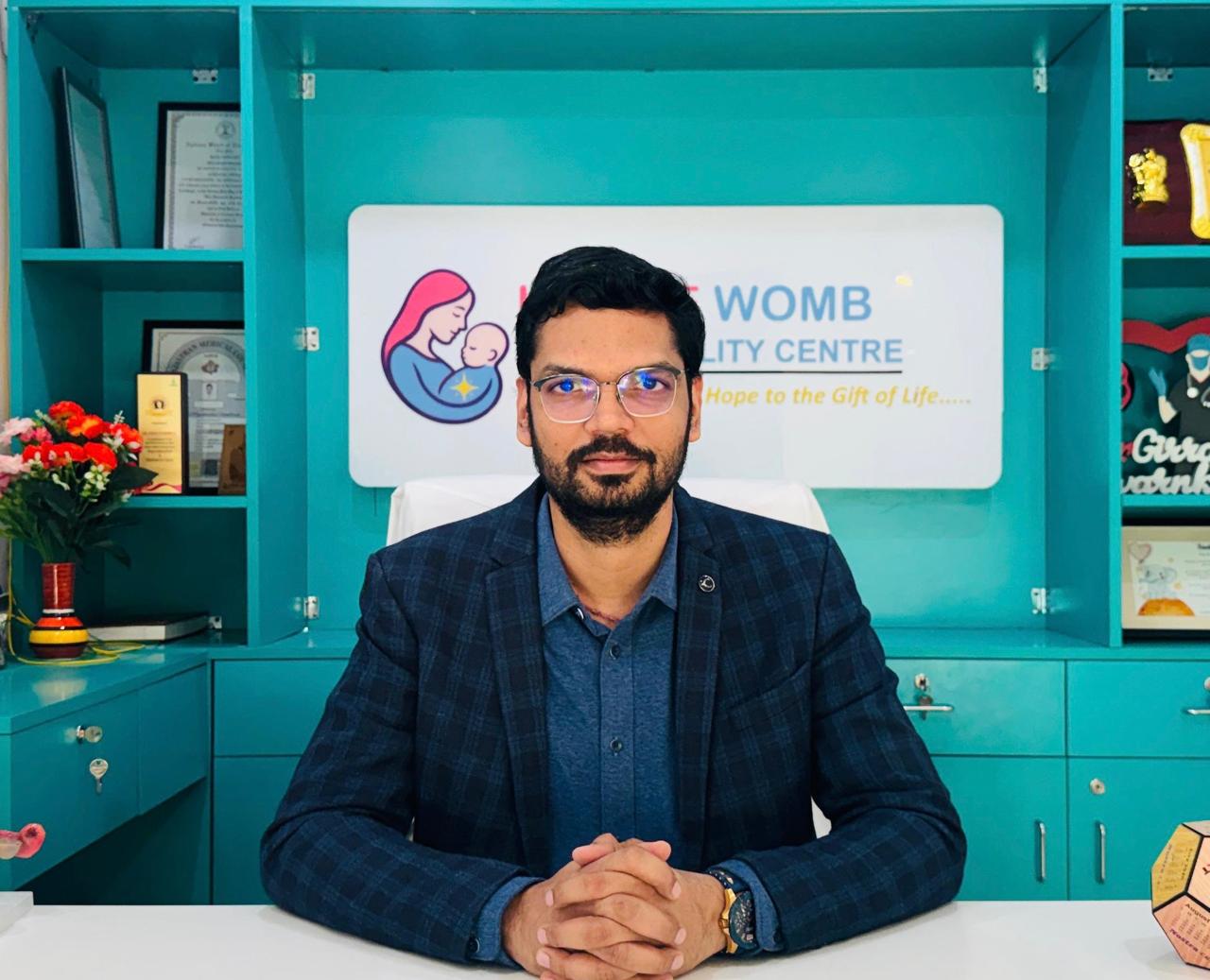
Charu Bhatia, Senior News Editor, Business Remedies, in conversation with Dr. Girraj Prasad Swarnkar, Founder of Kindle Womb IVF and Fertility Centre, Jaipur
Fertility treatment has evolved significantly over the years, with advancements in assisted reproductive technology, fertility preservation and personalised treatment planning. However, successful fertility care involves more than medical procedures. Understanding each couple’s circumstances, providing appropriate counselling and setting realistic expectations are equally important.
 The founder of Kindle Womb IVF and Fertility Centre, Jaipur, Dr. Girraj Prasad Swarnkar, has built his professional journey around these principles. From growing up in Sawai Madhopur to pursuing postgraduate studies in gynaecology and specialised training in IVF, his experience reflects the changing landscape of reproductive medicine in India. In this interview, he discusses his career, the factors influencing fertility, the growing acceptance of male infertility and why couples should seek professional advice without unnecessary delays.
You are the founder of Kindle Womb IVF and Fertility Centre. Tell us about your professional journey and what inspired you to enter the medical field.
Answer: I belong to Sawai Madhopur, where I spent a significant part of my childhood and completed much of my schooling. My family comes from a business background, but I was deeply influenced by my maternal uncle, who is a doctor. I saw the respect he received from our family and relatives, which left a lasting impression on me. During those years, medicine and engineering were widely regarded as prestigious and noble professions. An equally important source of inspiration was my mother. Her encouragement gave me the confidence to pursue medicine and to stay committed to my goal. I see her faith in me as one of the foundations that helped me move forward.
I began my medical education in the early 2000s. When I had to choose a specialisation, gynaecology emerged as a natural choice. Male gynaecologists were not uncommon in Sawai Madhopur, although my decision was sometimes questioned elsewhere. When I pursued my postgraduate studies in gynaecology at St. Stephen’s Hospital in Delhi, one of the first questions I encountered was why I wanted to enter the field despite being a man.
I wanted to establish my own identity as a gynaecologist and provide personalised attention to patients. Initially, I was interested in reproductive medicine, although I had not imagined that I would eventually specialise in IVF.
After working in different places, including Ajmer, Bhilwara and Bandikui, I decided to pursue comprehensive training in fertility treatment. I learned about Dr. Priya Bhave in Bhopal and applied for a fellowship. I performed strongly in the selection examination and my examination performance helped me secure a good position. That opportunity proved to be a turning point in my career.
During my training in Bhopal, I gained experience in scans, sonography and other clinical responsibilities while learning about IVF. I returned to Sawai Madhopur in 2019 with the dream of establishing my own clinic. Owing to family circumstances, I eventually moved to Jaipur, where I founded Kindle Womb IVF and Fertility Centre.
Fertility treatment has evolved from generalised approaches to personalised care. How do you view this transformation?
Answer: Every patient has a different story, and every couple has individual needs, priorities and expectations. Their preferred timeline for parenthood must also be considered. Therefore, fertility treatment cannot follow the same approach for everyone.
Medical science has advanced considerably, making it possible to preserve eggs, sperm and embryos for future use. Many couples now choose to marry or plan their first pregnancy in their mid-thirties or later. It is important for them to understand how age can influence fertility.
Consulting a gynaecologist or fertility specialist early can help couples understand their reproductive health and available options. Personalised counselling allows us to develop a treatment plan based on medical history, age, fertility goals and individual circumstances.
Women with a good ovarian reserve may still experience difficulty conceiving. Why does this happen?
Answer: Ovarian reserve primarily indicates the quantity of eggs available, but quantity does not necessarily guarantee quality. The ability of an egg to mature, become fertilised and develop into a healthy embryo is equally important.
A woman may have a relatively high number of eggs, but their developmental potential can vary depending on factors such as age, hormonal health, lifestyle and medical history.
For instance, women with polycystic ovary syndrome (PCOS) may have a higher number of follicles, but this does not automatically mean that conception will be easy. Ovulation-related difficulties and other associated factors may affect fertility. A proper evaluation is essential to understand the underlying cause.
What are the major factors that influence IVF success rates?
Answer: Age is an important factor, particularly because egg quality generally declines with advancing age. However, IVF outcomes depend on several factors, including the fertility status of both partners, the underlying diagnosis, the quality of eggs and sperm, embryo development and the condition of the uterine environment.
Lifestyle also matters. Maintaining a healthy weight, eating a balanced diet, avoiding smoking and limiting alcohol consumption can support reproductive health.
Patients must also understand that IVF is a process requiring time, monitoring and individualised medication. The dosage and treatment protocol may differ from one patient to another. Laboratory conditions, including the environment in which embryos develop, are also important. Although modern technology has improved treatment possibilities, IVF cannot guarantee pregnancy in every case.
How has the understanding of male infertility changed over the years?
Answer: Awareness of male infertility has improved considerably. Earlier, infertility was often considered primarily a woman’s problem. Today, more men are willing to undergo evaluation and recognise that male factors can also contribute to difficulties in conception.
Male factors are involved in a substantial proportion of infertility cases, either independently or alongside female factors. Potential causes include abnormalities in sperm production or function, hormonal problems, certain medical conditions and lifestyle factors such as smoking and excessive alcohol consumption.
Both partners should therefore be evaluated when a couple experiences difficulty conceiving. A balanced approach helps avoid unnecessary blame and ensures that treatment addresses the actual cause.
Repeated implantation failures can be emotionally and financially exhausting. How do you counsel couples in such situations?
Answer: We do not immediately recommend IVF to every couple. Depending on the diagnosis, we may begin with medication, lifestyle changes or less invasive treatments. IVF is considered when clinically appropriate and when other suitable options have not worked or are unlikely to be effective.
When a couple experiences repeated unsuccessful attempts, we review their medical history and treatment outcomes before deciding on the next steps. Counselling is essential because fertility treatment can create emotional pressure and financial difficulties.
We explain the available options, realistic chances of success, limitations and expected costs. Patients should not feel compelled to continue expensive treatment without a reasonable medical basis. Our responsibility is to provide honest information, build trust and help couples make informed decisions rather than encourage unrealistic expectations.
What is delayed parenthood, and how can it affect fertility?
Answer: Delayed parenthood refers to planning a pregnancy at a later age, often because of career priorities, financial considerations or personal choices. However, reproductive ageing is an important factor to consider.
In women, both egg quantity and quality decline with age, while the risk of miscarriage and certain pregnancy complications increases. Male fertility can also change with age, although the pattern differs.
Conditions such as hypertension and diabetes may further complicate pregnancy planning if they are not adequately managed. Couples considering parenthood later in life should seek medical advice to understand their reproductive health and the options available to them.
What fertility preservation methods are available today?
Answer: Several fertility preservation options are available, depending on an individual’s medical circumstances and future reproductive plans.
Egg freezing allows women to preserve unfertilised eggs for possible future use. Sperm freezing can help men preserve sperm before medical treatments or other circumstances that may affect fertility. Embryo freezing involves preserving fertilised eggs for future treatment.
Ovarian tissue cryopreservation may be considered in selected cases, particularly for certain patients undergoing cancer treatment. The suitability of each method depends on factors such as age, diagnosis, treatment urgency and personal preferences. Patients should discuss the benefits, limitations and realistic expectations of these procedures with a specialist.
What precautions should women take after an embryo transfer?
Answer: Patients are generally advised to continue normal, light daily activities unless their treating specialist recommends otherwise. Complete bed rest is not routinely necessary after embryo transfer. However, strenuous exercise and activities that cause significant physical discomfort should be avoided according to medical advice.
Women should take prescribed medication on time, maintain a balanced diet, stay hydrated and follow their clinic’s instructions. It is also helpful to manage stress and seek support when needed. Ordinary movement, such as walking or going to the office, does not generally need to be avoided unless there is a specific medical reason.
Why do some couples struggle to conceive even when initial investigations reveal no obvious fertility problems?
Answer: Such cases may be classified as unexplained infertility after an appropriate evaluation fails to identify a clear cause. Standard investigations may not detect every factor affecting fertilisation, embryo development or implantation.
Possible explanations may involve subtle reproductive, genetic or other biological factors. However, unexplained infertility does not necessarily mean that the body is rejecting an embryo. The cause may remain unidentified even after testing.
How has public perception of fertility and fertility treatment changed?
Answer: People are becoming more aware of reproductive health and the treatment options available. Conversations about infertility are gradually becoming more open, and more couples are willing to seek professional help.
However, social media contains both useful information and misleading claims. General advice cannot replace an individual medical assessment, and success stories do not represent the likely outcome for every patient. People should verify information with qualified doctors, ask questions and clarify their doubts before making treatment decisions.
Finally, what is your message to couples experiencing fertility concerns?
Answer: Time is precious when it comes to fertility, so couples should not postpone medical consultation unnecessarily. If they have concerns or have been trying to conceive without success, they should seek timely guidance rather than wait indefinitely.
Seeking advice does not automatically mean undergoing IVF or another advanced procedure. Sometimes, reassurance, counselling, lifestyle changes or simpler treatments may be sufficient.
Every couple deserves individual attention, honest guidance and realistic expectations. My message is to seek the right advice at the right time, understand your options and make informed decisions.