

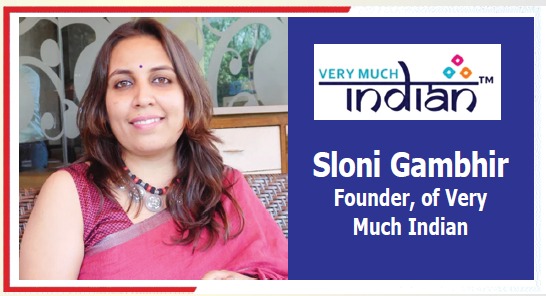
Business Remedies | Rajshree Upadhyaya | June 28,2025 | Sloni Gambhir, the founder of Very Much Indian, has carved a niche for herself by reviving India’s forgotten handloom legacy. Born and raised in Yeola, Maharashtra, Sloni spent her childhood in her father’s textile shop, where she gained deep insights into fabrics, craftsmanship, and customer service. A defining moment came at the age of 14 when she independently made a sale worth Rs. 15,000, igniting a lifelong passion for textiles.
Sloni holds a B.Tech in Computer Science and an MBA in Marketing. After spending nearly a decade in corporate roles across engineering and management, the pull of her roots proved stronger than the perks of the boardroom. In 2016, she left her stable job to follow her passion and launched Very Much Indian from her home in Pune, starting with just 25 sarees borrowed from her initially skeptical father. Her husband, Manish Atri, whom she met during her MBA, stood firmly by her side during the uncertain journey of entrepreneurship.
Though the beginning was modest, Sloni was determined. She personally met customers, sold sarees door to door, and participated in exhibitions. Winning customer trust, understanding the weaving ecosystem, market trends, and evolving consumer preferences took her nearly a year, but her persistence paid off. Gradually, Very Much Indian became a trusted name for authentic, handcrafted sarees.
Collaborating Directly with Over 2,500 Weavers Across Eight States
Very Much Indian was founded with the core mission of preserving India’s textile heritage and ensuring fair compensation for artisans. Today, the brand works directly with more than 2,500 weavers across eight states, bypassing exploitative middlemen to deliver traditional sarees like Paithani, Banarasi, Kota, Kalamkari, Chanderi, Maheshwari, and Kanjivaram directly to customers. Its catalog reflects not just tradition but also innovation, offering sarees ranging from Rs. 1,800 to Rs. 78,000.
A turning point came in early 2023 when Sloni appeared on Shark Tank India Season 2. Confident, authentic, and deeply knowledgeable, she pitched Very Much Indian, asking for Rs. 50 lakhs for a 3% stake at a valuation of Rs. 16.67 crore. Her passion deeply resonated with the Sharks, especially Anupam Mittal, who grew emotional recalling his family’s textile background. Aman Gupta and Namita Thapar saw potential in the brand and jointly offered Rs. 50 lakhs for 10% equity, valuing the company at Rs. 5 crore, a deal Sloni accepted.
Introducing Eco-Friendly Collections and Achieving Rapid Growth
Her Shark Tank appearance was much more than a funding opportunity, it significantly boosted brand visibility, strengthened the artisan network, and accelerated growth. From Rs. 17 lakh in revenue in FY 2018-19, the brand grew to Rs. 65 lakh in 2020-21, Rs. 1.5 crore in 2021-22, and approximately Rs. 2.5 crore in 2022-23.
Sloni also diversified the brand by launching Very Much Eco, an eco-friendly collection of organic cotton sarees that cater to the global demand for sustainability. Strategic partnerships followed, including an investment from Bestvantage Investments to enhance supply chains and support global expansion. A strong digital presence and growing social media community played a vital role in outreach.
Despite occasional criticism about premium pricing or comparison with cheaper alternatives, Very Much Indian has earned admiration for its cultural authenticity and unwavering commitment to supporting weavers.
A Platform for Artisan Empowerment, Cultural Preservation, and Heritage-Driven Enterprise
Today, Sloni remains closely connected with weaver communities, visiting them, co-designing products, and ensuring quality at every step. Very Much Indian is more than just a brand, it is a platform for artisan empowerment, cultural preservation, and heritage-led entrepreneurship. From early days in her father’s shop to negotiating equity deals on national television, Sloni’s journey is a powerful example of how tradition, innovation, and resilience can together weave a legacy, one that honors the past while shaping a sustainable and inclusive future.
 Written & Edited By:
Rajshree Upadhyaya