
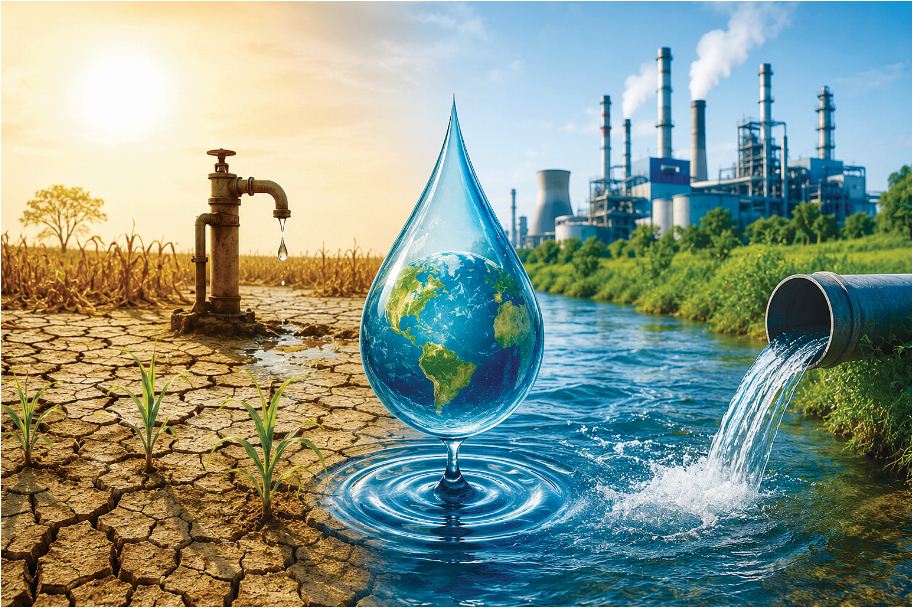
Jaipur | Charu Bhatia | Water scarcity is no longer just an environmental concern, it is fast becoming a defining economic risk for countries, industries and investors. As climate change, population growth and urbanisation intensify demand, water stress is beginning to shape agricultural output, industrial planning and long-term business strategies across the globe. According to global estimates, over two billion people already live in water-stressed regions, and this number is expected to rise sharply over the next decade. For businesses and policymakers, the implications are significant: water availability now directly influences productivity, supply chains and economic stability.
Water Stress as an Economic Risk: Impact on Agriculture and Industry
Agriculture is the first sector to feel the impact of water shortages. Farming accounts for roughly 70% of global freshwater use, making it extremely vulnerable to erratic rainfall, declining groundwater levels and prolonged droughts. Crop yields become unpredictable, irrigation costs rise and food prices often follow. In major agricultural economies, water shortages can trigger cascading effects, reduced harvests, increased imports, and inflationary pressure on food markets. For agribusinesses, this volatility complicates long-term planning and investment decisions. Countries heavily dependent on monsoon cycles or river systems are particularly exposed to sudden production shocks.
The industrial sector is increasingly facing similar risks. Water is critical for manufacturing processes across industries including textiles, chemicals, semiconductors, steel and energy production. From cooling power plants to processing raw materials, reliable water supply is essential for maintaining operations. Water stress can disrupt factory output, raise operating costs and even force companies to relocate facilities. Regions once attractive for manufacturing may lose competitiveness if water scarcity becomes severe. As a result, companies are beginning to factor water availability into site selection, risk assessments and sustainability strategies. The financial impact is also becoming clearer. Investors are now treating water scarcity as a material risk, similar to energy or supply chain disruptions. Companies operating in water-stressed regions may face higher insurance costs, stricter regulations and growing pressure from ESG-focused investors.
Governments are responding with policies that encourage water efficiency, recycling and conservation technologies. Innovations such as precision irrigation, wastewater recycling and desalination are gaining traction as industries search for sustainable solutions. Ultimately, water is emerging as a critical economic resource, one that influences everything from food security to industrial growth. As scarcity intensifies, businesses that adapt early through efficient water management and sustainable practices will be better positioned to remain resilient in an increasingly water-constrained world.