



Charu Bhatia, Senior News Editor, Business Remedies, in conversation with Mr. Pramod Yadav, the Founder of Nidhivan Foundation
Environmental conservation is increasingly becoming a matter of collective responsibility as communities across the country face challenges ranging from air and water pollution to groundwater depletion, deforestation and changing climatic conditions. For Pramod Yadav, Founder of Nidhivan Foundation, the relationship between human beings and nature has been a personal journey that gradually evolved into a structured effort towards environmental conservation. Coming from a village between Alwar and Bharatpur, he developed an early connection with nature and later established an ashram where thousands of birds visit every day. His experience of understanding the relationship between birds, plants and the larger ecosystem eventually inspired him to establish Nidhivan Foundation after the COVID-19 pandemic. The foundation now works across Rajasthan on plantation, afforestation, irrigation and environmental awareness initiatives and has planted around 1.5 lakh trees. In this conversation, he discusses his journey, the importance of greenery, the role of young people in conservation, the challenges faced by environmental NGOs and the need to balance industrial development with ecological responsibility.
Question: You are an advocate of environmental conservation and have established Nidhivan Foundation. Please tell us about your journey so far.
Answer: I would like to begin my journey with an exploration that changed the way I looked at nature. Once, I happened to listen to the thoughts of Osho, who said that the only righteous thing one can do is to feed birds. Coming from a philosopher like him, I felt there had to be a deeper logic behind that statement. I spent nearly six months trying to understand it.
When a baby is born, the first thing he needs is breath, and the oxygen we breathe is closely connected with plant life. Plants grow from seeds, and birds play an important role in dispersing seeds. That made me realise the interconnectedness of birds, plants and human life. For me, feeding birds therefore became much more than an act of kindness; it became a way of understanding and contributing to the larger ecological cycle.
I come from a village situated between Alwar and Bharatpur, around 150 kilometres from Jaipur. I have an ashram there where I try to create a conducive environment for birds, particularly sparrows, to come, stay and thrive. Around 25 kilograms of grain is provided to the birds every day, and nearly 2,000 birds visit the place daily.
The idea of conserving nature had been with me since childhood, but after the COVID-19 pandemic, I decided to give it a more structured form and established Nidhivan Foundation.
Today, there are several pressing environmental challenges before us, including air pollution, soil pollution, water pollution, depletion of groundwater, droughts and floods. I believe trees and forests can play a crucial role in addressing several of these challenges. We need to revive the legacy of trees and forests because they are among our most valuable natural assets.
This is the purpose with which Nidhivan Foundation works across Rajasthan. Our approach is not simply about planting as many trees as possible. Before plantation, we research the land, understand its suitability and identify what kind of plants can survive there. Once we undertake plantation, we take responsibility for the trees for three years, providing water, manure and other necessary support. After that, responsibility is transferred to the landowner or institution, although we continue to visit and monitor the plantation.
We also undertake plantation projects through CSR support and, in some cases, name the garden after the land or institution where it has been developed. So far, we have planted around 1.5 lakh trees. Our projects also include facilities such as drip irrigation.
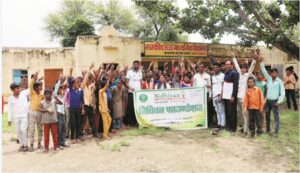
Another initiative we are developing is an internship programme for college students. We want young people to gain practical exposure to environmental conservation rather than learning about it only theoretically. We are currently in discussions with leading colleges in Jaipur for this initiative.
Question: Very basic yet important, what are the many advantages of living around greenery?
Answer: First of all, I believe we need to recognise that plants are living beings. They breathe, provide fruits and shade and contribute enormously to our lives, yet, they never demand recognition for what they give us.
People who live close to nature often develop a more positive relationship with their surroundings. What is important is to develop emotional sensitivity towards nature and greenery. Human beings can sometimes be selfish in the way they use natural resources, but we need to develop a sense of affection and responsibility towards the living world around us.
The COVID-19 pandemic made us realise the significance of oxygen and, consequently, the importance of plants and forests. That experience brought the issue much closer to ordinary people.
We often overlook the ecological processes happening around us because they are part of our everyday lives. Trees and plants continuously contribute to the environment in different ways. Their importance goes far beyond simply providing oxygen. They support biodiversity, offer shade, help maintain local ecosystems and contribute to soil and water conservation.
Therefore, greenery should not be treated merely as a decorative element in a residential area. It is an essential part of a healthy environment and our relationship with it needs to become more conscious and responsible.
Question: How does the approach of the young generation differ from that of older generations regarding environmental protection?
Answer: I think every generation is shaped by the circumstances in which it grows up. The older generation, in many cases, experienced a time when financial resources and material comforts were limited. Naturally, their priorities were different. They were focused on securing basic necessities and improving their standard of living.
The present generation, particularly Gen Z, has grown up in a different environment. Young people have greater access to information and are increasingly exposed to conversations about climate change, sustainability and environmental protection. We can see young people taking initiatives and showing enthusiasm towards protecting trees and nature.
I believe this growing awareness can have a positive impact on future generations as well. At the same time, rapid urbanisation and industrialisation are changing the way people live. Large-scale migration from villages to cities has reduced the direct connection many people once had with nature.
Earlier, people often lived in homes and communities that were naturally integrated with open spaces, trees and local ecosystems. Today, urban development is increasingly replacing those spaces. Therefore, the challenge is to ensure that development does not completely disconnect human beings from nature.
Question: How is Nidhivan Foundation different from other NGOs working for environmental protection?
Answer: Nidhivan Foundation certainly promotes afforestation and plantation, but our work does not end once a tree is planted. We take responsibility for the plants for three years and provide the necessary support, including water and manure.
We generally prefer locations where responsibility for the plantation can be continued after our initial three-year period. Government-supported or institutional spaces can sometimes provide that continuity. Depending on the project, we also facilitate fencing and tubewells and incorporate drip irrigation where required.
 Another important aspect of our approach is that we focus on plantation in bulk rather than planting isolated individual trees. We first study the location and identify suitable species and then develop plantation projects accordingly.
Even after handing over the responsibility, we continue to monitor the plantations through regular visits. We try to ensure that the effort made in planting trees translates into their long-term survival.
The location can vary considerably. It could be a school, an institutional campus, a cremation ground or another suitable piece of land. Before plantation, we research the site according to the needs of the plants.
Question: How do you see the government’s role in saving the environment?
Answer: I believe the government has shown enthusiasm towards environmental conservation and has undertaken several plantation and forest conservation initiatives. Forest departments, in particular, have played an important role in protecting and conserving forests.
There are also several policies and programmes aimed at environmental protection. However, one area that requires greater attention is implementation. A policy can achieve its intended objective only when it is effectively implemented on the ground.
Public awareness is equally important. Many people think that as long as they have access to oxygen and basic resources, their responsibility is fulfilled. But environmental conservation is a collective responsibility. Forests, water bodies, soil and biodiversity need to be protected not only through government action but also through public participation.
Question: What are your views on balancing the goals of industrialisation with environmental obligations?
Answer: Industrialisation and environmental protection need to be considered together. Every company should assess the environmental impact of its activities and also take responsibility for mitigating that impact.
There are companies that have undertaken initiatives linking their business activities with environmental action. For instance, some brands have pledged to plant trees in connection with their products, while Tata has undertaken a tree plantation initiative linked to dot balls during the IPL.
However, the larger question is implementation and monitoring. Whenever such commitments are made, there should be a mechanism to maintain records and verify whether the commitments are actually being fulfilled.
We should also maintain proper records of non-urbanised land and identify ways of protecting these areas from unnecessary conversion. Development is necessary, but environmental considerations must remain an integral part of the development process.
Question: What challenges do you think an NGO faces when it starts working for environmental protection?
 Answer: One of the biggest challenges is public perception. There is sometimes a belief that if an organisation is an NGO, it must necessarily be collecting money for profit rather than working for social welfare. That perception is not fair to genuine organisations working in the sector.
There may be organisations that do not operate responsibly, but we should not generalise that experience to all NGOs.
Another major challenge is funding. Genuine environmental organisations require financial resources to undertake meaningful work. Even something as basic as buying plantlets, manure, setting up irrigation facilities, fencing a plantation site or conducting research requires money.
Environmental projects also need long-term commitment. Plantation is not a one-day activity. If we want trees to survive, we have to invest in their care and maintenance. Therefore, adequate and transparent funding is extremely important for NGOs working in environmental conservation.
Question: How do you see the role of technology in environmental protection?
Answer: Technology can play a very important role, particularly in research and monitoring. Before planting trees, we need to understand the soil conditions of a particular location, the suitability of different species, the temperature, water availability and the kind of manure or nutrients required.
Technology can help us assess these environmental conditions more scientifically. Instead of making decisions only on the basis of assumptions, we can use data to understand whether a particular plant is suitable for a particular location.
Technology can therefore make environmental projects more efficient. It can help us make better decisions about plantation, irrigation, soil management and monitoring. Going forward, I believe the combination of environmental awareness and technology can significantly strengthen conservation efforts.
Question: Lastly, what message would you like to give to the general public about environmental conservation?
Answer: My message would be that in today’s era, earning money and improving our standard of living are important, but protecting our surroundings is equally important. We cannot separate our lives from the environment.
If there is no clean air to breathe, no amount of wealth or luxury can compensate for it. Therefore, people need to understand the importance of trees, forests, water and the natural environment around them.
We should not destroy trees merely to create more luxurious spaces for ourselves. Every tree that is removed affects the environment in some way, and the consequences can ultimately be faced by future generations.
Environmental conservation does not always require extraordinary action. It begins with small, responsible decisions and a change in our attitude towards nature. If each person develops a sense of responsibility towards the environment, those individual efforts can collectively create a significant difference.
The generations that come after us will inherit the environment that we leave behind. Therefore, protecting nature today is not just an environmental responsibility; it is also a responsibility towards the future.