
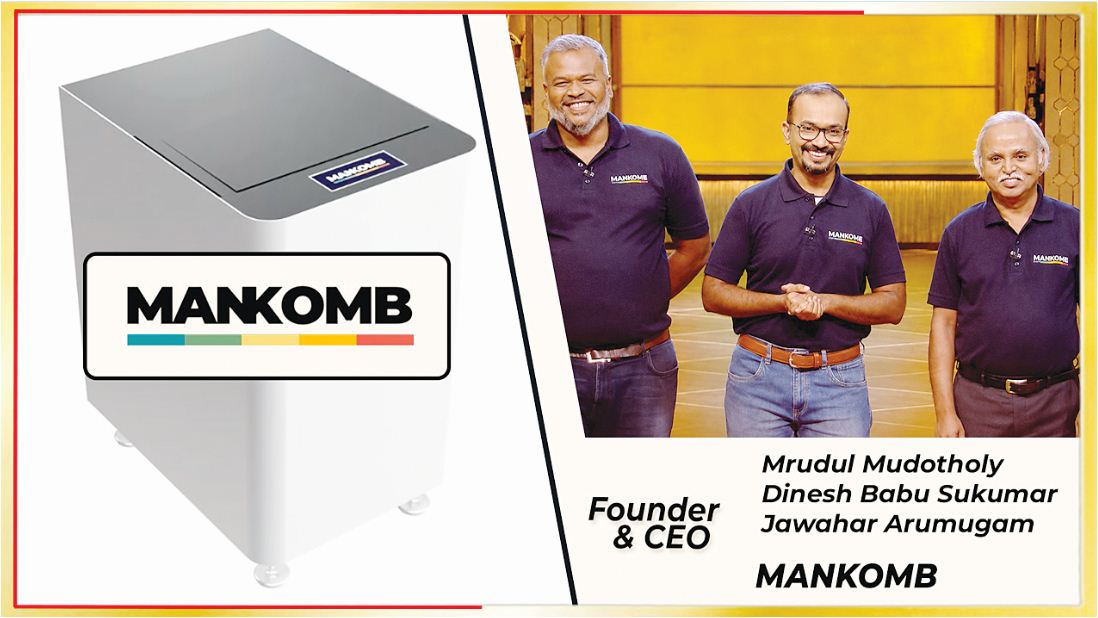
Jaipur | Rajshree Upadhyaya | In 2024, Mrudul Mudotholy, Dinesh Babu Sukumar, and Jawahar Arumugam established their position in the climate-tech sector by transforming the way households manage everyday kitchen waste through Chewie, a flagship product of Mankomb Technologies Private Limited. The company entered India’s climate-tech ecosystem with a mission to address one of the country’s biggest environmental challenges by combining expertise in technology, engineering, and product development. Instead of treating wet waste as something to be discarded, the founders envisioned a future where households could convert it into a valuable resource using intelligent technology. This vision eventually became Chewie, a startup focused on making sustainable living easier for modern homes. The company’s flagship product, Chewie AI-Powered Wet Waste Management System, is designed to process daily kitchen waste-including fruit peels, vegetable scraps, and leftover food-directly inside homes. Using smart automation and artificial intelligence, the appliance converts organic waste into regenerated soil while reducing unpleasant odours, eliminating the need for manual handling, and lowering dependence on municipal waste collection systems. The founders wanted sustainability to become a natural part of everyday life rather than an additional responsibility. Therefore, they focused on building a connected appliance that continuously improves through software updates while delivering a seamless user experience.
Presented Their Mission to Solve India’s Growing Wet Waste Challenge
Chewie attracted nationwide attention after appearing on Shark Tank India Season 5, where the founders presented their mission of tackling India’s growing wet waste problem through home-based innovation. Seeking an investment of Rs. 2 crore in exchange for 1.5% equity, they demonstrated how their product could reduce landfill waste while encouraging sustainable waste management practices at the household level. Although the Sharks appreciated the product’s purpose and engineering, they raised concerns about its commercial readiness, valuation, and scalability. Despite generating considerable interest and sparking conversations around environmental innovation, the startup did not secure an investment and left the show without a deal. However, the television outcome did not slow the founders’ momentum. Instead, they continued refining the product through extensive testing, hardware improvements, and software optimisation. Mankomb regularly shared development milestones, including quieter machine operation, improved durability, enhanced power optimisation, and progress towards commercial manufacturing. The startup also strengthened its presence by participating in technology showcases and startup initiatives, demonstrating its commitment to building a world-class product rather than rushing prematurely into the market.
Became Part of the Startup and Climate Innovation Ecosystem
Mankomb received a significant boost when it was recognised under the Elevate Program by the Government of Karnataka, validating both its technology and its sustainability-focused vision. The company also became part of the startup and climate innovation ecosystem, gaining valuable mentorship and support for future growth. These milestones reflected growing confidence in the startup’s long-term potential and reinforced the founders’ belief that solving environmental challenges requires continuous innovation and patience rather than immediate commercial success. Today, Mankomb Technologies Private Limited continues to develop and enhance Chewie, focusing on making its AI-powered wet waste management solution accessible to more households while continuously improving the product through ongoing research and engineering. Although the company’s Shark Tank journey ended without funding, the experience introduced Chewie to audiences across India and highlighted the importance of sustainable technology specifically designed for Indian households. The founders continue to pursue the same mission that inspired them to launch the company in 2024, proving that resilience, innovation, and a long-term commitment to solving real-world environmental problems can be just as valuable as securing investment on television.
 Written & Edited By:
Rajshree Upadhyaya