

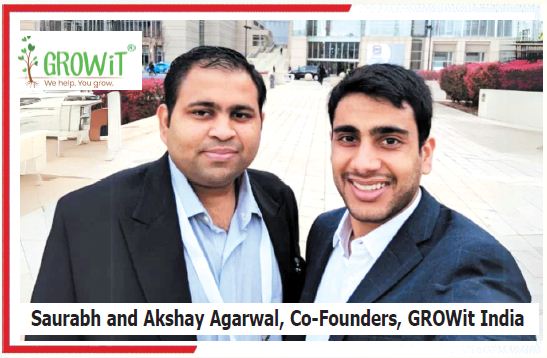
Business Remedies | Rajshree Upadhyaya | By changing the method of foodgrain production in India, two brothers from Surat, Saurabh and Akshay Agarwal, established GROWit India by introducing protective farming technology and made their mark. They decided to give up their family packaging business to address the uncertainty of farming. This soon turned into a mission to change the way foodgrains were produced in India. Saurabh Agarwal himself learned farming on a small plot of land and, along with his brother Akshay, discovered protective farming techniques. This dramatically improved yields and reduced input wastage. That initial modest experiment gave birth to the idea of a company called GROWit, which would package protective farming inputs such as mulch films, crop covers, and soil testing services into an accessible model for small and marginal farmers. The founders built GROWit India on two quiet but strong beliefs: that farmers need technologies that are easy to use and economically viable, and that crop-level protection can provide multiple benefits where traditional practices were failing. Instead of selling theories from an office, they worked at the grassroots to listen to farmers and test solutions. This approach helped them achieve rapid success in yield and quality, opening doors to distribution channels, franchise partners, and direct farmer engagement programs. In just a few years, the company moved beyond backyard trials to serve thousands and later more than two lakh farmers through a combination of franchise stores and field programs.
Acceleration in product development and supply chain reach
The public turning point came when GROWit stepped onto the stage of Shark Tank India Season 2 to present protective farming to people. The brothers sought an investment that not only reflected a bold valuation but also brought solid momentum and clear unit economics. Their story appealed to the sharks because it combined impact with numbers. The team had customer stories and a clear distribution role. The episode ended with a highly significant validation. Investors Namita Thapar and Peyush Bansal agreed to support the business in a deal that included a mix of equity and debt. This gave GROWit access to both capital and advisory support. After the show, the company doubled down on its strategy, investing in production quality, expanding its franchise network, and deepening its farmer outreach. This momentum helped the company attract institutional capital, culminating in a Series A, which further accelerated product development and supply chain reach. This funding marked a shift. GROWit was no longer just a regional success story but had become an agri-tech brand, ready to promote protective farming across different states and crop types.
Even small operational changes become a source of better income for producers
What makes GROWit’s story more important than just a business case is that it views agriculture as a systemic problem. Even small operational changes become a source of better income for producers. The founders view their growth not merely in terms of revenue figures, but as upliftment and sustainability for farmers by reducing chemical waste, improving water usage, and stabilizing yields. As the company expands, the challenge will be to maintain closeness with farmers while building large-scale processes, good manufacturing, and reliable distribution. But the early chapters reflect a founder-led, field-tested model that transformed a backyard experiment into a platform for change. For readers and founders alike, GROWit’s journey is a reminder that reliability in agriculture comes from patiently verified results and translating technology into the farmer’s language. Saurabh and Akshay Agarwal took a risky turn from packaging to protective farming and turned curiosity into a movement. One mulch film, one soil test, and one field at a time, proving that thoughtful intervention in the soil can produce not only crops but also a sustainable business and measurable farmer prosperity.
 Written & Edited By:
Rajshree Upadhyaya