
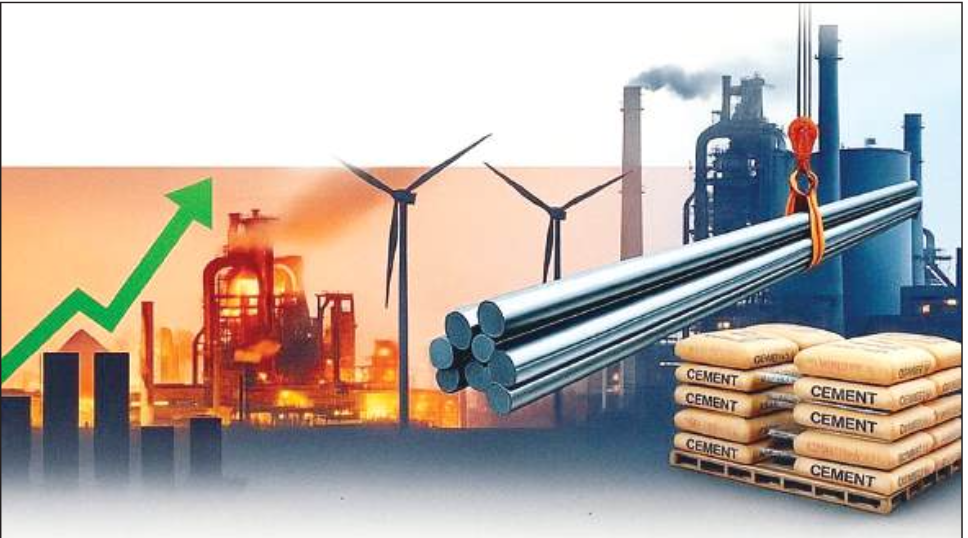
Charu Bhatia | Business Remedies | India’s secondary sector, the engine that converts raw materials into economic value, is once again in focus as the country pushes towards higher growth, infrastructure expansion and global manufacturing relevance. At the heart of this sector lie steel, cement and a basket of core industries that together act as a barometer of industrial health. Their performance offers crucial clues about demand conditions, investment momentum and the broader economic cycle.
Steel remains one of the most sensitive indicators of industrial activity. Over the past year, domestic steel demand has been supported by government-led infrastructure spending, housing construction and capital goods manufacturing. Large-scale projects in railways, roads, urban redevelopment and defence have provided steady offtake, cushioning the sector against global price volatility. While export demand has faced pressure due to weak global growth and trade uncertainties, India’s strong domestic consumption has helped producers maintain capacity utilisation at relatively healthy levels.
Cement, closely tied to construction and real estate, tells a similar story. Housing demand, particularly in tier-2 and tier-3 cities, along with sustained public infrastructure investment, has kept cement consumption resilient. Consolidation in the sector has improved pricing discipline, allowing major players to partially offset rising input costs such as power and logistics. However, margins remain vulnerable to energy price fluctuations, especially coal and petcoke, making cost efficiency a key focus area for producers.
Beyond steel and cement, the performance of core industries, including coal, crude oil, natural gas, refinery products, fertilisers and electricity, provides a composite view of industrial momentum. Growth in electricity generation and coal production has reflected rising industrial and residential demand, while refinery output has benefited from steady domestic fuel consumption. At the same time, challenges persist in segments like crude oil and natural gas, where output constraints underline India’s continued reliance on imports.
From a business trends perspective, the underlying theme is capacity building. Companies across steel and cement are investing in brownfield and greenfield expansions, betting on medium- to long-term demand growth driven by infrastructure, manufacturing and urbanisation. This capex cycle has positive spillover effects across engineering, logistics and employment, reinforcing the secondary sector’s multiplier effect on the economy.
However, the road ahead is not without risks. Global commodity price swings, geopolitical tensions and tighter environmental norms could impact costs and profitability. The transition to greener production, including low-carbon steel, blended cement and renewable energy integration, will require sustained investment and technological upgrades. For companies that adapt early, sustainability could become a competitive advantage rather than a constraint.
Overall, the health of steel, cement and core industries suggests a secondary sector that is steady but not complacent. Domestic demand remains the primary growth anchor, while policy support and infrastructure spending continue to provide visibility. As India pursues its ambition of becoming a global manufacturing hub, the performance of these foundational industries will remain central to assessing whether industrial growth is both durable and inclusive.