
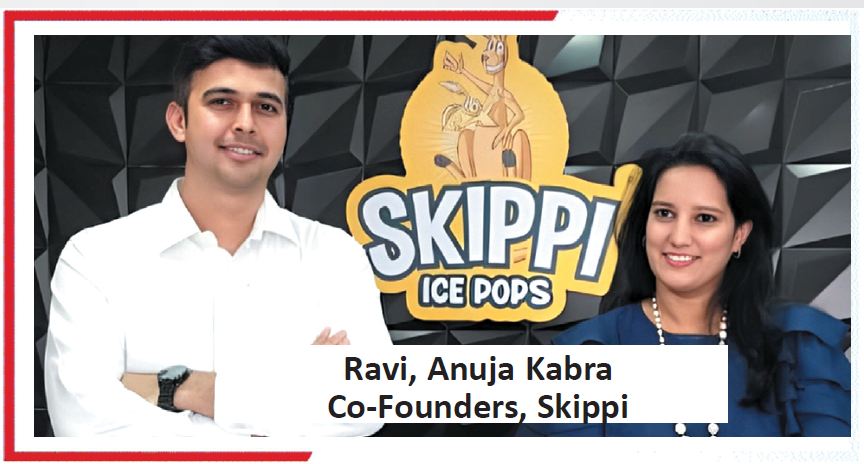
Rajshree Upadhyaya/Jaipur. Business Remedies. In the sweltering heat of Hyderabad, a wave of nostalgia led Ravi and Anuja Kabra to an unexpected entrepreneurial path. After nearly a decade in Australia, the couple returned to India, only to notice the absence of a childhood favourite, the humble chuski. A family member’s effort to bring hygienic ice pops from abroad during a visit made them realize the lack of safe, flavorful frozen treats in the Indian market. With a background in the food and beverage industry, the Kabras saw an opportunity to reimagine this nostalgic treat in a modern, health-conscious avatar.
They envisioned a brand that would deliver clean, natural ice pops free from artificial colors, preservatives, and refined sugar. Their product would use fruit and vegetable extracts, 100% RO water, and be suitable for health-aware families and millennials alike. But just as they were ready to launch in 2020, the COVID-19 pandemic struck. Lockdowns halted operations, delayed production, and resulted in losses of Rs. 11 lakh after an initial investment of Rs. 55 lakh. Still, the couple refused to abandon their vision. Instead, they used the downtime to perfect their formulations, study market behavior, and lay the groundwork for a stronger comeback.
By April 2021, Skippi Ice Pops officially hit the market. The response was immediate and encouraging, the first batch sold out within three weeks, with monthly sales reaching 60,000 units. One of their key innovations was that the ice pops could be stored at room temperature, removing the need for a continuous cold chain. This made the product viable even in regions with limited refrigeration, vastly improving accessibility and distribution.
The turning point came later that year when the Kabras appeared on Shark Tank India. Their pitch struck a chord with all five sharks, Aman Gupta, Ashneer Grover, Anupam Mittal, Namita Thapar, and Vineeta Singh, who collectively offered Rs. 1 crore for 15% equity. The investment was later increased to Rs. 1.2 crore by Lenskart founder Peyush Bansal, who saw great potential in their vision. The Shark Tank episode triggered a surge in visibility, with their website crashing under 400,000 hits and over 20,000 orders flooding in overnight. Monthly revenues skyrocketed from Rs. 5 lakh to over Rs. 2 crore. Distributors began paying in advance and were willing to wait up to a month for deliveries. Production scaled rapidly, and the team expanded to keep up with demand.
To address distribution bottlenecks and expand their reach, Skippi launched freezer-equipped electric bikes in partnership with BikeWO. These mobile units allowed vendors to serve ready-to-eat ice pops directly in local neighborhoods, bringing back the charm of street vending while solving last-mile delivery issues. The brand’s presence quickly grew to over 20,000 retail outlets across India, with international exports to countries like Kuwait, Oman, the UAE, Nepal, and even back to Australia, completing a full-circle moment for the founders.
By the end of FY23, Skippi had grown from Rs. 2.5 crore in annual revenue to Rs. 15.4 crore, with a target of touching Rs. 100 crore in ARR by FY25. The brand’s success was recognized with several awards, including the Economic Times Award for Corporate Excellence and the Franchise India Small Business Award, placing Skippi firmly among India’s most promising consumer startups.
What began as a craving for a frozen childhood delight evolved into a thriving business rooted in nostalgia, resilience, and thoughtful innovation. Ravi and Anuja Kabra’s journey is a testament to how a simple, personal memory, combined with the courage to reimagine it, can lead to a brand that not only captures hearts but also reshapes a market.