

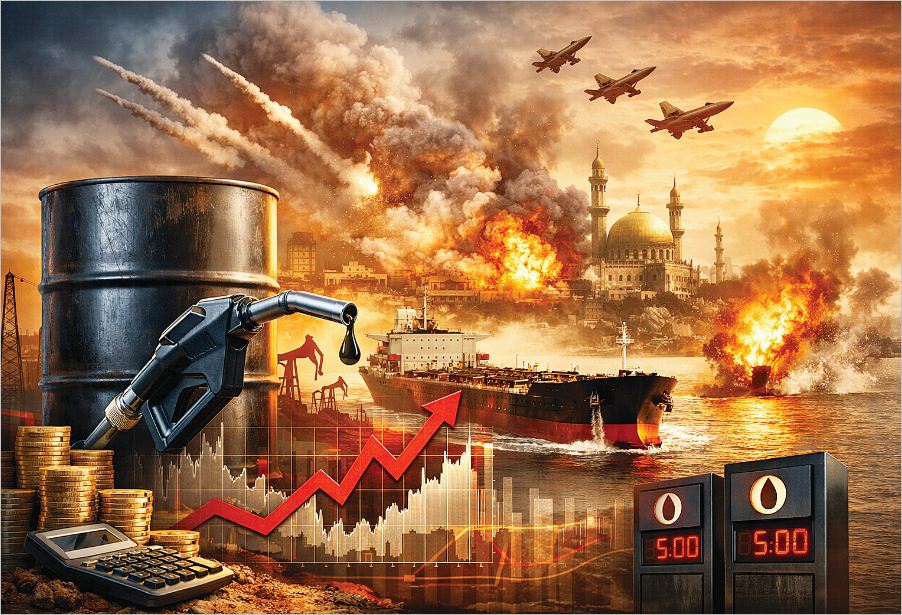
Charu Bhatia | Business Remedies | Escalating tensions in the Middle East have once again placed global energy markets on edge, raising concerns that crude oil prices could surge beyond the $100 per barrel mark. As the region remains central to global oil production and supply routes, any prolonged conflict risks triggering significant disruptions that could ripple across economies worldwide.
The Middle East accounts for nearly a third of global crude oil production and holds some of the world’s most critical energy infrastructure. Key producers such as Saudi Arabia, Iran, Iraq and the United Arab Emirates play a vital role in maintaining the balance between global supply and demand. When geopolitical tensions rise in this region, oil markets tend to react swiftly, often pushing prices upward due to fears of supply shortages.
One of the primary concerns for global markets is the potential disruption of major shipping routes. The Strait of Hormuz, through which nearly one-fifth of the world’s oil supply passes daily, remains one of the most strategically important chokepoints in global energy trade. Any escalation that threatens tanker movement through this corridor could immediately tighten global supply and drive prices higher.
Higher oil prices typically have wide-ranging economic consequences. For energy-importing countries such as India, Japan and several European economies, a sharp increase in crude prices could lead to higher fuel costs, rising inflation and pressure on government finances. Transport, aviation and logistics industries are particularly vulnerable, as fuel costs form a major part of their operating expenses.
A sustained surge in oil prices could also impact global growth. When energy becomes more expensive, production costs for businesses rise, which can eventually translate into higher prices for consumers. Central banks may face additional challenges managing inflation, especially at a time when many economies are already navigating slow growth and volatile financial markets.
At the same time, oil-exporting countries may temporarily benefit from higher revenues if prices remain elevated. However, prolonged geopolitical instability could still create long-term uncertainty for producers and investors alike. Energy markets typically prefer stability, as predictable supply flows are essential for maintaining global economic balance.
The situation could also accelerate conversations around energy diversification. Governments and corporations may intensify efforts to invest in renewable energy, strategic reserves and alternative supply sources to reduce dependence on geopolitically sensitive regions.
While it remains uncertain whether crude oil will sustainably cross the $100 threshold again, the possibility highlights how deeply interconnected geopolitics and energy markets remain. A prolonged Middle East conflict would not only influence oil prices but could reshape global energy strategies, trade flows and economic stability in the months ahead.