

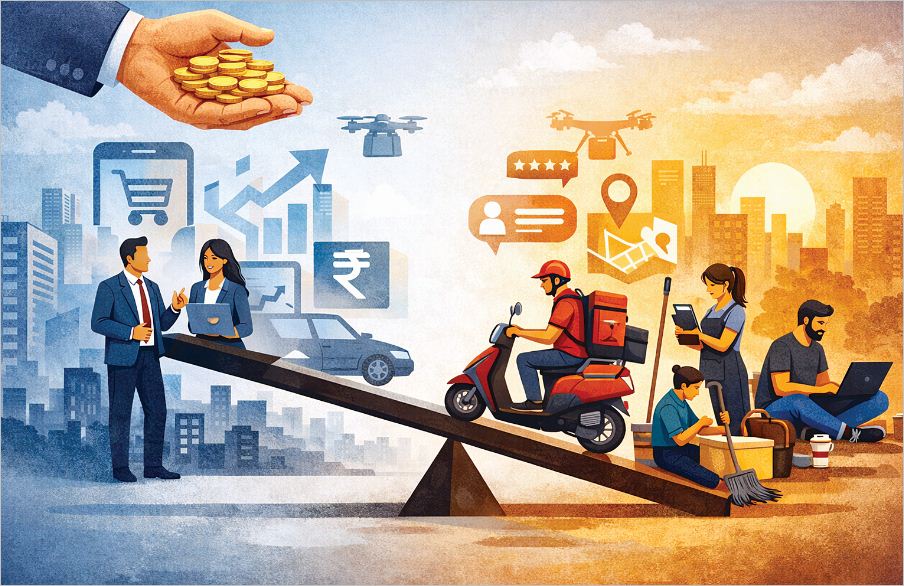
Charu Bhatia | Business Remedies | India’s platform economy has expanded at breakneck speed over the past decade. From food delivery and ride-hailing to home services and freelance marketplaces, digital platforms have reshaped how urban India works and consumes. For customers, the promise is convenience. For workers, it is flexibility and income access. For investors, it is scale. But as the ecosystem matures, a pressing question emerges: who truly benefits the most, the apps or the workers powering them?
India is estimated to have millions engaged in platform-based work, spanning delivery partners, drivers, beauty professionals, tutors and digital freelancers. For many, gig work offers a relatively low entry barrier compared to traditional employment. It provides earning opportunities without formal degrees and allows workers to log in and out based on availability. In Tier-2 and Tier-3 cities, platform jobs have become an accessible route to urban income mobility.
However, the economics tell a more layered story. Most platforms operate on commission-based models, taking a percentage of each transaction. As competition intensified in the early years, companies prioritised growth over profitability, backed by venture capital funding. Now, with investors pushing for sustainable margins, many platforms have recalibrated incentives, reduced bonuses and tightened payout structures. This shift has directly affected worker earnings.
Workers, meanwhile, bear several operational costs, fuel, vehicle maintenance, insurance and smartphones, which reduce net income. Algorithm-driven allocation systems determine order flow, surge pricing and visibility, leaving workers with limited negotiation power. Ratings and performance metrics further influence earnings stability. While top-performing partners can earn competitively, income volatility remains a key concern.
On the corporate side, leading platforms have moved closer to profitability, improved average order values and expanded into high-margin segments such as quick commerce and financial services. Data ownership, cross-selling opportunities and scale advantages strengthen their long-term business case. Public listings and rising valuations suggest investor confidence in the model’s durability.
Yet, the debate is not binary. Platforms have undeniably generated large-scale employment and formalised certain service sectors. The real tension lies in sustainability, ensuring worker welfare while maintaining business viability. Discussions around social security benefits, insurance coverage and credit access for gig workers are gaining momentum at policy levels.
India’s platform boom is far from over. But its next chapter will likely hinge on balancing profit with protection, redefining whether growth can be both scalable and equitable.