

Jaipur | Charu Bhatia | The global shift towards electrification is turning energy storage materials into one of the most powerful growth engines in the industrial economy. As countries accelerate renewable energy adoption, electric vehicle (EV) production, and grid modernisation, the materials that make batteries and storage systems possible are emerging as a multi-trillion-dollar business opportunity.
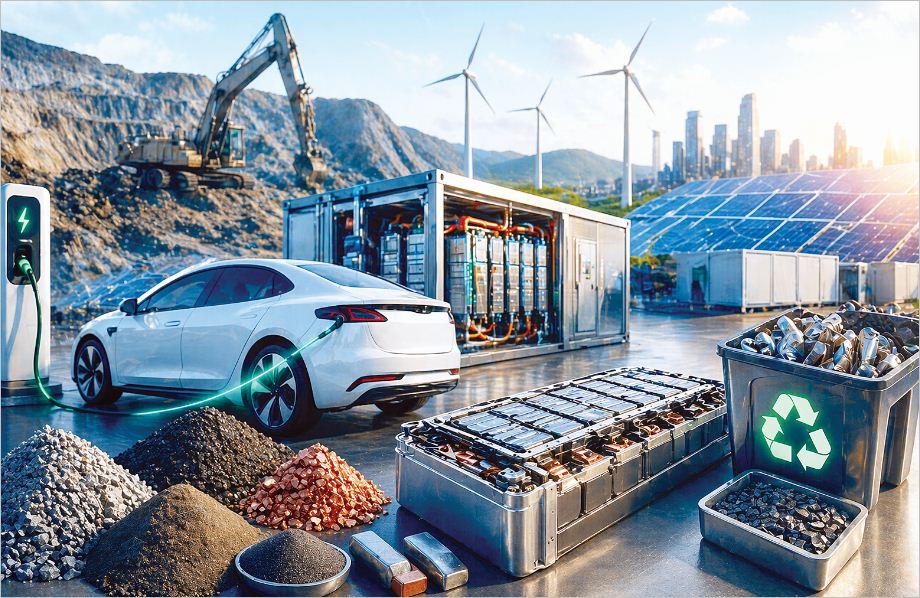
At the centre of this transformation are lithium-ion batteries, which rely on a complex supply chain of critical minerals such as lithium, nickel, cobalt, manganese, graphite, and copper. Demand for these materials is rising at unprecedented speed. EV adoption alone is projected to multiply battery demand several times over the next decade, while renewable energy projects increasingly require large-scale storage systems to manage intermittent solar and wind power.
This demand surge is reshaping global mining, refining, and materials manufacturing. Companies are investing heavily in securing long-term supplies of critical minerals, building gigafactories, and developing alternative battery chemistries that reduce reliance on scarce resources. Governments are also stepping in with incentives and strategic policies to build domestic battery supply chains, recognising energy storage as a matter of economic and national security.
The business opportunity extends beyond mining. The value chain spans advanced materials processing, cathode and anode manufacturing, battery recycling, and next-generation research. Cathode materials, often the most expensive component of a battery, are becoming a key battleground for innovation and investment. Meanwhile, graphite and silicon-based anodes are evolving to deliver higher energy density and faster charging times.
Another major growth area is stationary energy storage for power grids. As renewable energy expands, utilities are investing in massive battery storage facilities to stabilise electricity supply. This is creating demand for alternative chemistries such as sodium-ion, iron-air, and solid-state batteries, opening new opportunities for materials manufacturers beyond lithium.
Recycling is also emerging as a critical pillar of the industry. With millions of EV batteries expected to reach end-of-life in the coming years, recovering valuable materials like lithium, cobalt, and nickel is becoming both an environmental necessity and a profitable business segment. Companies that build efficient “closed-loop” recycling systems could gain a major competitive advantage.
However, the sector faces challenges, including geopolitical tensions over resource access, environmental concerns around mining, and the need to scale production sustainably. These pressures are accelerating innovation in alternative materials and supply chain diversification.
For the materials industry, energy storage represents a rare convergence of climate policy, technological innovation, and massive capital investment. As electrification reshapes transportation, power, and industry, the race to secure and innovate energy storage materials is poised to define the next era of global industrial growth.


