


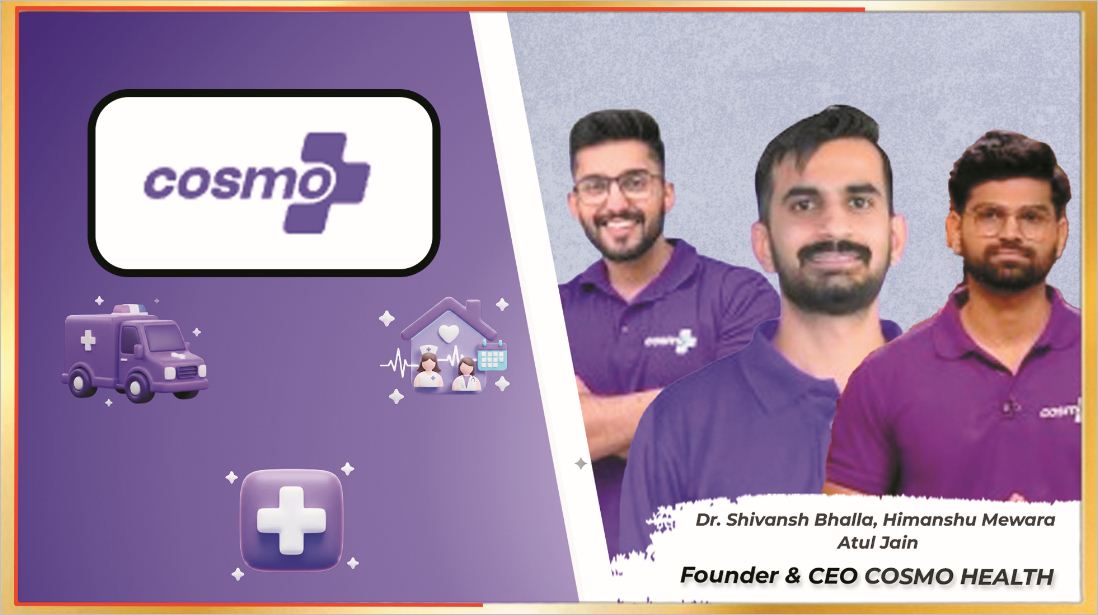
Jaipur | Rajshree Upadhyaya | Cosmo Health stepped into India’s healthcare landscape with a clear and urgent mission to bridge the dangerous time gap between a medical emergency and the arrival of help. Founded in July 2025 by Atul Jain, Dr. Shivansh Bhalla, and Himanshu Mewara, the startup was built around the idea that the biggest challenge in healthcare is not always treatment but timely access. Instead of competing with hospitals, the founders chose to solve the first and most critical layer of care, what happens before a patient even reaches a hospital.
The company introduced a community-first healthcare model, placing medical infrastructure directly inside residential societies. This meant that instead of waiting for ambulances to arrive from far-off locations, trained responders and emergency support could be accessed within minutes. Through its integrated platform, Cosmo Health offers emergency response services, ambulance support, doctor consultations, home nursing, and elderly care, creating a seamless healthcare ecosystem that operates at the neighborhood level. The approach was designed to make healthcare immediate, accessible, and coordinated rather than delayed and fragmented.
A defining feature of Cosmo Health is its 24×7 SOS system, which allows residents to trigger instant medical assistance through a single tap. Once activated, the alert is sent to on-ground medical staff, nearby residents, and emergency contacts simultaneously, ensuring that help begins even before professionals arrive. This network-driven response system transforms residential societies into active healthcare units, where the first few minutes of an emergency are managed efficiently, often determining better outcomes for patients.
When the founders appeared on Shark Tank India Season 5 in early 2026, they brought forward not just a business idea but a solution deeply rooted in real-world urgency. At the time of their pitch, the startup had already onboarded more than 7,000 families across cities like Hyderabad and Ludhiana and had handled over 1,000 medical requests within just a few months of operations. This early traction highlighted both the demand for such a service and the scalability of the model in urban India.
The founders entered the tank seeking Rs. 1 crore for 4 percent equity, valuing the company at Rs. 25 crore. After detailed discussions around execution challenges and scalability, they secured a deal of Rs. 1 crore for 9 percent equity from Anupam Mittal, Kanika Tekriwal, and Kunal Bahl, bringing the valuation to approximately Rs. 11.11 crore. The deal reflected investor confidence in a model that addresses a real and pressing gap in India’s healthcare system.
Cosmo Health operates on a subscription-based model, partnering with residential welfare associations and real estate developers instead of targeting individuals directly. Societies pay a monthly fee per family, generally in the range of Rs. 99 to Rs. 299, making the service both affordable and scalable. This B2B2C structure allows the company to achieve rapid adoption across entire communities while ensuring consistent engagement and predictable revenue.
Beyond emergency care, the brand has steadily positioned itself as a long-term healthcare partner by offering routine health checkups, first aid assistance, and preventive care services. This dual focus on prevention and response strengthens its value proposition, especially in a country where healthcare is often reactive rather than proactive. By embedding healthcare into everyday living spaces, Cosmo Health is redefining how people interact with medical services.
As of now, Cosmo Health is operational and actively expanding its presence across multiple cities, continuing to onboard residential societies and strengthen its on-ground infrastructure. From its establishment in 2025 to gaining national visibility on Shark Tank India within months, the company’s journey reflects both the urgency of the problem it addresses and the effectiveness of its solution. In a system where delays can cost lives, Cosmo Health is quietly building a faster, decentralized healthcare network that brings immediate medical support closer to where people live, turning residential communities into the first line of defense in emergencies.
 Written & Edited By:
Rajshree Upadhyaya