

Devendra Fadnavis and the quiet arithmetic of perseverance
By Dr. Manoj Pochat
Jaipur | BR Team
In the Bhagavad Gita, Sri Krishna offers a definition of excellence that has outlived every empire: योगः कर्मसु कौशलम् If one were to search contemporary Bhartiya public life for a leader who embodies that verse without ever quoting it about himself, the search would end in Nagpur, at the doorstep of Devendra Gangadharrao Fadnavis.
His is not a story of oratory. Maharashtra has had louder voices. It is a story of a man who, at every stage of a thirty-four-year public life, let the ledger of work speak and who, when the ledger was snatched from his hands, quietly opened a new one.
The Nagpur apprenticeship
The temperament was forged early. In 1975, when the Emergency put his father Gangadharrao a Jan Sangh legislator behind bars, a five-year-old Devendra refused to attend a school named after the Prime Minister who had jailed him. It was a child’s protest, but it revealed the grain of the wood: conviction held quietly, acted upon firmly.
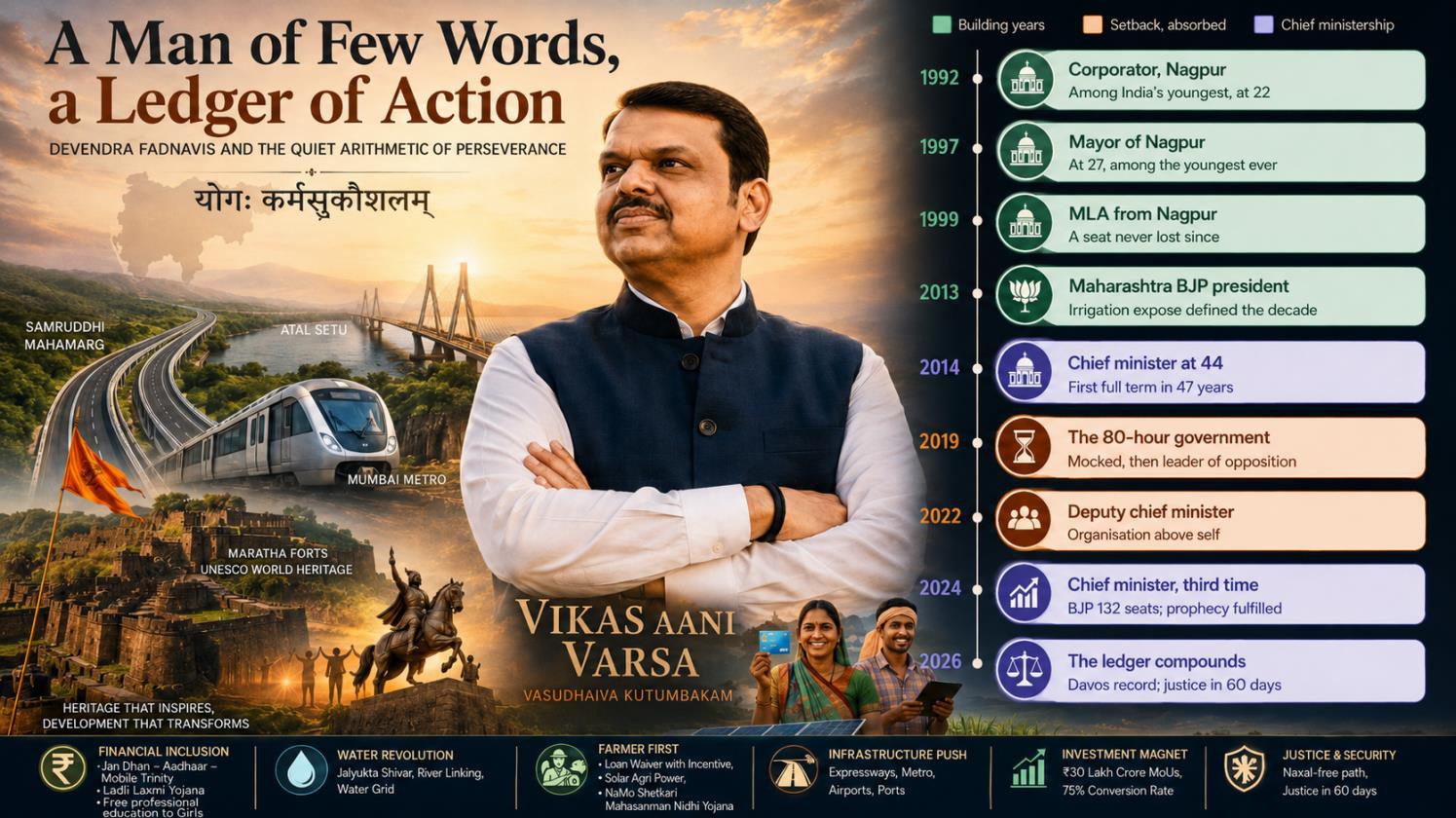
The Sangh(RSS) Shakha gave that conviction structure and gave him something rarer: a civilisational compass. Nagpur, after all, is not merely a city; it is the sanctum of the Sangh, and the boy who grew up in its discipline absorbed early the idea that politics is only the outer courtyard of a deeper temple the rebuilding of a civilisation’s self-respect. In 1992, at twenty-two, he entered the Nagpur Municipal Corporation as one of Bharat’s youngest corporators. Five years later, at twenty-seven, he became one of the youngest Mayors in the country’s history. Those who expect ceremonial mayors misread the man. He treated the municipal file as seriously as a state budget sanitation, urban finance, civic accountability. The corporator years taught him what no Lutyens apprenticeship can: that governance is ultimately about the water connection, the property tax record, the streetlight that works.
In 1999 he entered the Legislative Assembly from Nagpur West, later Nagpur South West a seat he has never lost since. By 2003, the Commonwealth Parliamentary Association’s Maharashtra branch had named him the state’s outstanding parliamentarian.
The opposition years: homework as politics
Through the 2000s and early 2010s, Fadnavis built a reputation as the opposition benches’ most forensic mind. The irrigation scam exposé was his signature thousands of pages of documentation, not a single unsubstantiated allegation. When the party made him Maharashtra BJP president in 2013, it was recognition of a simple fact: here was a leader who did his homework while others did their theatre.
The 2014 sweep that followed made him, at forty-four, the second-youngest Chief Minister in Maharashtra’s history and the first from the BJP. Many predicted the Brahmin from Vidarbha would not survive the Maratha-dominated politics of the state. He served the full five years the first CM to complete an uninterrupted term since Vasantrao Naik Ji.
The first term: infrastructure as ideology
What did those five years produce? The Samruddhi Mahamarg 701 kilometres from Nagpur to Mumbai was not merely announced but financed, land-acquired and driven; it has since collapsed a sixteen-hour journey to eight and stitched Vidarbha and Marathwada into the state’s economic mainstream. The Mumbai Metro’s expansion, the Coastal Road, the Mumbai Trans Harbour Link, the Mumbai-Pune Connecting Link, the Navi Mumbai airport push, the systematic squeezing of Naxalism in Gadchiroli each was seeded or accelerated in this period.
The pattern is worth naming: for Fadnavis, infrastructure is not a photo opportunity. It is ideology made concrete the belief that a civilisation renews itself by building.
The first term also brought his quietest test. On January 1, 2018, violence around Bhima Koregaon threatened to tear open the state’s oldest fault line caste against caste, community against community. A lesser government would have reached for the theatrical response; his read the violence as engineered rather than spontaneous, pursued the Elgar Parishad investigation into the machinery behind it, and this is the part history should record restored the sanctity of the commemoration itself. Every New Year’s Day since, lakhs pay homage at the Vijay Stambh in peace, under an administrative bandobast so thorough it makes no news at all.
Water: a million small dams instead of one big one
Maharashtra’s tragedy has always been arithmetic: 40 percent of the country’s large dams, yet among its lowest irrigation coverage. Fadnavis inverted the model. Jalyukta Shivar did not build one grand reservoir; it built lakhs of small ones deepened streams, farm ponds, cement bunds across more than sixteen thousand drought-prone villages, decentralising water the way the shakha decentralises character-building: village by village, hand by hand. Magel Tyala Shettale ‘a farm pond to whoever asks’ exceeded its own target. And in his current term the vision has scaled from the village tank to the river basin: the Wainganga–Nalganga river-linking project, sanctioned at over ₹88,000 crore, will carry Vidarbha’s surplus monsoon water to its parched cotton belt the largest such intervention in the region’s history while the Marathwada Water Grid and the Nar-Par-Girna link address the two thirstiest quadrants of the state. No Chief Minister before him treated drought as an engineering problem with a deadline.
The farmer’s ledger
The numbers here deserve to be read slowly. In 2017, the Chhatrapati Shivaji Maharaj Shetkari Sanman Yojana wrote off over Rs. 34,000 crore for 89 lakh farming families at the time the largest farm relief in the state’s history. Double support for Maharashtra’s farmers! Under PM-KISAN and Namo Shetkari Maha Samman Nidhi, eligible farmers receive Rs.12,000 annually Rs. 6,000 from the Centre & Rs. 6,000 from the MH Gov. In the 2026–27 budget, presented by Fadnavis himself as Finance Minister, the Punyashlok Ahilyadevi Holkar Shetkari Karjmafi Yojana waived crop loans of up to Rs.2 lakh and, in a first that quietly corrects a moral distortion of every loan waiver ever announced in Bharat, gave a ₹50,000 incentive to farmers who repaid honestly. For decades, the diligent farmer subsidised the defaulter; Fadnavis is the first Chief Minister to reward discipline alongside relief. Add to this the solar agriculture feeders delivering daytime power to the farm, and the direction is unmistakable: from the politics of the farmer’s grievance to the economics of the farmer’s balance sheet.
The tightrope no Chief Minister had walked
Every Maharashtra Chief Minister for four decades inherited the same unexploded shell: the Maratha demand for reservation, pressing against the OBC’s fear of dilution. Most chose the oldest trick in politics appoint a committee, outlast the agitation, pass the shell to a successor. Fadnavis chose to defuse it. In 2018, his government passed the Maratha reservation law with rigorous backward-classes documentation and it did what almost no quota law in Bharat manages: it survived the High Court. When the Supreme Court later struck it down on the 50-per-cent ceiling, the Mahayuti government returned in 2024 with the 10 per cent SEBC Act, drafted to answer the court’s specific objections reservation for Marathas without subtracting a single percentage point from the OBC pool.
Then came September 2025, when the agitation arrived at Mumbai’s Azad Maidan and the state held its breath. Recall how such confrontations have ended elsewhere lathis, bullets, burnt buses, curfew. In Maharashtra: five days of negotiation, a Government Resolution operationalising the 1918 Hyderabad Gazette so that Marathwada’s Marathas with documented Kunbi lineage could claim certificates through an evidence-based committee and the crowd went home peacefully. Not one OBC entitlement was touched; Fadnavis said so on the floor of the House and to OBC leaders directly. The courts will have the final word, as they must in a constitutional republic. But consider the political physics: a Brahmin Chief Minister, in a Maratha-dominant polity, absorbing the entire heat of the state’s most emotive agitation his two Maratha allies conspicuously quiet and resolving it without a single life lost. No Chief Minister at this scale, holding both scales — Maratha aspiration in one pan, OBC protection in the other has kept the beam level. That is not management. That is statecraft.
The investment magnet
At Davos in January 2026, Maharashtra signed MoUs worth Rs. 14.5 lakh crore on Day One nearly matching what the entire previous year’s summit had yielded and closed at roughly Rs. 30 lakh crore, about $360 billion. To grasp that figure: it approaches five times Maharashtra’s own annual budget, committed in seventy-two hours. And this is not the usual MoU theatre 83 per cent of it is foreign direct investment from 18 countries, and the state’s conversion rate on the previous year’s agreements stands at 75 percent, a number industry veterans regard as the real headline. The projected yield: thirty to forty lakh jobs over the decade.
Look at the geography of it, because that is where the Fadnavis signature lies. Bharat’s first Innovation City with the Tata Group near Mumbai; a Rs. 1 lakh crore hyperscale data-centre park; the Raigad-Pen Growth Centre; Rs. 55,000 crore for Chhatrapati Sambhajinagar; Rs. 50,000 crore across Nashik, Jalgaon and Ahilyanagar; Rs. 2.7 lakh crore for Nagpur and Vidarbha including ArcelorMittal’s Rs. 1.1 lakh crore green steel plant in Gadchiroli. Read that last sentence again: Gadchiroli, which a decade ago made news only for landmines, is becoming a steel city. Under his sustained anti-Naxal campaign, the district stands at the threshold of being declared Naxal-free and Fadnavis’s answer to extremism was never merely the rifle; it was the blast furnace, the mine lease, the salary slip. Maharashtra today is the GST capital of Bharat and is racing to become the country’s first trillion-dollar state economy.
The civilisational thread
Running beneath every role he has held is a conviction he has never hidden and never weaponised: that Maharashtra’s development is incomplete without the recovery of its civilisational self-respect. He has said it plainly he is a proud Hindu and then done what proud men of substance do: worked, rather than shouted. Consider the record. Aurangabad is now Chhatrapati Sambhajinagar; Osmanabad is Dharashiv; Ahmednagar is Ahilyanagar cities that for centuries carried the names of those who subjugated this soil now carry the names of the son of Shivaji who chose death over conversion, and of the queen who rebuilt Kashi Vishwanath. The Prime Minister’s panch pran asked Bharat to shed every last symbol of the slave mentality; Maharashtra, under Fadnavis’s stewardship, answered on its own map.
The forts tell the same story. For decades, the gads and killas of the Swarajya the stone diary of Shivaji Maharaj’s revolution were left to crumble beneath neglect and illegal encroachment of every description. His government ordered the unauthorised structures removed, fort by fort, under due process of law, and poured resources into conservation and in July 2025 came the vindication no propaganda can purchase: the Maratha Military Landscapes, twelve of those forts, inscribed by UNESCO as a World Heritage of humanity. What encroachment had disfigured, the world now venerates. Add the grand memorial rising for Chhatrapati Shivaji Maharaj, the state’s embrace of Shivsrushti, the preparations for the Nashik Simhastha Kumbh, and the pattern is unmistakable: heritage, for Fadnavis, is not nostalgia. It is infrastructure of the soul and he builds it with the same DPRs and deadlines as an expressway.
The same clarity extends to the ideology that has bled Maharashtra for half a century. Having strangled armed Naxalism in Gadchiroli’s forests, he turned to its urban bloodstream: in July 2025, as Chief Minister and Home Minister, he piloted the Maharashtra Special Public Security Act through both Houses after a joint select committee sifted more than twelve thousand public submissions to proscribe the frontal organisations of Left-Wing Extremism that recruit in seminar halls what they can no longer recruit in jungles. And note the restraint that separates conviction from vendetta: he assured the House, on record, that the law targets those who seek to overthrow the Constitution. But the essential fact stands: the first Chief Minister to fight Naxalism simultaneously in the forest, in the city, and in the mind and to pair every ban with a blast furnace, every FIR in Gadchiroli with a job there. He is a staunch Hindu leader without a decibel of jingoism: his Hindutva renames, restores, conserves and builds.
The Home Ministry: justice at the speed of sixty days
He holds the Home portfolio too, and there the method is identical: no thunder, only machinery. The Nasrapur case will be taught in police academies. On May 1, 2026, the rape and murder of a three-and-a-half-year-old girl in Nasrapur, in Pune district’s Bhor taluka, convulsed Maharashtra. Now watch the clock, because the clock is the story. Arrest: the very next day. Chargesheet — 1,200 pages: fifteen days. Fifty-five witnesses examined: sixteen days. Conviction and death sentence by the special court: within sixty days of the crime, under day-to-day hearings ordered directly by the Chief Minister who is also Home Minister. Set that against the national norm to feel its weight: in a country where serious trials routinely stretch across a decade where ‘tareekh pe tareekh’ is a punchline Maharashtra delivered the gallows verdict for a child’s killer before the season changed. It stands among the fastest-concluded serious-crime trials in the Republic’s history, and it converted a phrase into a standard: justice in sixty days.
When the murder of young entrepreneur Ketan Agarwal at Lohagad fort stunned the state weeks later, the same reflex appeared: Fadnavis met the grieving father and, in that very meeting, sanctioned a fast-track court and directed the appointment of the country’s most formidable special public prosecutor, Ujjwal Nikam. But listen to what he said in that moment, because it reveals the governing mind: this, he told the state, must be seen not merely as a crime but as a summons to social introspection why are children of educated, settled homes developing such destructive instincts? A Home Minister who reads crime sociologically, not only just forensically, is a rarity in any state. And here sits the core of his philosophy of justice: speed without vigilantism. No glorification of encounters, no punishment before trial, evidence, testimony, argument, verdict, everything inside the Constitution’s framework, merely at a velocity the framework had forgotten it possessed. That fidelity to natural justice, without a gram of jingoism, is what keeps the applause democratic rather than dangerous and the accused in the Agarwal case will get exactly the fair, fast trial the Constitution promises, which is precisely the point.
The same ministry is prosecuting a systematic war on two fronts: narcotics and crimes against women. Drug factories dismantled, distribution chains ripped out at the root, the harshest provisions of law reserved for those tightening this noose around a young generation the campaign runs statewide and unsentimentally. The message to Maharashtra is spare and cold: touch a daughter of this state, and the machinery can walk you from crime to gallows in sixty days.
Fulfilling the Prime Minister’s dream
None of this is happening in isolation, and Fadnavis would be the first to say so. There is, at the centre of his public life, a relationship that explains almost everything else: the bond between a karyakarta and his leader. When Prime Minister Narendra Modi articulated Viksit Bharat 2047 a developed Bharat by the centenary of independence he set every CM a question: what is your share of the dream? Most answered with speeches. Fadnavis answered with a spreadsheet. His Viksit Maharashtra roadmap begins from a piece of arithmetic he repeats in every investor room from Mumbai to Davos: Maharashtra contributes roughly one-seventh of Bharat’s GDP, leads the nation in GST collections & in foreign direct investment. Therefore and this is the sentence on which his entire third term rests Bharat cannot become a five-trillion-dollar economy unless Maharashtra becomes a one-trillion-dollar economy first. The Prime Minister’s national target is not, for Fadnavis, a slogan to be garlanded; it is a work-order to be executed, and Maharashtra is its largest line item.
Watch how methodically he is retiring that work-order. The ₹30 lakh crore Davos harvest is not trophy hunting; it is the capital formation a trillion-dollar economy requires. The 21 per cent jump in capital expenditure in his own budget is the state’s matching contribution. Every national mission finds its Maharashtra multiplier: Make in Bharat finds Magnetic Maharashtra; PM Gati Shakti finds the Samruddhi Mahamarg, the Atal Setu and the new Navi Mumbai International Airport inaugurated by the Prime Minister himself; the national renewable push finds Maharashtra’s pledge of 52 per cent clean electricity by 2030; Digital Bharat finds the subcontinent’s data-centre capital rising on Maharashtra’s soil; the Prime Minister’s insistence on Antyodaya the last person first finds the Ladki Bahin transfers reaching crores of women every month, Gadchiroli’s tribal youth on industrial payrolls, and Mumbai’s mill workers holding house keys. Point to any chapter of the Prime Minister’s national manifesto, and Fadnavis has already opened the Maharashtra annexure.
And here lies the quality rarest in Bhartiya politics: he labours to make his leader successful, not to succeed his leader. His energy flows in one direction downward into Maharashtra’s soil, so that the harvest may be credited upward to the national cause. The Prime Minister, in turn, trusts him: visible at many occasions. This is the Sangh’s oldest teaching rendered in modern governance the individual dissolving into the mission. One man dreams for Bharat; the other, asking nothing for himself, builds the dream’s largest room.
The wilderness: 2019–2022
Then came November 2019 the moment that would have broken a lesser politician. The people of Maharastra gave mandate for Mahayuti; the chair was denied by a partner of twenty-five years. The early-morning oath with Ajit Pawar lasted barely eighty hours before Fadnavis resigned rather than preside over instability. His words in the campaign mi punha yein, I will return became the punchline of a thousand jibes.
He absorbed the mockery in silence. That silence is the most misunderstood chapter of his career. As Leader of Opposition from 2019 to 2022, he did not sulk; he worked. He held the government to account session after session, kept the party organisation battle-ready, and delivered Bihar for the NDA as election in-charge in 2020. The wilderness, for him, was simply another posting.
The discipline test
June 2022 brought vindication and then a test few saw coming. When Eknath Shinde walked out of the Shiv Sena with the majority of its legislators, everyone assumed Fadnavis would reclaim the Chief Ministership. Instead, the party asked him to serve as Deputy under Shinde a man who had been a minister in his own 2014 cabinet. He had announced he would stay out of government altogether; within hours, on the party president’s public request, he accepted the number-two chair.
Commentators called it a demotion. Swayamsevaks recognised it as something else: sanghatan above self. For two and a half years he carried Home and later Finance, kept the Mahayuti machinery humming, and in July 2023 widened the coalition when Ajit Pawar crossed over with the larger faction of the NCP.
The return
The 2024 Lok Sabha results in Maharashtra were a setback, and Fadnavis did what accountable leaders do he offered to step aside. The party refused, and he answered the only way he knows: with work. Five months later, the Mahayuti swept the Assembly elections with a mandate of historic proportions, the BJP alone winning 132 seats. On 5 December 2024, at Azad Maidan, with the Prime Minister in attendance, he took oath as Chief Minister for the third time. Mi punha yein was no longer a jibe. It was a prophecy fulfilled without a single bitter word spent on those who had mocked it.
The present tense
The third term has carried grief alongside ambition. When tragedy struck in January 2026 the plane crash near Baramati that took Deputy Chief Minister Ajit Pawar it was Fadnavis’s steady hand that held the government and the state’s composure together, honouring a colleague and friend, declaring state mourning, and assuring a grieving Maharashtra of a full and impartial investigation. Even sorrow, in his hands, was administered with dignity.
The verse he lives
Politics rewards noise; history rewards endurance. Devendra Fadnavis has been corporator, Mayor, legislator, party president, Chief Minister, Leader of Opposition, Deputy Chief Minister and Chief Minister again perhaps the only Bharatiya politician to have travelled that entire arc, twice climbing back from positions others considered humiliations. Through it all: no theatrics, no victimhood, no vendetta. A man who renamed cities without a riot, resolved agitations without a bullet and built temples and expressways from the same table. Only the calm of a man who believes the work will speak.
कर्मण्येवाधिकारस्ते मा फलेषु कदाचन your right is to action alone, never to its fruits. Most politicians quote the verse. Very few have been forced by circumstance to live it, twice over, in the full glare of public ridicule and emerged with both their equanimity and their state stronger.
That, finally, is the measure of the man of few words: his actions have never needed a spokesperson.
The writer is Co-founder and Chairman of Sakar Robotics Pvt. Ltd., Pune, and Convenor of PuneSamvad. Views are personal.