

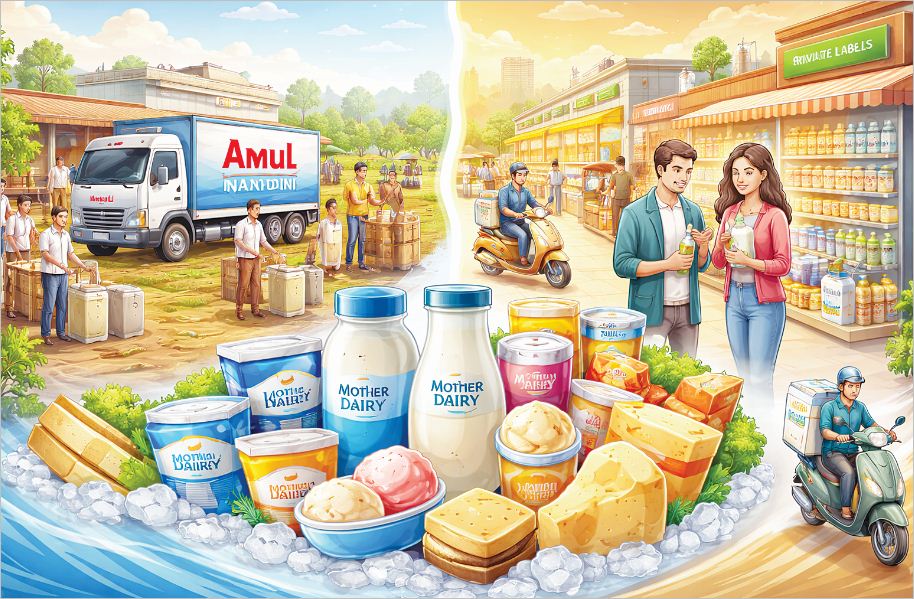
Charu Bhatia | Jaipur | Business Remedies | India’s dairy industry, the world’s largest by milk production, is entering a new competitive phase. For decades, cooperative giants such as Amul, Mother Dairy and Nandini have dominated the market, building trust through farmer-led models and strong distribution networks. But the rapid rise of private labels and retail-led dairy brands is reshaping the competitive landscape, setting up a high-stakes battle for the next decade.
Cooperatives still enjoy a powerful advantage: scale and trust. Built on farmer networks and backed by decades of brand loyalty, they have deep penetration across urban and rural markets. Their strength lies in affordability, wide distribution and the ability to stabilise milk procurement prices for farmers. This structure has helped cooperatives maintain a stronghold over staple products like milk, butter and curd.
However, the market is changing as private dairy brands and retailer-owned labels expand aggressively. Supermarket chains and quick-commerce platforms are launching in-house dairy products that compete on pricing and convenience. With direct access to consumer data, these players can quickly adapt to demand, experiment with smaller batches and launch niche products faster than traditional cooperatives.
The real battleground is shifting towards value-added dairy products. Segments such as cheese, yogurt, lactose-free milk, high-protein beverages and premium ice creams are growing far faster than liquid milk sales. Private brands are capitalising on this trend by positioning themselves as premium, innovative and health-focused. Their ability to target urban consumers with specialised offerings gives them a strong edge in higher-margin categories.
Technology is another factor reshaping the competition. Private players are investing heavily in supply-chain analytics, cold-chain logistics and direct-to-consumer delivery models. Subscription milk services and app-based ordering are reviving the traditional “milkman” model in digital form, allowing new entrants to bypass conventional distribution barriers.
That said, cooperative giants are far from passive observers. Many have begun expanding their premium portfolios, investing in automation and launching direct-to-consumer channels. Their vast procurement networks and strong farmer relationships remain difficult for new entrants to replicate, giving them resilience in a price-sensitive market.
The next decade is unlikely to produce a single winner. Instead, the industry may split into two parallel growth tracks. Cooperatives are expected to retain dominance in staple dairy products and rural markets, while private labels could gain ground in premium, niche and urban segments.
For consumers, this competition is likely to bring more choice, innovation and better pricing. For the dairy industry, it signals a transformation from a largely commodity-driven sector into a dynamic, brand-driven marketplace where both legacy giants and agile newcomers will shape the future.