

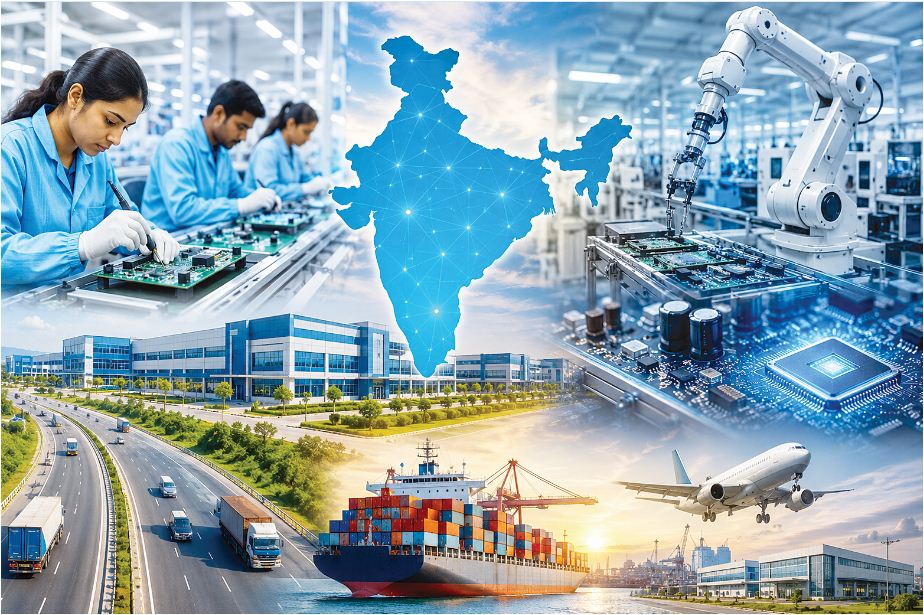
Jaipur | Charu Bhatia | India’s electronics manufacturing sector is emerging as a major catalyst for industrial development, reshaping the country’s economic landscape through the creation of new manufacturing corridors and production clusters. Supported by government incentives, rising domestic demand, and growing global interest in diversifying supply chains, the sector is attracting significant investments and generating employment opportunities across multiple regions. Over the past few years, India has witnessed a surge in investments in electronics production, particularly in smartphones, consumer electronics, components, semiconductors, and telecom equipment. This growth has encouraged the development of dedicated industrial corridors and manufacturing hubs in states such as Uttar Pradesh, Tamil Nadu, Karnataka, Andhra Pradesh, Gujarat, and Maharashtra.
One of the key drivers behind this transformation is the Production Linked Incentive (PLI) scheme, which has encouraged both domestic and international companies to expand their manufacturing presence in India. Global brands and contract manufacturers have established large-scale facilities, creating integrated ecosystems that support production, logistics, warehousing, and ancillary industries.
These emerging industrial corridors are doing more than just housing factories. They are becoming comprehensive economic zones that attract suppliers, component manufacturers, research centres, and service providers. As a result, entire regional economies are benefiting from increased investment, infrastructure development, and job creation. The expansion of electronics manufacturing is also improving connectivity and logistics infrastructure. Governments are investing in highways, freight corridors, airports, and industrial parks to facilitate the smooth movement of goods and raw materials. This enhanced infrastructure is helping businesses reduce costs and improve operational efficiency, making India a more competitive manufacturing destination.
Employment generation remains another significant benefit. Electronics manufacturing facilities require a diverse workforce ranging from assembly-line operators and technicians to engineers and research professionals. The growth of industrial corridors is creating opportunities for skill development and vocational training, enabling local communities to participate in the sector’s expansion.
Furthermore, the rise of electronics manufacturing hubs is supporting India’s ambition to become a global export powerhouse. As companies increase production capacity, exports of smartphones, consumer electronics, and electronic components continue to grow, strengthening the country’s position in international supply chains. Industry experts believe that the next phase of growth will focus on deepening the domestic component ecosystem, encouraging innovation, and attracting investments in advanced technologies such as semiconductors, artificial intelligence-enabled devices, and smart manufacturing. As electronics manufacturing continues to expand, new industrial corridors are emerging as engines of economic growth, fostering regional development and reinforcing India’s aspirations of becoming a global manufacturing and technology hub.