
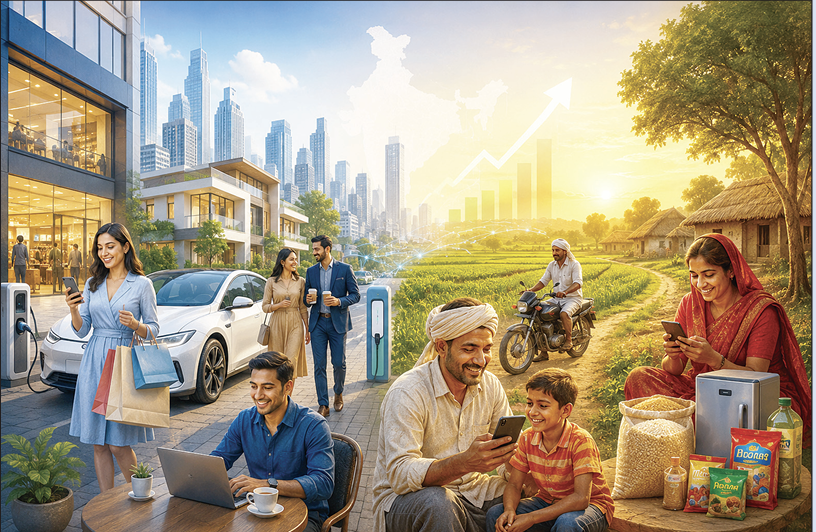
Jaipur | Charu Bhatia | Consumer spending has long been one of the strongest pillars of India’s economy, contributing nearly 60% to the country’s Gross Domestic Product (GDP). But in recent years, the country’s consumption story has become more nuanced. Instead of moving in one direction, urban and rural markets are displaying distinct spending patterns that offer valuable insights into the health of the economy and the opportunities ahead for businesses. Urban India continues to be driven by premiumisation. Consumers in cities are increasingly spending on experiences, technology, branded products, electric vehicles, premium housing and financial services. Higher disposable incomes, digital adoption and easier access to credit have encouraged spending on lifestyle upgrades rather than just essential goods. Sectors such as travel, luxury retail, food delivery and organised retail have benefited from this shift.
In contrast, rural India is witnessing a gradual recovery after facing challenges from inflation, erratic weather and rising input costs. Improved agricultural output, higher government spending on rural infrastructure, and stronger wage growth are helping restore purchasing power in many regions. Demand for two-wheelers, affordable smartphones, consumer durables and fast-moving consumer goods (FMCG) is beginning to improve, indicating renewed confidence among rural households. This divergence has prompted businesses to adopt differentiated strategies. While premium brands continue to target affluent urban consumers with high-value products, companies are also expanding affordable product portfolios for smaller towns and villages. Many FMCG firms are introducing low-unit packs, while automobile manufacturers are tailoring offerings to suit varying income segments.
Digital connectivity is also narrowing the gap between urban and rural consumption. The widespread adoption of smartphones, affordable internet and UPI-based payments has enabled consumers in Tier-2, Tier-3 and rural markets to access e-commerce platforms, digital banking and online services more easily than ever before. This has opened new growth avenues for retailers, fintech companies and consumer brands.
At the same time, economists caution that consumption growth remains uneven. Inflation, employment trends and borrowing costs continue to influence household spending decisions. While urban demand has remained relatively resilient, sustaining rural consumption will require continued investment in agriculture, job creation and infrastructure development. Looking ahead, India’s consumption landscape is expected to become increasingly diverse rather than uniform. Businesses that understand regional preferences, income variations and evolving consumer aspirations are likely to be better positioned for long-term growth. Ultimately, the contrast between urban aspiration and rural resilience tells an important story about India’s economy. Together, these markets are shaping the country’s next phase of growth, making consumption not just an economic indicator but a reflection of changing lifestyles, rising ambitions and expanding opportunities across the nation.