


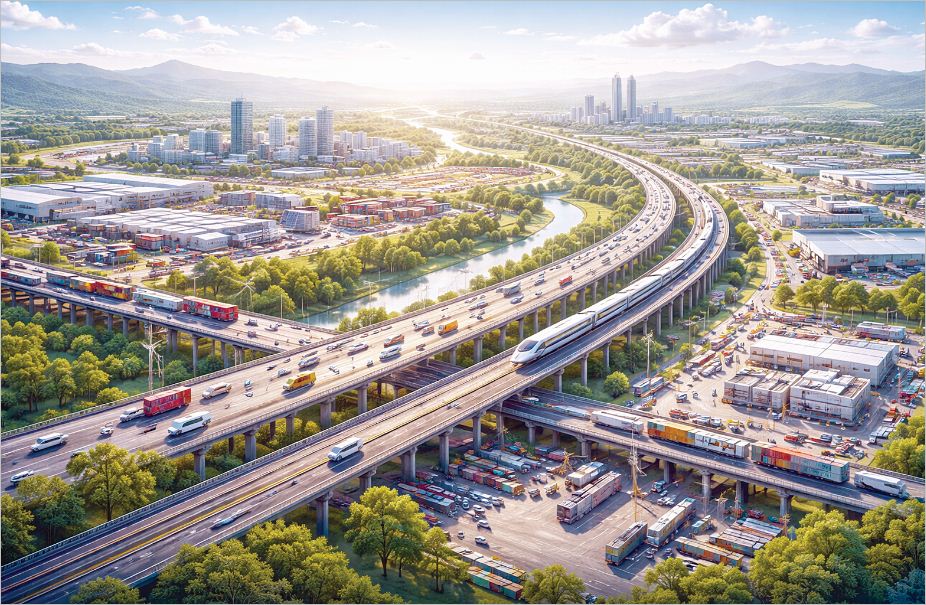
Jaipur | Charu Bhatia | Business Remedies | Across emerging and developed economies, governments are accelerating investments in mega infrastructure corridors to boost economic growth, improve logistics efficiency and attract private capital. These large-scale projects, spanning highways, rail networks, industrial zones and freight corridors, are increasingly becoming a cornerstone of long-term development strategies.
Infrastructure corridors are designed to connect major economic hubs, ports, manufacturing clusters and urban centres through integrated transport and logistics networks. By reducing travel time and lowering freight costs, these corridors aim to improve supply chain efficiency and enhance regional competitiveness. For businesses, the shift signals new opportunities across construction, real estate, logistics and manufacturing.
A major driver behind this push is the growing need to strengthen domestic supply chains following years of global disruptions. Governments are prioritising resilient infrastructure to reduce dependency on distant production hubs and support local manufacturing ecosystems. Integrated corridors make it easier to move raw materials, finished goods and labour efficiently across regions, helping industries operate at scale.
For the construction sector, mega corridors represent a long pipeline of projects ranging from highways and rail lines to industrial parks, warehousing hubs and urban townships. Contractors, engineering firms and material suppliers are likely to benefit from sustained demand as multi-year infrastructure programmes move from planning to execution.
Real estate development is also closely tied to corridor growth. Areas along new transport routes often witness a surge in demand for logistics parks, data centres, residential projects and commercial spaces. Investors are increasingly viewing corridor-linked locations as long-term growth zones, particularly as businesses seek proximity to faster transport networks.
Private sector participation is becoming central to financing these ambitious initiatives. Public-private partnership models, infrastructure investment trusts and global institutional funding are playing a growing role in bridging funding gaps. For investors, infrastructure corridors offer relatively stable, long-term returns backed by government support and rising demand for modern logistics.
Technology is another defining element of new corridor projects. Smart traffic systems, digital tolling, real-time freight tracking and sustainable construction practices are becoming standard features. Governments are also emphasising green infrastructure, with a focus on reducing emissions through electrified transport and energy-efficient design.
However, challenges remain. Land acquisition, environmental clearances and project financing can slow implementation timelines. Ensuring coordination across multiple agencies and states is also critical to maintaining momentum.
Despite these hurdles, the long-term outlook remains strong. Mega infrastructure corridors are reshaping how goods, people and capital move across regions, creating new business opportunities and accelerating urbanisation. For the construction and infrastructure industry, the government-led push marks a defining trend that will shape investment and growth for decades.


