
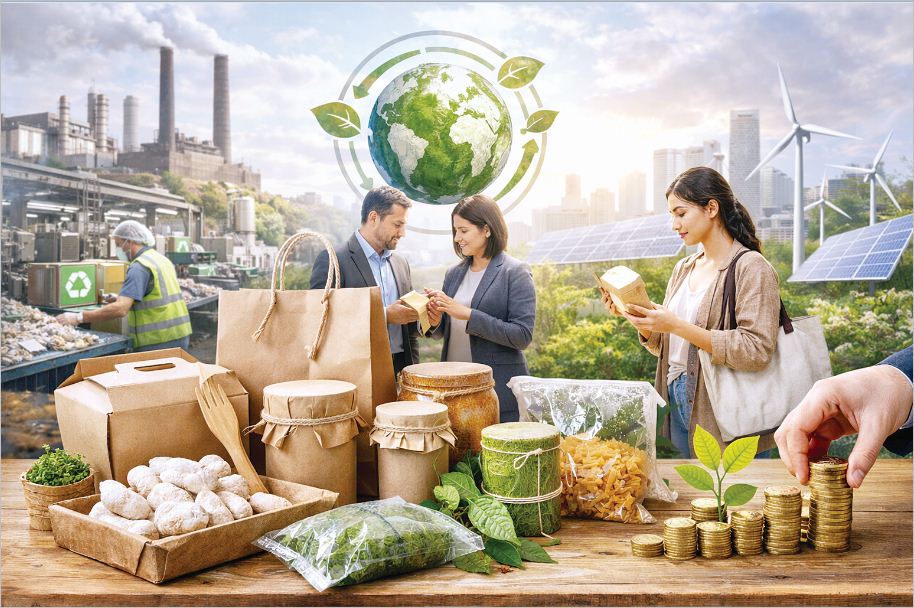
Charu Bhatia | Jaipur | Business Remedies | As regulatory scrutiny tightens and consumers grow more climate-conscious, sustainable packaging has moved from being a niche branding exercise to a boardroom priority. The question for businesses in 2026 is no longer whether to adopt eco-friendly packaging, but whether it represents a financial strain or a long-term strategic advantage.
Rising Compliance Pressure
India’s Extended Producer Responsibility (EPR) norms and global sustainability benchmarks are pushing companies to reduce plastic usage, increase recyclability and disclose environmental impact. For FMCG, e-commerce and food delivery platforms, packaging accounts for a significant share of waste generation. Non-compliance now risks penalties, reputational damage and supply chain disruptions.
However, transitioning to biodegradable materials, recycled plastics or innovative alternatives such as mushroom-based or seaweed packaging involves higher upfront costs. Industry estimates suggest sustainable materials can be 15-40% more expensive than conventional plastic, depending on scale and sourcing.
The Cost Equation
For small and mid-sized enterprises, these costs can strain margins already pressured by inflation, logistics expenses and volatile commodity prices. Supply chain realignment, vendor audits and redesign investments further add to capital expenditure. Yet, cost comparisons often ignore long-term savings. Lightweight packaging reduces freight expenses. Recyclable designs lower waste management liabilities. Bulk procurement and scaling gradually reduce per-unit cost. Companies investing early may also benefit from policy incentives and tax credits as governments encourage green manufacturing.
Consumer Shift and Premiumisation
Perhaps, the most significant shift is on the demand side. Urban Indian consumers, particularly Gen Z and millennials, increasingly associate sustainability with quality and responsibility. Surveys indicate that a growing segment is willing to pay a premium for environmentally responsible brands.
This trend is visible across sectors, from personal care brands advertising refill packs to D2C startups building entire identities around zero-waste models. For many companies, sustainable packaging is becoming less about compliance and more about differentiation in a crowded marketplace.
Investor and ESG Lens
Institutional investors are also factoring environmental metrics into valuation models. Companies with clear sustainability roadmaps often enjoy stronger ESG scores, improving access to global capital. For listed firms, sustainable packaging initiatives signal governance maturity and long-term risk management.
Innovation as Competitive Edge
Technological innovation is reshaping the cost narrative. Advances in bio-polymers, smart labelling, and circular packaging ecosystems are making sustainable alternatives more viable. Indian startups are collaborating with large manufacturers to develop compostable and reusable formats tailored to domestic supply chains. Early adopters are positioning themselves not just as compliant businesses, but as industry leaders shaping the next phase of responsible consumption.
Strategic Choice, Not Binary Debate
The debate between cost burden and brand advantage may ultimately be a false binary. In the short term, sustainable packaging can strain margins. In the long run, it aligns with regulatory direction, consumer sentiment and global investment flows.
As climate accountability becomes embedded in business metrics, sustainable packaging is less a discretionary expense and more a strategic recalibration. For brands navigating India’s evolving consumption landscape, the real risk may lie not in adopting sustainable packaging, but in delaying it.