


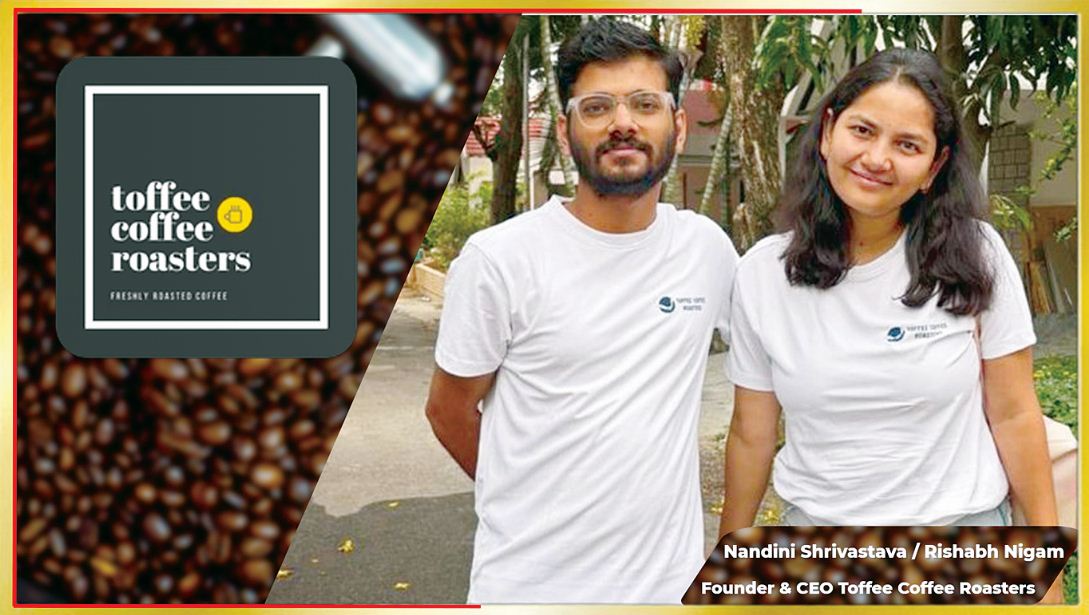
The Journey of Toffee Coffee Roasters’ Founders, Rishabh Nigam and Nandini Shrivastava
Building a Distinct Identity as a Digital-First Specialty Coffee Company
Rajshree Upadhyaya
Jaipur
Business Remedies. Founded in 2019, Toffee Coffee Roasters was started by Rishabh Nigam and Nandini Shrivastava with the vision of transforming how Indians consume coffee on a daily basis. Based in Mumbai, the founders decided to challenge the dominance of over-roasted, stale coffee beans prevalent in the market. Their philosophy was simple yet uncompromising: coffee should be fresh, responsibly sourced, and carefully roasted.
The brand began as a small specialty cafe and micro-roastery in Bandra, where beans were roasted in limited batches and served within days rather than weeks. This approach created the foundation of the company’s identity. In its early days, the cafe acted as a testing ground where customers could interact directly with the founders, sample coffees from different origins, and understand the nuances of brewing.
The real inflection point came in 2020, when the pandemic disrupted cafe footfall but opened up a significant opportunity for at-home consumption. Instead of stepping back, Toffee Coffee Roasters pivoted to a direct-to-consumer (D2C) model, focusing on nationwide delivery of freshly roasted coffee beans and ground coffee. This shift enabled the company to serve customers well beyond Mumbai.
As demand grew, the founders chose a measured approach to expansion rather than rapid portfolio diversification. Alongside their core single-origin and blended coffee beans, they introduced calibrated ground coffee tailored to different brewing styles. Later, they entered the cold brew coffee segment to appeal to consumers seeking convenience without compromising on quality. A strong emphasis was placed on roast freshness, traceability, and flavor clarity, while packaging and logistics were optimized to ensure the coffee reached customers at peak taste. This balance between craft and scale became central to the brand’s identity.
Support from Organized Angel Networks and Venture Investors
Toffee Coffee Roasters gained national recognition after appearing on Shark Tank India Season 3, where Rishabh Nigam and Nandini Shrivastava openly discussed their journey, the challenges of scaling a specialty product, and the economics of roasting and distribution. The pitch resulted in a deal with investor Ritesh Agarwal, providing not only capital but also strategic validation.
The appearance significantly boosted brand recall and introduced Toffee Coffee Roasters to a wider audience interested in premium, India-made coffee. Post Shark Tank, instead of chasing aggressive expansion, the company focused on strengthening its backend operations. Investments were made to increase roasting capacity, improve fulfillment efficiency, and build a robust supply chain.
Over the past few years, the startup has received support from organized angel networks and venture investors, culminating in a pre-Series funding round. The objective of this funding was to scale production, enhance packaging, and expand distribution across quick commerce platforms and online marketplaces.
An Active Player in India’s Specialty Coffee Ecosystem
Like many fast-growing D2C brands, Toffee Coffee Roasters faced operational challenges as order volumes increased. While the brand earned customer loyalty for its taste and freshness, it also had to navigate logistical and customer experience issues during peak demand periods. These realities highlighted the complexities of scaling a product where quality is closely tied to time, handling, and precision.
Today, Toffee Coffee Roasters remains an active and evolving player in India’s specialty coffee ecosystem. The company operates a larger-scale roastery, serves customers across multiple cities, and continues to sell freshly roasted coffee beans, ground coffee, and cold brew through its own channels as well as partner platforms.
From a small cafe in Bandra to a nationally recognized brand, the journey of Rishabh Nigam and Nandini Shrivastava demonstrates how a clear product philosophy, timely adaptation, and disciplined growth can help build a lasting presence in an increasingly competitive consumer market.