
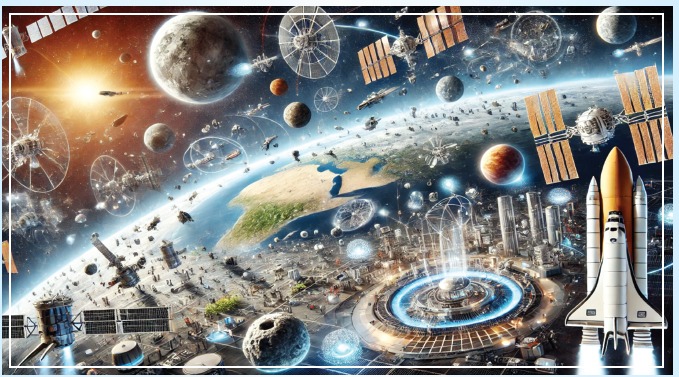
Business Remedies | Charu Bhatia | Once the exclusive domain of government agencies and scientists, space is rapidly becoming a bustling marketplace. The “Space Economy 2.0” era is here, a stage where satellite services, private rocket launches, and even leisure trips beyond Earth’s atmosphere are no longer science fiction but billion-dollar realities. The first wave of the space economy was dominated by public-sector giants like NASA, ISRO, ESA, and Roscosmos, with the primary focus on exploration, defense, and scientific research. Now, private players such as SpaceX, Blue Origin, Virgin Galactic, and India’s Skyroot Aerospace are redefining the ecosystem. They’re moving beyond national prestige projects to scalable, profitable ventures, and they’re doing it faster, cheaper, and with consumer demand in mind.
Satellite Services: The Backbone of Space 2.0
Currently, the most lucrative segment of the space economy lies in satellite-based services. From global internet coverage via constellations like Starlink, to real-time weather monitoring and precision agriculture, satellites have become critical infrastructure for modern life. According to the Satellite Industry Association, satellite services already account for over 60% of the $500+ billion global space economy, and this share is set to expand as connectivity needs skyrocket in remote and rural areas.
India is positioning itself as a strong contender in this race. With ISRO opening the space sector to private companies, startups are developing small satellites, launch vehicles, and data analytics platforms. Affordable satellite imagery is aiding sectors from mining to maritime security, while enabling governments and businesses to make better, faster decisions.
Space Tourism: From Elite Fantasy to Emerging Market
If satellites are the present, space tourism is the aspirational future. Virgin Galactic has already flown its first paying customers to the edge of space, while Blue Origin’s suborbital flights have hosted high-profile passengers. Though ticket prices currently hover around $250,000-$450,000, industry experts predict costs will fall as competition and technology improve.
Space tourism could evolve into a niche luxury segment in the next decade, much like private yachts or high-end safaris. There’s also a growing market for “space-adjacent” experiences, zero-gravity flights, simulated Mars habitats, and virtual reality spacewalks, offering more affordable ways for the public to connect with the idea of space travel.
The Road Ahead
Space Economy 2.0 is not without its challenges. Space debris management, regulatory frameworks, and sustainable operations are pressing concerns. However, with advancements in reusable rockets, miniaturized satellites, and cross-border collaborations, the potential for growth is immense.
What was once the “final frontier” is fast becoming the “next marketplace.” Whether it’s beaming internet to the Himalayas or selling tickets to orbit, the space industry’s trajectory is clear, it’s moving from a government-funded ambition to a commercially viable reality, redefining how humanity engages with the cosmos.
 Written & Edited By:
Charu Bhatia