

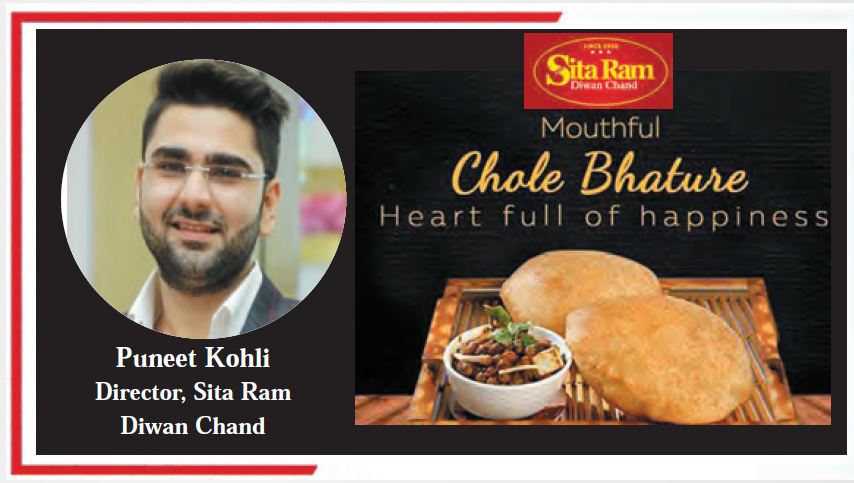
Rajshree Upadhyaya | Jaipur | Business Remedies | In the bustling heart of Paharganj, New Delhi, where the aroma of street food weaves through narrow lanes and history whispers from every crumbling facade, a humble eatery has grown into a landmark that draws food lovers from all walks of life. The name Sita Ram Diwan Chand doesn’t just evoke the memory of a spicy, tangy plate of chole bhature, it conjures generations of devotion, a story that begins not in a kitchen but in the ashes of one of the subcontinent’s greatest upheavals.
 It was 1947. The country was cleaved in two, and amidst the chaos of Partition, a fifteen-year-old boy named Sita Ram Kohli fled Lahore for a new life in Delhi. He came with almost nothing, no wealth, no certainty, just grit and a treasured family recipe. He settled in Paharganj, a chaotic but hopeful hub for refugees, traders, and working-class families. There, among the restless bustle, he found his footing with a pushcart near DAV School on Jhula Mandi Street. With simmering Lahori-style chole, soft paneer-stuffed bhature, seasonal pickles, and a warm smile, he began serving plates that brought a taste of home to countless others searching for their anchors in the new India.
Word spread quickly. The flavors were bold, the portions generous, and the experience unforgettable. Sita Ram’s pushcart soon drew crowds, students, office-goers, families-all hungry not just for food but for comfort, for memory, for something that felt unchanging in a world that had shifted overnight. Seeing the potential to grow, Sita Ram joined hands with his brother, Diwan Chand. Together, they moved closer to the once-bustling Imperial Cinema, positioning themselves at a cultural crossroads that brought even more footfall. Cinema-goers came for the movies and stayed for the bhature, turning the stall into a pre- or post-show ritual for many.
By 1965, the duo made a leap that marked a new chapter in their journey. They moved from the street to a small shop near Chuna Mandi, introducing a live kitchen that allowed customers to watch their food being made. This touch,simple but intimate,set them apart. It wasn’t just about eating anymore; it was about watching dough swell into golden bhature, hearing the hiss of spices in the pan, and catching the steam that rose from the chole pot. Dining at Sita Ram Diwan Chand became an experience.
As the years rolled on, the business remained a tight-knit family affair. In 1984, Sita Ram’s son, Pran Kohli, stepped in, carrying with him not only a sense of duty but a deep reverence for his father’s legacy. He never rushed the chole, it was still cooked with patience and over 20 hand-ground spices. The bhature was still airy yet firm, lightly flavored with carom and fenugreek. Pickles shifted with the seasons, just like they did in the early days. Mango in the summer, gooseberry in the winter. Everything was rooted in the same philosophy, if it’s not from the heart, it’s not served.
Now, as the third generation, Rajiv, Utsav, and Puneet Kohli, takes the reins, they’re steering the brand into modern terrain while staying tethered to their origins. Recognizing the need to reach beyond Paharganj, they opened new outlets in Pitampura, Paschim Vihar, and Gurugram. They didn’t stop at brick-and-mortar expansion. Embracing technology, they launched a mobile app, partnered with delivery platforms, and even introduced ready-to-eat kits for people craving that familiar taste far from Delhi’s spice-laden air.
Through all the growth, one thing remains constant: the plate. Still just Rs. 65, it carries the same promise it did decades ago, a generous helping of hot chole, two perfectly puffed bhature, a handful of fresh salad, and a spoonful of pickle. It’s uncomplicated, honest, and soul-satisfying, a rarity in a world of rebranding and reinvention. And it’s this unwavering consistency that draws people back, some who’ve been coming since they were children, now bringing their children and grandchildren, creating new memories layered upon old ones.
For many, a visit to Sita Ram Diwan Chand isn’t just about hunger. It’s about nostalgia. It’s about the familiar comfort of a paper plate weighed down by history and heart. It’s about legacy. A simple meal that tells the story of survival, of rebuilding, and of generations who found their identity not just in what they ate, but in how it made them feel. What began as one boy’s brave attempt to begin again has become a symbol of Delhi’s undying appetite for stories, for tradition, and for that unforgettable bite of chole bhature that tastes just like home.

Written & Edited By :
Rajshree Upadhyaya