
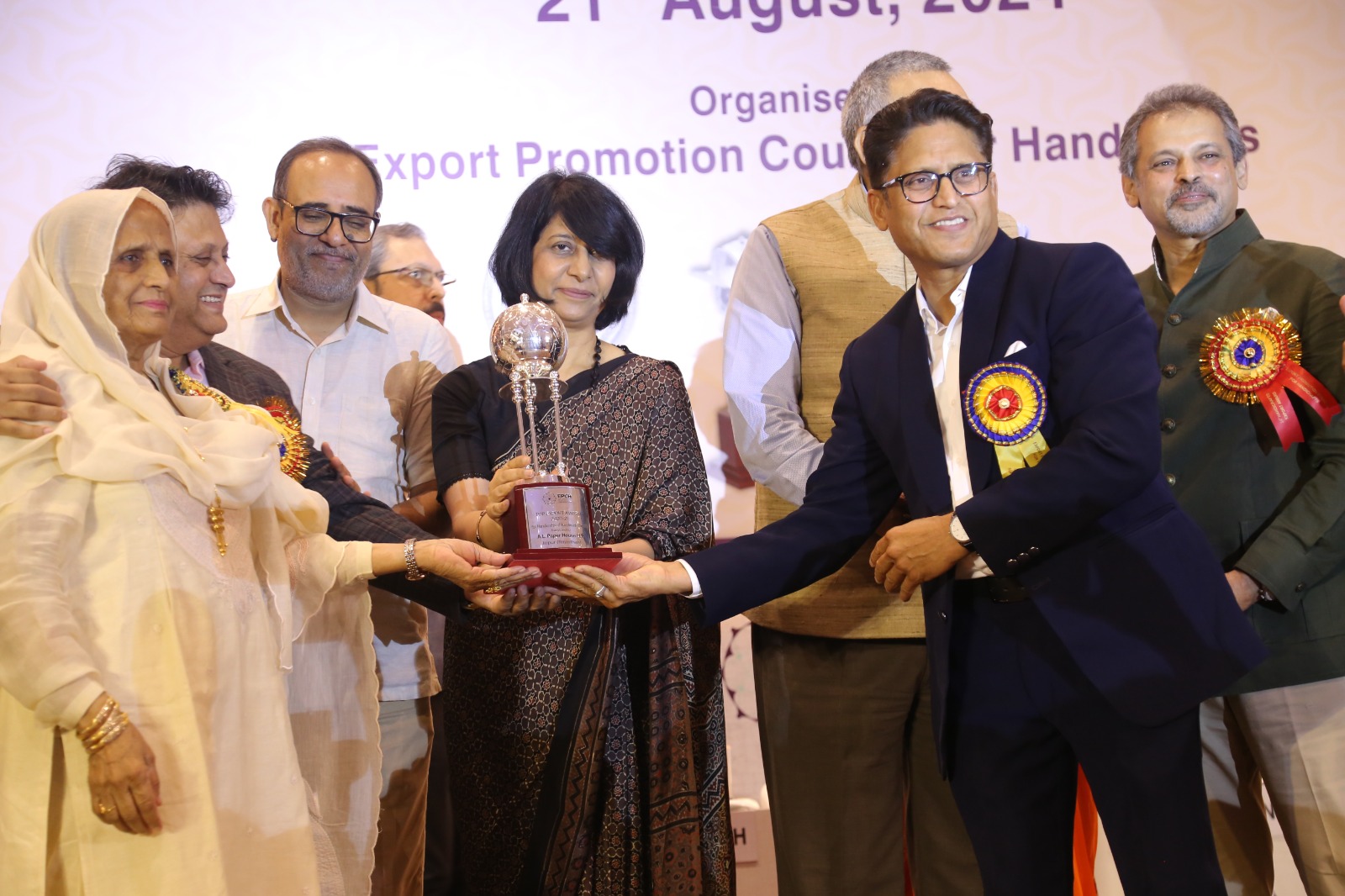
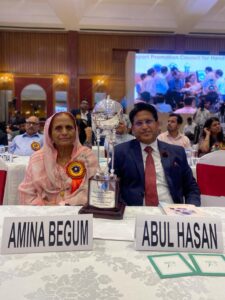
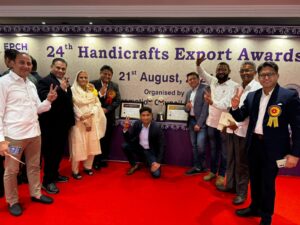
 As we celebrate the spirit of our nation on this Independence Day, we honour stories of Indian craftsmanship that have been passed down through generations. Dr. Abul Hasan Kagzi is the custodian of one such timeless craft, a papermaking legacy that his family brought to India centuries ago. Their extraordinary story began in Uzbekistan and wove through the Mughal era, with his forefathers becoming revered artisans within the royal courts of our land. Today, this rich heritage is a source of national pride. His company, A L Paper House LLP, has not only preserved this ancient art but has made “Made in India” a stamp of excellence on the world stage. Their incredible success is marked by an astounding 23 consecutive top exporter awards from India, as well as five National and two State awards, celebrating the power of Indian enterprise. Beyond business, their legacy is rooted in social responsibility. Through the self-sustained A L Memorial Charitable Trust, they have been uplifting the underprivileged since 2020 by organizing free healthcare camps, sponsoring weddings for economically weaker girls, and helping communities access vital government services through e-Mitra at no cost. On this special day, join us as we celebrate a business that embodies the spirit of an independent, thriving India.
In conversation with Dr. Abul Hasan Kagzi, Director, A L Paper House LLP, Jaipur
Q: Could you share the story of A L Paper House LLP, from its founding to your personal journey of joining the family legacy and leading its remarkable growth?
A: The legacy of our company was founded by my father, Abdul Latif Kagzi, in 1975. I spent my formative years observing him and his team practice the craft in the front yard of our family home. The fascination of tourists who visited our Sanganer workshop, particularly international visitors, became a profound source of inspiration. When I formally joined the business in 1993, I was driven by a vision to take our artistry to a global audience. My first shipment reached Canada in 1995, initiated by the word-of-mouth recommendations of those very tourists. This momentum propelled us to become the nation’s largest exporter by 2000. Our dedication was first recognized with an award from the EPCH in 1999-2000. Today, my brothers and I collectively uphold this legacy, having formally restructured the business as A L Paper House LLP in 2018.
Q: Where do you source your raw materials today, and how have those materials evolved over time?
 A: Today, our papermaking process is beautifully circular. We craft our papers entirely from the waste of hosiery and cotton factories, especially from undergarment manufacturers. We source these discarded textiles from major production hubs in India, like Kolkata and Tiruppur, where they are first cleaned and then sent to us to be recycled into new, exquisite paper. This focus on cotton and hosiery is a more recent development, beginning around 1995. Before that, our ancestors were skilled in using a wide range of materials, depending on the specific needs of the paper they were creating. We worked with waste paper, jute fibre, and even Sunn Hemp (Crotalaria juncea), also known as Indian hemp. Each material imparted a unique strength and finish to the final paper, allowing us to create different kinds of products for different purposes.
Q: Let us journey back in time. As the custodians of this ancient art, what were the fundamental materials used to create paper during the Mughal era?
A: That is a truly fascinating question. While today we craft our paper from cotton and hosiery waste, the materials have evolved through history. Before cotton became our primary resource, my father would meticulously collect waste papers, transforming them into a fresh pulp to create new sheets. I have also witnessed paper being born from tent rags and jute. But if we go further back, our forefathers worked with the very essence of nature. In Rajasthan, the आंकड़ा (Madar or Giant Milkweed) tree was abundant, and its bark was a treasured material for papermaking. They also drew from the strength of wood fibre and the flexibility of bamboo to create the paper of their time.
Q: Could you describe the traditional manufacturing process in its entirety, from the formation of the pulp to the final product, and paint a picture of the community that worked together to create it?
 A: The traditional process was a deeply communal art form, rooted in a cooperative society within Sanganer’s Kagzi colony. As Rajasthan’s first registered society, it served as a vital hub, providing the beating machines that were financially out of reach for individual artisans. We would supply the raw materials, and in return for a concessional fee, the cooperative would process batches of 100 kg into pulp. The artisans would then transport this pulp to their homes, where every family member played an integral part. Every family member had a role, from forming the paper to drying sheets on walls and giving them a final shape and finish. It was an era of true craftsmanship and collaboration.
Q: Could you tell us about the early uses of these organic handmade papers? What purpose did they serve in those historical times?
A: The purpose of paper has certainly evolved. Today, we craft it for a variety of uses, from wedding invitations to file covers and paintings. However, the history of our paper is deeply intertwined with the royal heritage of the region. I remember my father taking me to the Jaipur Museum and pointing out something incredible: the exquisite paintings and priceless documents we were seeing were all created on paper made by our ancestors. It was an astonishing revelation for me. In those early days, our paper was the canvas for history. It was used by royalty to create magnificent paintings, and to meticulously document significant events and the lives of prominent personalities.
Q: It’s remarkable how so many ancient paintings, drawings, and documents have endured through the centuries. What is the secret to their incredible preservation?
 A: The longevity of those historical treasures is all about the pH of the paper. A neutral pH, typically around 7, is the key to a long life for paper. Our family has been dedicated to mastering the creation of neutral pH paper for many years, a skill passed down through generations. It’s this careful balance that prevents the paper from becoming brittle and deteriorating over time, allowing it to withstand the centuries and tell its story.
Q: Could you walk us through the intricate process of creating colour and texture in your handmade papers? How has this process evolved, from the traditional methods of the past to the innovations you use today?
A: The foundation of our craft is a deep respect for tradition. In the past, every stage was a meticulous labour of love. Each household had a handmade frame, or ‘chhapdi,‘ woven from bamboo and horse tail hair, which was dipped into pulp. As the water drained, a perfectly sized sheet of paper was born. The finishing was done by hand, using a smooth river stone or even a camel’s knee cap to polish the paper. This was our process just 30 to 40 years ago. The method for adding colour has remained remarkably consistent; we’ve always added natural colours directly to the pulp during beating, ensuring a deeply integrated and vibrant shade. Texture is a world of endless creativity, resulting in our 7,500 different types of papers. Some textures are created through embossing, while others are formed by mixing natural elements directly into the pulp. We use fresh petals from flowers like marigolds and roses to add colour and fragrance, a process so delightful that our entire workshop fills with their scent. We also incorporate other materials like tea leaves, coconut husk, or sugarcane fibres for unique effects.
Q: You mentioned having around 7,500 different types of paper. What kind of products are made from this vast range of papers, and what are some of the most popular items you create?
A: The world of paper products is incredibly vast, and we create around 300 to 350 different types of products from our unique papers. The most popular items include diaries, photo frames, and gift boxes. We align our production with different occasions and seasons around the world. For example, to prepare for Diwali, we deliver decorative items to our wholesalers two months in advance. We also create special products for Eid in the Gulf region. Gifting products are always in high demand, and we recently exported a large batch of eco-friendly rakhis made from our paper. Our products cover all major festive seasons, including birthdays, Eid, Diwali, Rakhi, Christmas, and Easter, and we export huge quantities for each.
Q: If someone in India or Jaipur wanted to purchase your paper or paper products, how would they go about doing so?
A: Currently, our entire production is exported. We’ve established a compliance factory that adheres to international standards for safety and quality. Our raw materials, colours, and chemicals are certified as very safe and eco-friendly. For example, our colours are Aerosol-free, which increases our production costs. This high cost makes it difficult for us to compete in the domestic market. In India, many paper manufacturers prioritize lower costs over quality and environmental safety. A significant difference exists between our country and more developed nations, where consumers are highly aware and willing to pay for eco-friendly, chemical-free products. Our handmade paper is highly successful abroad precisely because it is wood-free and environmentally sustainable, a value that is yet to gain significant traction in the domestic market.
Q: To how many countries do you export your papers, and what gives you a competitive edge in the global market?
 A: We export to a vast number of countries, reaching almost everywhere in the world. Our primary markets are Europe, America, Australia, South Africa, and the Gulf region. Our competitive edge in the international market is twofold. Although Europe is a major producer of handmade paper, our product is comparatively more affordable, which makes it a preferred choice for many buyers. Furthermore, we consistently offer a much higher quality than our main competitor, China. This combination of superior quality and unique designs gives us a significant advantage, allowing us to thrive in the highly competitive global market.
Q: With paper’s inherent fragility, how do you maintain the quality of your products so that they can endure for such an impressive length of time?
A: The longevity of our paper is a testament to the quality of our materials and our craftsmanship. The paper we create, if handled with care, has a potential lifespan of up to 400 years. The secret lies in the fibre we use. Papers crafted from cotton fibre possess the best lifeline and exceptional strength.
Q: Plastic’s harm to our planet is widely known, yet we still struggle to move away from it. From your perspective, what are the primary obstacles we face as a nation, and what must we do to become more conscious and embrace eco-friendly alternatives?
A: The biggest obstacle is our collective mindset. We know plastic is harmful, yet we continue to use it. The government cannot succeed in banning plastic alone; true change will only happen when every individual’s mindset shifts, when we collectively decide that this is wrong and we must stop using it. The change begins with each one of us. The government is making a sincere effort to ban plastic, but a major challenge remains: we do not yet have a strong, equally affordable substitute. Plastic polythene bags are simply the most accessible option due to their low cost, and this is the main hurdle in becoming a plastic-free nation. Affordability is a significant issue.
Q: What has been your greatest motivation, and what foundational principles have guided you through the challenges of this journey?
A: My greatest motivation is a legacy of wisdom passed down by my father. He was a man of profound integrity whose core belief was in the power of pure intentions and a clear sense of purpose. He instilled in us a simple yet powerful philosophy: that a clean neeyat, a pure intent, is the ultimate compass for navigating and conquering any obstacle. This principle has been the bedrock of my life, and it is the guiding force behind our ability, as five brothers, to run this family legacy together with unwavering unity and mutual trust.
Q: As a successful entrepreneur in a traditional craft, what is your key message or advice for aspiring business owners today?
A: My message to aspiring entrepreneurs is to start small. The papermaking industry alone offers a vast number of opportunities across many different sectors. If you’re interested in this field, I suggest you focus on just one product to begin with, like a diary. By concentrating on a single item, you can start with a minimal initial investment. From there, you can steadily add more products as your business grows and flourishes.
 Interviewed By:
Shruti Kothari