
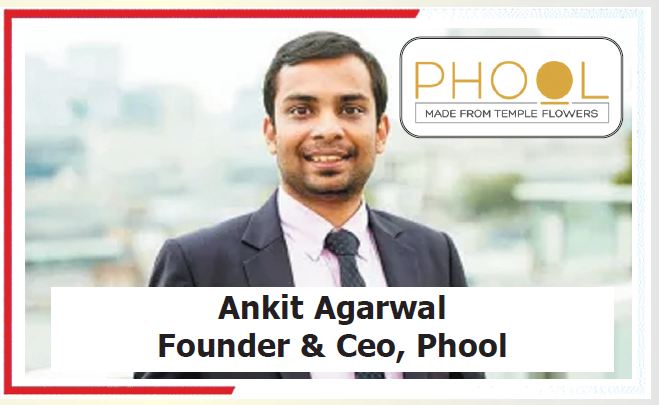
Business Remedies | Rajshree Upadhyaya | May 20,2025 | In the spiritual city of Kanpur, where the Ganges flows as both lifeline and legacy, a disturbing sight left a lasting mark on Ankit Agarwal. During a winter morning in 2015, amid the rituals of Makar Sankranti, he watched heaps of discarded temple flowers, rich in synthetic dyes and pesticide residues, float into the sacred river, turning symbols of devotion into sources of pollution. An automation scientist recently returned from a Fulbright fellowship in social innovation. Ankit saw not just ecological damage, but a symbolic loss. The moment sparked a powerful question: could these sacred offerings be transformed rather than discarded?
Teaming up with his childhood friend, environmental engineer Prateek Kumar, Ankit launched a bold experiment. The duo began collecting floral waste from Kanpur’s temples using borrowed jute sacks and built a makeshift lab on a rooftop. Initial attempts at composting failed, turmeric and vermilion proved toxic to worms, but perseverance led to a breakthrough. After months of trial and error, they developed a proprietary method to convert flower petals into charcoal-free incense sticks. This process, later trademarked as “flowercycling,” marked the birth of Phool, a startup rooted in the regeneration philosophy.
Incorporated in 2017 as Kanpur Flowercycling Pvt Ltd, Phool was more than a recycling initiative, it was a social enterprise built on empathy. The founders began employing women from Dalit and Muslim communities, many of whom had previously worked in hazardous tannery jobs for meager pay. Phool offered them dignified work, health benefits, and wages significantly above the minimum standard. The early days were humble, but word spread quickly. Retailers like Fabindia and Organic India began stocking the incense sticks, and the brand found resonance among consumers looking for ethical and traditional products. Scientific innovation soon took center stage. Beyond incense, Phool faced the challenge of what to do with leftover rose stems. The team delved deeper into R&D and, under the guidance of biomaterials scientist Prof. Veena Sikri, developed Fleather, a pliable, cruelty-free leather alternative made from floral waste. The material quickly caught the attention of global fashion brands. By 2021, companies like Adidas and Stella McCartney had requested samples, and an Italian label signed an offtake agreement. With 85% less water usage compared to animal leather, Fleather promised a sustainable future for fashion.
Phool’s public breakthrough came with its appearance on Shark Tank India in early 2022. Ankit Agarwal pitched the company seeking Rs. 80 lakh for 1% equity, showcasing a model that had diverted thousands of tonnes of floral waste and created hundreds of jobs. The pitch struck a chord. Sharks Vineeta Singh and Peyush Bansal offered Rs. 2 crore for 6%, eventually closing at 5%. The episode led to a spike in website traffic and sales, propelling Phool into mainstream consciousness.
By 2025, Phool has grown into a company with over Rs. 45 crore in annual revenue, collecting and processing more than 20 tonnes of floral waste daily across cities like Kanpur, Varanasi, and Tirupati. Its incense sticks, essential oil products, and leather sheets now reach international markets, with exports to the US, UK, and UAE. A Series A round led by IvyCap Ventures helped fund automation upgrades and expand biomaterial production, while the brand’s innovations like FloraFoam, a compostable floral foam, entered pilot testing with a global cosmetics brand.
Yet, despite its growth, Phool remains anchored in its mission: to reimagine waste, empower women, and protect the environment. More than 400 women are now employed through the initiative, earning nearly double the local minimum wage. Many have opened bank accounts for the first time, sending their children to school and leaving behind generations of exploitative labor. Every incense box tells a story, not just of flowers saved from pollution, but of lives transformed.
From a moment of reflection by the Ganges to global fashion houses and sustainability labs, Phool stands as a symbol of what Indian innovation can achieve when empathy meets enterprise.
 Written & Edited By:
Rajshree Upadhyaya