
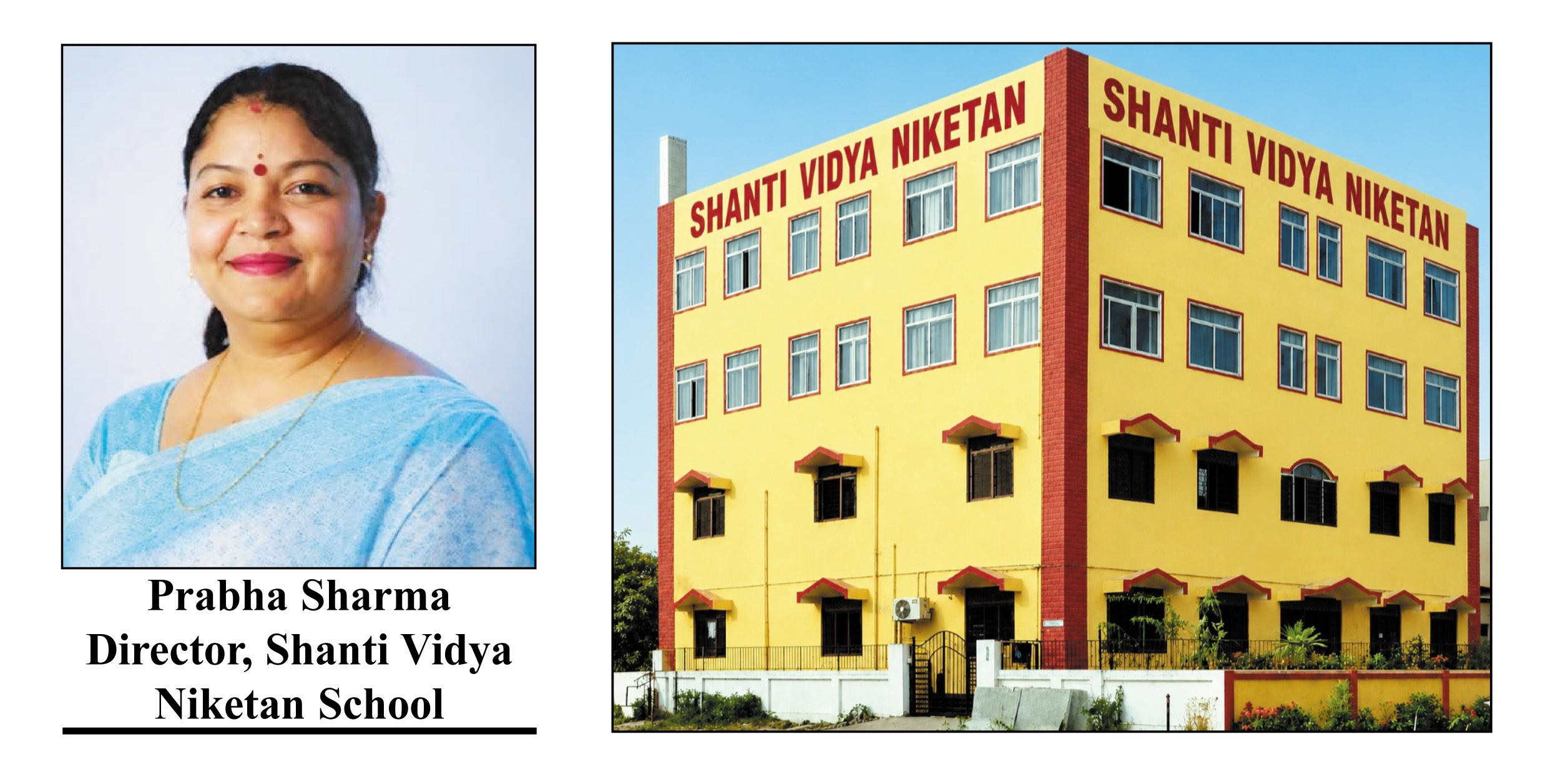
Charu Bhatia, Senior News Editor, Business Remedies in conversation with Dr. Prabha Sharma, Director of Shanti Vidya Niketan School, Jaipur
Education is not merely about academic achievement; it is about shaping individuals who can think independently, make responsible decisions and contribute meaningfully to society. For Dr. Prabha Sharma, Director of Shanti Vidya Niketan school, the journey into education began with a simple thought that gradually transformed into experience, and eventually into a dream of creating an institution where children could learn, discover their potential and grow with confidence.
With a strong emphasis on quality education, values, discipline and practical learning, Dr. Sharma believes that schools must prepare children not only for examinations and careers but also for the challenges of life. From integrating technology and AI into classrooms to strengthening teacher training and creating awareness about contemporary social issues, her educational approach combines traditional values with modern methods.
In this conversation, Dr. Prabha Sharma shares her journey, educational philosophy, views on NEP 2020, the changing nature of learning, the role of technology and her vision for the future of the institution.
Question: Could you tell us about your journey into education and what inspired you to establish a school?
Answer: My journey in the field of education began with a simple thought. Over time, that simple thought became my experience, and my experience eventually became my dream. This dream led me towards creating an institution where children could receive quality education in a positive environment, identify their talents and move forward with confidence.
For me, education has always been more than textbooks and examinations. I wanted to create an environment where children could feel encouraged to learn, explore their abilities and develop into confident individuals. This thought gradually became the foundation of my journey as an educationist and ultimately inspired me to establish the school.
Question: What was the vision behind starting the school, and how has that vision evolved over the years?
Answer: When I started the school, my vision was to provide children with quality education along with strong values. With time, my approach evolved. Along with academics, I began emphasising practical knowledge through activities so that children could remain connected with their culture and traditions.
I believe that education must evolve according to the changing needs of society. While academic excellence continues to be important, children also need exposure to activities, experiences and situations that help them understand the world around them. Our effort has therefore been to create a balanced educational environment where modern learning goes hand in hand with cultural values.
Question: What educational philosophy or values form the foundation of your institution?
Answer: The objective of our school is based on values such as quality education, discipline, good values and hard work. I believe children should receive not only academic knowledge but also learn good behaviour and how to make the right decisions.
The foundation of my institution is based on a simple yet profound thought—“Vidya Vinayen Shobhate,” meaning knowledge shines through humility. Education should make a child knowledgeable, but it should also make the child humble, disciplined and responsible. Our endeavour is to ensure that students understand the importance of respect, hard work, honesty and compassion alongside their academic responsibilities.
Question: In your view, what are the biggest gaps in the Indian school education system today?
Answer: In my view, one of the biggest shortcomings in the Indian school education system today is that education in many places continues to be overly focused on marks. Academic performance is important, but marks alone cannot define a child’s ability, intelligence or potential.
Children should be given more opportunities to learn according to their interests, gain practical knowledge and develop independent thinking. Every child has different abilities and interests, and the education system must provide adequate opportunities for children to discover those strengths. The focus should gradually move towards holistic development rather than only examination-oriented learning.
Question: With technology and AI transforming education, how is your school adapting to these changes?
Answer: I believe technology is not a substitute for teachers; rather, it is a powerful medium to make education more effective. With this approach, our school uses smart classrooms, digital learning material and audio-visual resources to make learning easier and more engaging.
At the same time, we teach children that AI should not be used to eliminate their ability to think, but rather to enhance their capacity to learn. Technology should support curiosity and creativity instead of replacing independent thought. Our core philosophy is—“Values from tradition, innovation through technology, and a bright future through education.”
We believe that children must understand both the opportunities and responsibilities that come with new technologies. The objective is to make them technologically aware while ensuring that fundamental human values remain at the centre of their education.
Question: How has the way children learn changed compared with a decade ago?
Answer: Ten years ago, children primarily depended on books and teachers for learning. Today, they learn through a wide range of digital tools. As a result, the way children learn has become easier, more diverse and different from what it was earlier.
The availability of digital resources has opened up a much wider world of information for students. However, this also makes the role of teachers extremely important. Teachers now have to guide students in identifying reliable information, understanding concepts and using technology responsibly. The learning environment has become more interactive, and schools must adapt to these changing expectations.
Question: What are your views on NEP 2020? Do you believe the framework, if implemented properly, can give positive results?
Answer: In my opinion, the National Education Policy (NEP) 2020 can bring about a positive transformation in the education system. It focuses on children’s understanding, skills and practical knowledge. If implemented properly, it can significantly benefit students.
I believe the objective of NEP 2020 is not merely to create educated students, but to develop capable, creative and responsible citizens. The emphasis on skills, experiential learning and a broader understanding of education can help children become better prepared for the future.
Question: How do you train and empower teachers to adopt new teaching methodologies?
Answer: I believe that a good teacher is always a lifelong learner. Therefore, our institution regularly organises training programmes and workshops for teachers, covering new teaching methodologies, technology and training sessions, demonstration-based learning and peer-learning activities.
Teachers are at the heart of any educational institution. If teachers continue to learn and update themselves, they can provide better learning experiences to students. My philosophy in this regard is simple—“The more a teacher learns, the better the students learn.”
Question: What are some of the biggest challenges you have faced while building and managing the institution?
Answer: Building and successfully running an institution came with several challenges, including arranging appropriate resources, building a team of capable and dedicated teachers, earning the trust of students and parents, adapting to a changing education system and keeping ourselves updated with new knowledge and technology.
An educational institution develops gradually. It requires continuous effort, patience and the ability to adapt. One of the most important aspects has been maintaining a balance between the institution’s core values and the changing expectations of modern education.
Question: What distinguishes your school from other institutions in the increasingly competitive education sector?
Answer: Even in an increasingly competitive education sector, our school stands apart because many schools are caught up in a race for competition, where children are often evaluated primarily on the basis of marks without adequately recognising their individual talents.
However, my team of teachers and I believe that every child is special. Our effort is to identify each child’s unique qualities and give them the right direction. As the saying goes, “Yadrishi Bhavana Yasya, Siddhir Bhavati Tadrishi” — our achievements reflect our thoughts and aspirations.
At our school, programmes, workshops and counselling sessions are organised from time to time to create awareness among students about contemporary issues such as juvenile crime, youth violence, the safety of girls, substance abuse and cybercrime. We believe that children should be aware of the challenges around them and should be equipped with the knowledge and values required to make responsible decisions.
Question: How do you see the Indian education sector evolving over the next five to ten years?
Answer: Over the next five to ten years, the Indian education system is likely to move towards a more technology-driven and skill-based approach. This will prepare children not merely for jobs, but for different situations and challenges they may encounter throughout their lives.
Technology, artificial intelligence, experiential learning and skill development are likely to become increasingly important. However, while education becomes more technology-driven, human values, creativity, critical thinking and emotional development must remain equally important.
Question: What are your plans for expanding or strengthening the institution in the coming years?
Answer: In the coming years, our focus will remain on further improving the quality of education provided by the school. We have plans to continuously work on adopting new technologies, improving facilities, enhancing teacher training and creating new learning opportunities for children.
Our goal is not merely to expand the physical infrastructure of the school, but to build a stronger and better educational institution. We want to continuously improve our teaching practices and provide students with an environment where they can learn, explore and develop their talents.
Question: Finally, what message would you like to give to students about what meaningful education should truly mean?
Answer: According to me, the true meaning of meaningful education is: “Education is not merely what teaches us how to earn; education is what teaches us how to live and move forward in the right direction.”
Education should give children the confidence to face life, the wisdom to make the right decisions and the humility to respect others. Academic knowledge is certainly important, but true education also develops character, responsibility and compassion.
As scholars have also said, “Vidya Dhanam Sarvadhanam Pradhanam” — knowledge is the greatest of all forms of wealth.
I believe that when education combines knowledge with values, technology with wisdom, and ambition with responsibility, it can truly transform the lives of children and contribute to the progress of society.